
.jpg)
.jpg)





.jpg)


When a Home Equity Loan Can Pay Off a Mortgage

Yes, a home equity loan can pay off a mortgage, but it only makes sense in a narrower set of situations than many homeowners expect. The key point is simple: you are not eliminating debt. You are replacing one home-secured loan with another, often with different rates, terms, closing costs and risks.
For some homeowners, that swap can create a shorter payoff path, remove an unfavorable mortgage structure or simplify a small remaining balance. For others, it can turn an affordable first mortgage into a more expensive loan secured by the same property. Before using a home equity loan to pay off mortgage debt, compare the full cost, not just the monthly payment.
What it means to pay off a mortgage with a home equity loan
A home equity loan lets you borrow against the equity you have built in your home. You receive a lump sum, usually with a fixed rate and fixed repayment term, then repay it in monthly installments. If the loan amount is large enough, you may be able to use the proceeds to pay off your existing mortgage balance.
In practice, there are two common versions of this strategy.
First, a homeowner with a relatively small mortgage balance takes out a home equity loan, uses the proceeds to satisfy the existing first mortgage, then repays the home equity loan over a shorter term. Second, a homeowner uses a home equity loan to make a large principal payment on the mortgage, reducing the balance but not fully paying it off.
The first option is what most people mean by a home equity loan to pay off mortgage debt. It is also the option that requires the closest review because lien position, closing requirements and lender guidelines matter. A home equity loan is often structured as a second mortgage, but if it is used to pay off the first mortgage, the lender will want to understand how the payoff will be handled and whether the new loan will become the primary lien on the property.
If you are still learning how equity is calculated, New Era Lending has a helpful explainer on how mortgage equity works and how to use it wisely. That background is useful because your usable equity is not always the same as your total equity.
When a home equity loan can make sense for paying off a mortgage
The strategy works best when the numbers are clear, the purpose is specific and the new loan improves your position in a measurable way. These are the situations where it may be worth discussing with a mortgage professional.
Your remaining mortgage balance is small
A home equity loan may be more practical when you have a small balance left on your mortgage. For example, if you are near the end of your mortgage term and the remaining payoff is modest, a fixed home equity loan could help you close out the original loan and move into a defined, shorter repayment schedule.
This does not automatically mean you will save money. Home equity loan rates can be higher than first mortgage rates, and fees still matter. But when the balance is small, the cost difference may be easier to evaluate and the total dollars at stake may be lower than with a large payoff.
Your current mortgage has unfavorable terms
A home equity loan may be worth comparing if your existing mortgage has terms that no longer fit your life. This could include an adjustable rate that is about to reset, a balloon payment, private mortgage insurance that no longer makes sense or a loan structure that creates payment uncertainty.
In this case, the question is not just whether the home equity loan has a lower rate. The question is whether the new loan gives you a more stable, affordable and transparent path. A fixed home equity loan can be appealing because the payment is predictable, but predictability alone is not enough if the total cost rises too much.
You want a shorter payoff timeline and can afford the payment
Some homeowners use home equity strategically because they want to be debt-free sooner. A home equity loan with a shorter repayment term may force a faster payoff than a long remaining mortgage schedule.
That discipline can be useful, but it comes with a tradeoff. Shorter terms often mean higher monthly payments. If the higher payment strains your budget, the benefit can disappear quickly. A good test is whether you could still handle the payment after a job change, medical expense, home repair or insurance increase.
If your main goal is early payoff rather than changing loan structure, it is also worth reviewing whether extra principal payments would be simpler. New Era Lending covers that decision in more detail in its guide to paying off a mortgage early.
A full refinance is not the best fit
A traditional refinance replaces your current mortgage with a new first mortgage. That can be the better route when you need a large loan amount, want to change the term or can improve your rate. But refinancing can also come with closing costs, underwriting requirements and a restart of the mortgage clock if you choose a long term.
A home equity loan may be worth comparing if you only need enough to pay off a smaller remaining balance or if you want to avoid changing other aspects of your financial plan. Still, it should be compared against a rate-and-term refinance, cash-out refinance and simply continuing your current loan.
A quick fit check
Use this table as a starting point, not a final decision. Lender guidelines, interest rates, fees, credit profile and property value can change the answer.
| Situation | Home equity loan payoff fit | Why it may or may not work |
|---|---|---|
| Small remaining mortgage balance | Often worth comparing | The total loan amount is limited, so costs are easier to measure |
| Very low current first mortgage rate | Usually weak fit | Replacing cheap debt with higher-cost debt can increase total interest |
| Adjustable mortgage with payment risk | Possibly useful | A fixed home equity loan may add payment certainty |
| Large mortgage balance with many years left | Usually requires caution | The loan size, rate and term can make the payoff expensive |
| Goal is faster debt payoff | Possible fit | A shorter term can help if the payment is affordable |
| Budget is already tight | Poor fit | Your home secures the loan, so missed payments carry serious risk |
The numbers to compare before you decide
The right comparison is not old monthly payment versus new monthly payment. A lower monthly payment can still cost more if the term is longer, fees are higher or you borrow more than you need.
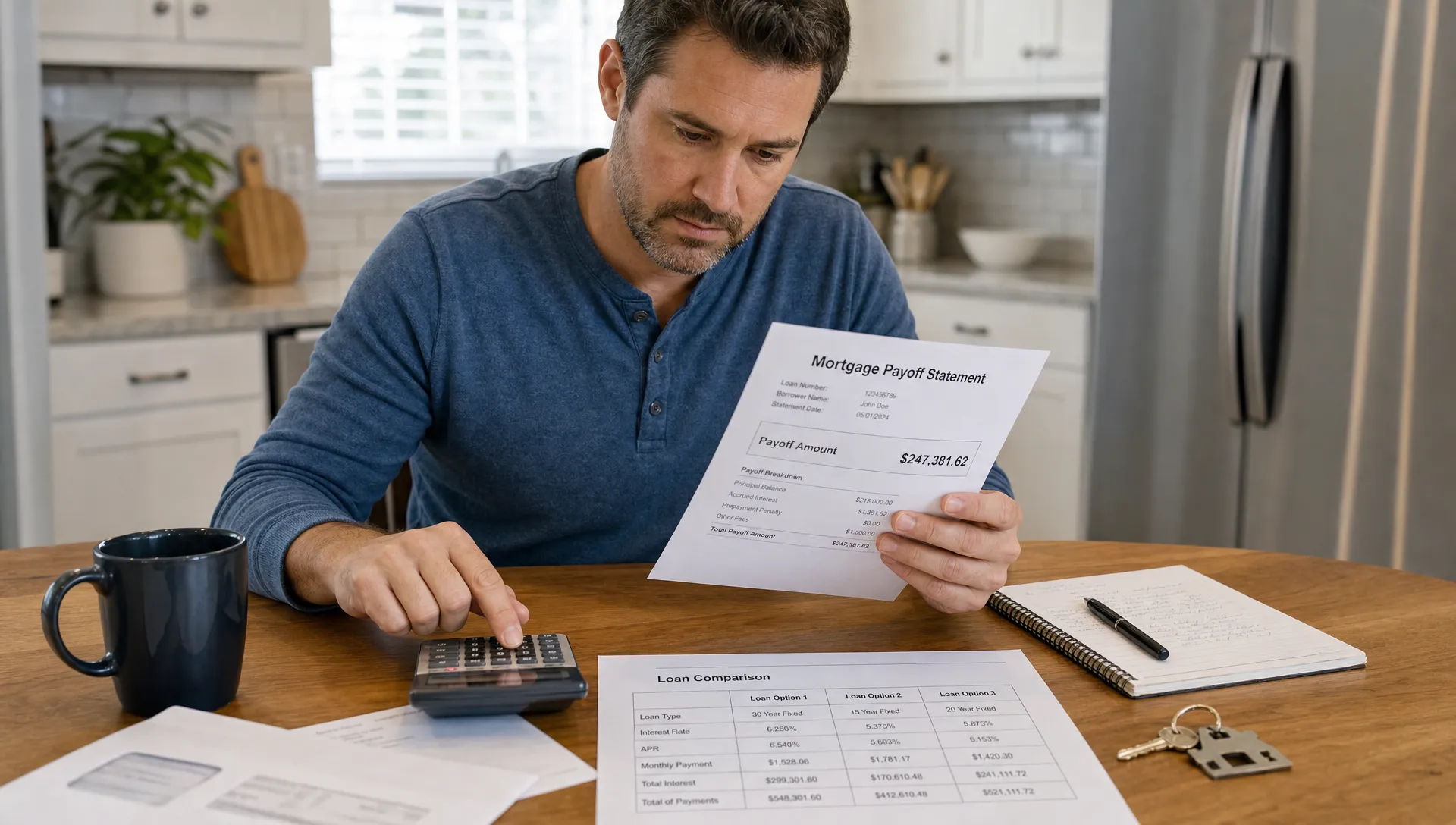
Start with the payoff amount on your current mortgage. This is not always identical to the balance shown on your monthly statement because it may include interest through the payoff date, recording fees or other charges. If your current loan has a prepayment penalty, that also belongs in the analysis.
Next, compare the proposed home equity loan terms. Look at the annual percentage rate, fixed or variable structure, repayment term, closing costs, payment amount and total interest over the life of the loan. The Consumer Financial Protection Bureau Loan Estimate resource is useful because it explains where to find key costs and how to compare offers.
Also consider tax treatment. The IRS explains that home mortgage interest deduction rules depend on how the loan proceeds are used and whether the debt qualifies under current law. You can review the general framework in IRS Publication 936, but a tax professional is the right person to answer how the rules apply to your situation.
When using a home equity loan to pay off a mortgage is a bad idea
A home equity loan is secured by your home, so the downside is real. If the new loan does not clearly improve your finances, keeping your current mortgage or choosing a different strategy may be safer.
Be especially cautious if your current mortgage has a low fixed rate. Many homeowners who financed or refinanced during lower-rate periods would pay more by replacing that debt with a newer home equity loan. Even if the new payment looks manageable, the lifetime interest cost may be higher.
It can also be a poor fit if the strategy resets your payoff progress. Suppose you have 8 years left on your mortgage and replace it with a 15-year home equity loan. Your monthly payment might fall, but you may be adding years of interest. That can work against the original goal of paying off the home.
Another warning sign is borrowing extra cash because it is available. If the purpose is to pay off the mortgage, keep the loan focused on that purpose. Adding credit card consolidation, renovations, vehicles or lifestyle spending can turn a clean payoff strategy into a larger debt problem.
Finally, think carefully before replacing a loan with valuable protections. Some government-backed loans or special programs may have benefits that are not duplicated in a standard home equity product. Ask what you might lose before you pay off the existing loan.
Alternatives to compare
A home equity loan is only one way to change your mortgage picture. The better option depends on your balance, equity, income, rate, risk tolerance and timeline.
| Option | Best for | Main caution |
|---|---|---|
| Home equity loan | Fixed lump sum and predictable repayment | May have a higher rate than a first mortgage |
| Rate-and-term refinance | Replacing the current mortgage without taking cash out | Closing costs and term reset can reduce savings |
| Cash-out refinance | Combining a new first mortgage with access to equity | Replaces the full mortgage balance, not just the cash needed |
| HELOC | Flexible borrowing over time | Variable rates can make payments less predictable |
| Extra principal payments | Paying down the current mortgage without a new loan | Requires discipline and may not reduce required payment |
| Mortgage recast | Lowering payment after a large principal payment | Not all loans or lenders allow recasting |
If you are choosing between an equity loan and a line of credit, this comparison of an equity mortgage loan versus a HELOC can help clarify the difference between fixed lump-sum borrowing and flexible credit access.
A cash-out refinance may also deserve a look, especially if the new first mortgage terms are competitive. New Era Lending explains the mechanics in its article on using equity when refinancing your home.
How lenders evaluate this request
Lenders usually focus on equity, creditworthiness, income stability, property value and debt-to-income ratio. They also evaluate the combined loan-to-value ratio, often called CLTV, which compares all loans secured by the home against the property value.
For a full mortgage payoff, the loan amount must be large enough to cover the payoff and any costs you choose to finance. If your equity is limited, you may not qualify for enough to pay off the current mortgage. If your equity is strong but your debt-to-income ratio is high, the lender may still limit the loan amount.
Property valuation also matters. Some loans require a full appraisal, while others may use different valuation methods depending on loan size, location and lender policy. A lower-than-expected value can reduce usable equity and change the decision.
A practical decision framework
Before applying, define what success looks like. Are you trying to reduce total interest, shorten the payoff timeline, stabilize your payment, remove an unfavorable mortgage feature or simplify your finances? A home equity loan should be judged against that goal.
Then compare offers using the same assumptions. Match payoff dates, include closing costs, confirm whether costs are paid upfront or financed and compare the total amount paid over the full term. If one option has a lower payment but a much longer term, do not treat it as automatically cheaper.
It also helps to stress-test the new payment. Ask whether the payment would still work if property taxes, insurance, utilities or maintenance costs increase. Homeownership costs rarely stay flat forever, and a loan that only works under perfect conditions may be too tight.
Before signing, ask your lender these questions:
- Will this loan fully pay off my existing mortgage or only reduce the balance?
- What is the total payoff amount including fees, interest and any penalties?
- What are the APR, closing costs, repayment term and total interest on the new loan?
- Will the new loan be fixed or variable?
- How does this compare with a rate-and-term refinance or cash-out refinance?
- Are there prepayment penalties or restrictions if I want to pay it off early?
- What happens to my payment and total cost if I choose a shorter or longer term?
Frequently Asked Questions
Can a home equity loan be used to pay off a mortgage? Yes, if you qualify for a loan amount large enough to cover the mortgage payoff and the lender allows the transaction. The home equity loan replaces or reduces the existing mortgage debt, but it does not remove the fact that your home secures the loan.
Is a home equity loan better than refinancing? Not always. A home equity loan may fit a smaller payoff need or a shorter fixed repayment plan. A refinance may be better if you want to replace the entire first mortgage with new terms. Compare APR, closing costs, term length and total interest.
Will paying off my mortgage with a home equity loan save money? It can, but only if the new loan lowers your total cost or helps you pay off the debt faster without creating budget stress. If the new rate is higher or the term is much longer, it may cost more.
Can I use a HELOC instead of a home equity loan to pay off my mortgage? Sometimes, but a HELOC usually has a variable rate and a draw period, which can make it less predictable. A fixed home equity loan is often easier to budget for if your goal is a defined payoff plan.
Does this strategy remove my lien? No. Paying off one mortgage with another home-secured loan typically replaces the lien rather than removing home-secured debt altogether. You own the home free and clear only after all loans secured by the property are paid off and released.
Get clear before you replace your mortgage
A home equity loan can pay off a mortgage in the right circumstances, especially when the remaining balance is manageable, the new term supports your payoff goal and the total cost is clearly justified. It can also be the wrong move if it replaces a low-cost mortgage, stretches debt over more years or creates a payment your budget cannot comfortably support.
New Era Lending helps homeowners compare personalized mortgage and home equity options with modern tools and human guidance. If you want to understand whether a home equity loan, refinance or another path fits your situation, start with New Era Lending and review your options before making a payoff decision.