
.jpg)
.jpg)





.jpg)


How to Estimate a Mortgage Payment Before You Apply

Before you apply for a mortgage, you can get surprisingly close to a realistic monthly payment with a few inputs, a calculator and a clear understanding of what lenders count as housing costs. The goal is not to predict your final approval number to the dollar. It is to know whether a home price fits your monthly budget before you spend time gathering documents or touring homes outside your comfort zone.
A reliable mortgage payment estimate should include more than principal and interest. Property taxes, homeowners insurance, mortgage insurance and HOA dues can change the number enough to affect your buying range. If you only look at the loan payment, you may underestimate the real monthly cost of owning the home.
What a mortgage payment estimate should answer before you apply
A pre-application estimate helps you answer three practical questions: how much the loan might cost each month, whether that payment fits your cash flow and how sensitive the payment is to changes in rates, taxes or down payment.
This matters because the payment you feel comfortable with may be different from the maximum payment a lender might approve. A lender evaluates your income, credit, debt and loan program guidelines. You still need to decide what leaves enough room for savings, maintenance, groceries, childcare, travel and the rest of your life.
A good estimate should show your full housing payment, often called PITI, which stands for principal, interest, taxes and insurance. In many cases, you also need to account for mortgage insurance and HOA dues. The Consumer Financial Protection Bureau explains that mortgage payments commonly include these separate pieces, even though they may be collected in one monthly bill.
If you want a deeper line-by-line breakdown after reading this guide, New Era Lending also has a detailed article on how to estimate your monthly mortgage payment.
Gather the numbers you need first
You do not need a signed purchase contract to build a useful estimate. You do need realistic assumptions. Start with a specific home price or price range, then adjust the numbers as you learn more about the property and your loan options.
Before using a mortgage calculator, collect these inputs:
- Estimated purchase price: Use a real listing price or a target price range, not the highest number you hope to qualify for.
- Down payment amount: Enter either a dollar amount or percentage. This determines your estimated loan amount.
- Loan term: Most buyers compare 30-year and 15-year terms, though other terms may be available.
- Estimated interest rate: Use a current quoted rate from a lender if you have one. Online averages can be a rough starting point, but rates change frequently and depend on borrower details.
- Estimated property taxes: Look up the property on the county assessor or treasurer website when possible.
- Homeowners insurance estimate: Use a local insurance quote or a conservative monthly estimate for the area.
- HOA dues: Include them if the property is in a condo, townhome or planned community with an association.
- Mortgage insurance estimate: This may apply depending on down payment, loan type and other factors.
The more property-specific your inputs are, the more useful your estimate becomes. A payment estimate based on a $450,000 house in one county can look very different from the same purchase price in another county because property taxes and insurance can vary widely.
Start with principal and interest
Principal and interest are the core loan payment. Principal is the amount you borrow. Interest is the cost of borrowing that money. Together, they are the part of the payment most mortgage calculators display first.
The standard fixed-rate mortgage formula is:
M = P [r(1+r)^n] / [(1+r)^n - 1]
In that formula, M is the monthly principal and interest payment, P is the loan amount, r is the monthly interest rate and n is the total number of monthly payments. For example, a 30-year loan has 360 monthly payments.
You do not need to solve this by hand every time. The formula is useful because it shows why three inputs matter so much: loan amount, rate and term. If any of those change, your principal and interest payment changes.
Here is a simple hypothetical example, not a rate quote or approval estimate:
| Input | Example assumption |
|---|---|
| Home price | $400,000 |
| Down payment | $40,000 (10%) |
| Estimated loan amount | $360,000 |
| Loan term | 30 years |
| Hypothetical interest rate | 6.75% |
| Estimated principal and interest | About $2,335 per month |
This first number is useful, but it is incomplete. If you stop here, you may be missing several hundred dollars per month or more.
Add taxes, insurance, mortgage insurance and HOA dues
Your total monthly payment is where affordability becomes clearer. Many homeowners pay property taxes and insurance through an escrow account, meaning the lender collects a monthly amount and pays those bills when due. HOA dues are usually paid directly to the association, but they still affect your monthly housing budget and loan qualification.
Use this table as a practical worksheet when you estimate payment on mortgage options before applying:
| Payment component | How to estimate it before applying | Why it matters |
|---|---|---|
| Principal and interest | Use loan amount, rate and term in a mortgage calculator | This is the base loan repayment amount |
| Property taxes | Check county records or divide the annual tax bill by 12 | Taxes can vary sharply by city, county and reassessment rules |
| Homeowners insurance | Request a quote or use a conservative local estimate | Insurance depends on property type, location, coverage and risk factors |
| Mortgage insurance | Ask a lender for an estimate based on loan type and down payment | It can apply when the down payment is below certain thresholds |
| HOA dues | Review listing details, HOA disclosures or community information | These dues add to monthly housing cost and may be counted in qualification |
Now extend the earlier example:
| Item | Estimated monthly amount |
|---|---|
| Principal and interest | $2,335 |
| Property taxes | $500 |
| Homeowners insurance | $150 |
| Mortgage insurance | $130 |
| HOA dues | $75 |
| Estimated total monthly housing payment | $3,190 |
In this example, the full estimated payment is $855 higher than the principal and interest amount alone. That difference is exactly why a realistic estimate matters before you apply.
Test the estimate against your real budget
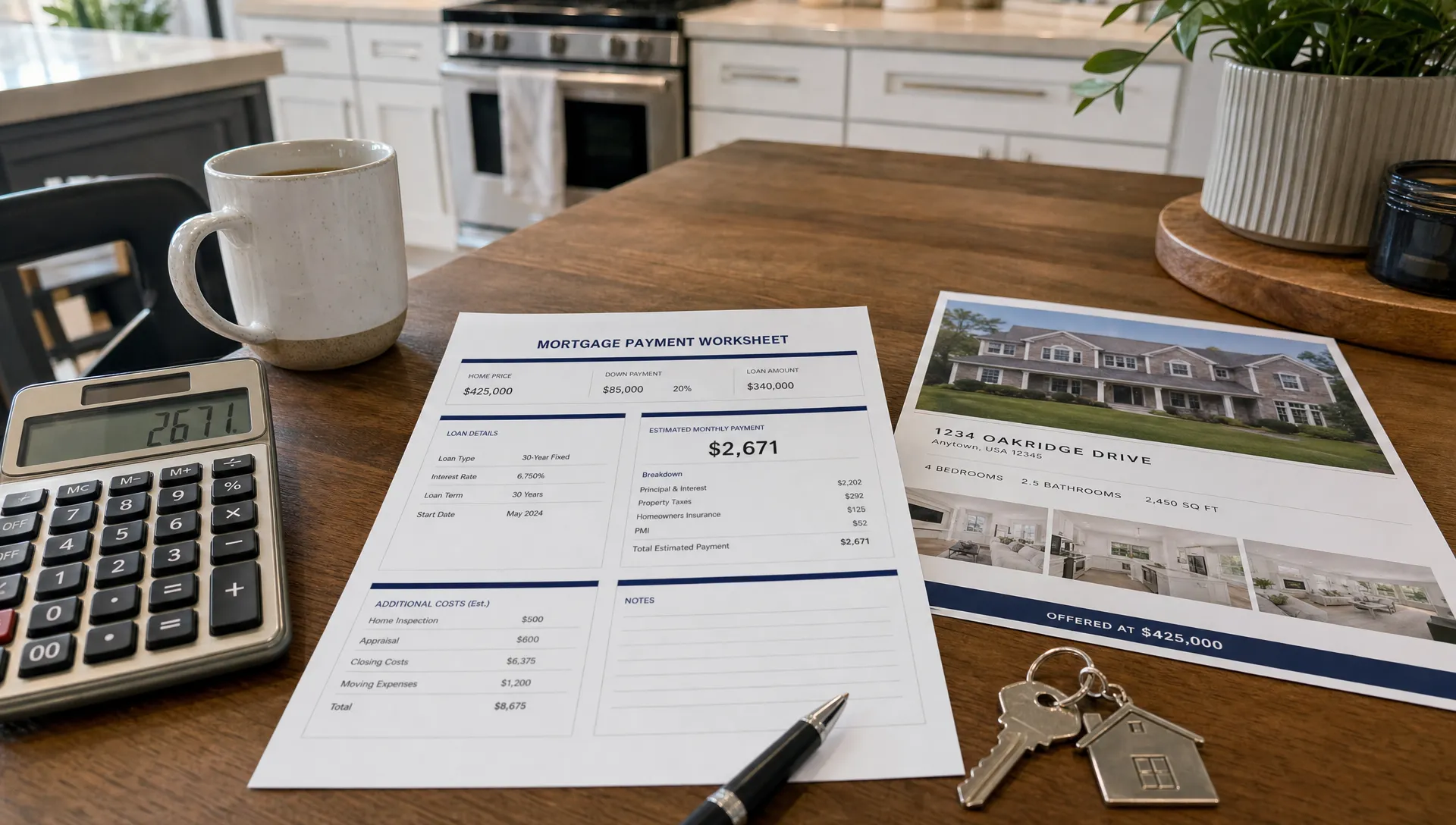
Once you have a full monthly number, compare it to your actual household cash flow. A mortgage payment should not be judged only by whether it fits a lender's debt-to-income calculation. It should also fit the way you live.
Start by listing your current monthly obligations, including auto loans, student loans, credit cards, personal loans, child support and any other recurring debts. Then add your estimated housing payment. Compare the result to your gross monthly income and your take-home pay.
Debt-to-income ratio, often shortened to DTI, is calculated like this:
Monthly debt payments ÷ gross monthly income = debt-to-income ratio
Lenders use DTI as one part of approval, but the right comfort zone is personal. A household with no childcare costs, no car payment and a large emergency fund may feel comfortable with a higher housing payment than a household with variable income or major upcoming expenses.
This is where it helps to separate qualification from comfort. Qualification is what the loan guidelines allow. Comfort is what you can pay without turning every unexpected repair, insurance increase or medical bill into a financial problem. If you are still defining that comfort zone, New Era Lending's guide on finding a mortgage that fits your budget can help you think beyond the calculator result.
Run several payment scenarios, not just one
A single estimate can create false confidence. Before applying, run at least three versions: your expected scenario, a more expensive scenario and a lower-payment scenario. This gives you a range instead of one fragile number.
For example, see how the payment changes if the interest rate is higher, the property taxes are above average or the HOA dues are more than expected. Also test what happens if you increase the down payment or choose a lower purchase price.
Using the same $360,000 loan example above, these approximate changes show how sensitive a payment can be:
| Scenario change | Approximate effect on monthly payment |
|---|---|
| Interest rate increases from 6.75% to 7.25% | About $120 more in principal and interest |
| Loan amount decreases by $20,000 | About $130 less in principal and interest |
| Property taxes are $100 higher per month | $100 more in total payment |
| HOA dues are $150 per month instead of $75 | $75 more in total payment |
| Homeowners insurance is $75 higher per month | $75 more in total payment |
These examples are simplified, but they reveal an important point: affordability is not controlled by one number. Rate, loan amount, taxes, insurance and HOA dues all work together.
A conservative estimate can protect you from disappointment later. If a home only works when every assumption is perfect, it may be too tight. If it still works after stress testing, you can move forward with more confidence.
Remember what an estimate cannot tell you
A pre-application estimate is useful, but it is not a loan approval and it is not a final Loan Estimate. Your official numbers depend on your application, credit profile, verified income, property details, loan program and market conditions at the time you lock your rate.
The official Loan Estimate is a standardized form that lenders provide after you apply. According to the CFPB's guide to the Loan Estimate, it helps borrowers review the loan terms, projected payments and closing costs. That document is far more specific than a pre-application estimate because it is based on actual lender disclosures.
Several items can change between your estimate and your final mortgage payment:
- Interest rate and points: Your final rate depends on market conditions, credit, loan program, down payment and whether you choose to pay points or use lender credits.
- Property taxes: Taxes may be reassessed after a purchase, especially if the home was previously assessed at a much lower value.
- Insurance premium: A real quote may differ from a rough estimate, especially in areas with higher weather, wildfire or flood exposure.
- Mortgage insurance: The amount can vary by loan type, down payment, credit profile and program rules.
- Escrow setup: Initial escrow deposits are part of closing costs, not just monthly payment planning.
This is also why it is smart to prepare your documents early. If your income includes bonuses, overtime, commissions, self-employment income or multiple jobs, a lender may need to review it more carefully. New Era Lending's simple lending tips for a smoother mortgage approval can help you avoid common issues before you submit an application.
Do not forget cash needed at closing
Monthly payment is only one part of readiness. You also need to estimate the cash needed to close, which may include your down payment, closing costs, prepaid taxes, prepaid insurance and escrow deposits.
A buyer may be comfortable with the monthly payment but still need more cash to close than expected. This can affect how much you choose to put down. For example, using every available dollar for the down payment may lower the monthly payment, but it can leave too little for moving costs, repairs or an emergency fund.
Before applying, create two separate estimates: one for monthly payment and one for cash to close. Keeping them separate makes tradeoffs easier to see. A lender can help compare options such as different down payment levels, loan programs and rate structures.
When you are ready to move from estimate to application
You are ready to apply when your estimated payment fits your budget, your cash-to-close plan is realistic and you understand which assumptions still need lender confirmation. At that point, applying can replace guesswork with verified numbers.
New Era Lending combines smart mortgage technology with personalized human guidance for home purchases, refinancing and equity access. If you want help comparing options before you commit, the team can walk through your estimated payment, discuss loan choices and help you understand what may change once your application is reviewed.
Frequently Asked Questions
Can I estimate a mortgage payment without applying? Yes. You can estimate a mortgage payment before applying by using the expected home price, down payment, loan term, interest rate, property taxes, homeowners insurance, HOA dues and mortgage insurance. The result is not an approval or final quote, but it can be a useful planning number.
What is the biggest mistake buyers make when estimating a payment? The most common mistake is looking only at principal and interest. Property taxes, insurance, mortgage insurance and HOA dues can significantly raise the total monthly housing cost.
How accurate are online mortgage calculators? Online calculators can be useful when the inputs are realistic. They become less accurate when taxes, insurance, HOA dues or mortgage insurance are guessed too low. They also cannot confirm your final rate, eligibility or closing costs.
Should I use gross income or take-home pay when checking affordability? Lenders typically use gross income for debt-to-income calculations, but you should also compare the payment to your take-home pay. Your personal comfort level depends on real monthly cash flow, not just qualification rules.
Will my final payment match my estimate? Not always. Your final payment can change after your credit, income, loan program, property taxes, insurance and rate lock are confirmed. A good estimate gives you a planning range, while the Loan Estimate gives you lender-specific numbers after you apply.
Estimate with confidence before you apply
A realistic mortgage estimate gives you more control before you start the formal loan process. It helps you shop within a comfortable range, compare loan options and avoid surprises from costs that are easy to overlook.
If you are ready to turn your estimate into clearer next steps, connect with New Era Lending for personalized mortgage guidance, secure document support and a simpler path from planning to approval.