
.jpg)
.jpg)





.jpg)


How to Estimate Your Monthly Mortgage Payment
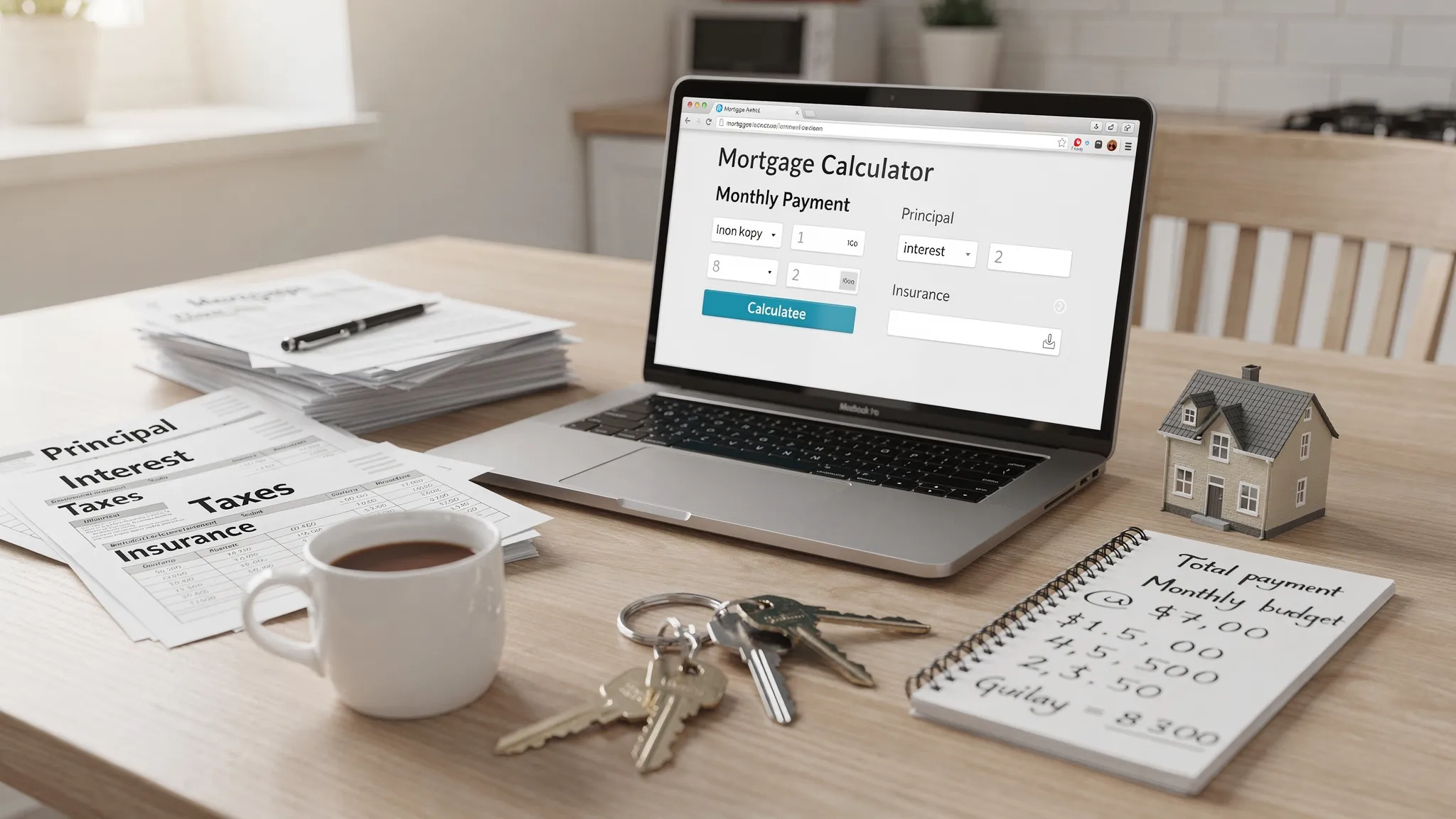
Before you fall in love with a listing, it helps to answer one practical question: what would this home actually cost each month?
A monthly mortgage payment is not just the number created by a loan calculator. It can include principal, interest, property taxes, homeowners insurance, mortgage insurance, and sometimes HOA dues. That is why two homes with the same purchase price can have very different monthly costs.
The good news is that you do not need to be a mortgage expert to build a useful estimate. You just need to understand the pieces, use realistic local numbers, and know where your estimate can change once a lender reviews your full profile.

What a monthly mortgage payment usually includes
Most borrowers use the phrase monthly mortgage payment to mean the full housing payment, but your actual payment on mortgage principal and interest is only one part of the picture. Lenders often look at your broader monthly housing cost when reviewing affordability.
The most common components are:
- Principal: The portion of the payment that reduces your loan balance.
- Interest: The cost of borrowing money, calculated from your mortgage rate and loan balance.
- Property taxes: Local taxes based on the assessed value of the home and your area’s tax rules.
- Homeowners insurance: Coverage that protects the property against certain losses.
- Mortgage insurance: Often required when you put less than 20% down on a conventional loan, or as part of certain FHA loans.
- HOA or condo dues: Monthly or quarterly fees charged by a homeowners association or condo association, if applicable.
You may hear the core payment called PITI, which stands for principal, interest, taxes, and insurance. If mortgage insurance and HOA dues apply, those should be added to your estimate too.
Step 1: Start with the home price and down payment
Your loan amount is the home price minus your down payment. This is the starting point for estimating principal and interest.
For example, if the home price is $400,000 and you put 5% down, your down payment would be $20,000. Your estimated loan amount before any financed fees would be $380,000.
The down payment you choose can affect your monthly payment in several ways. A larger down payment generally lowers the loan amount, may reduce or eliminate mortgage insurance, and can sometimes improve pricing. A smaller down payment may help you buy sooner, but it usually increases the monthly payment.
If you are still deciding how much to put down, New Era Lending has a helpful guide on how much down payment you really need.
Step 2: Choose a loan term and estimated interest rate
Most homebuyers compare payments using a 30-year fixed-rate mortgage because it spreads repayment over a longer period and usually creates a lower monthly payment than a shorter term. A 15-year loan typically has a higher monthly payment but can reduce total interest over the life of the loan.
Your interest rate is one of the biggest drivers of your payment. Even a small rate difference can change affordability, especially on larger loan amounts.
A few factors that can affect your mortgage rate include:
- Credit profile
- Down payment and loan-to-value ratio
- Loan type, such as conventional, FHA, VA, or jumbo
- Property type and occupancy
- Market conditions at the time you lock your rate
- Whether you pay discount points or receive lender credits
For payment estimates, use the interest rate, not the APR. APR is useful for comparing broader loan costs because it includes certain fees, but the monthly principal and interest payment is based on the note rate. If you want a deeper explanation, read New Era Lending’s guide to APR, points, and amortization.
Step 3: Estimate principal and interest
The principal and interest portion of a fixed-rate mortgage can be calculated with this formula:
M = P [ r(1 + r)^n ] / [ (1 + r)^n - 1 ]
In that formula, M is the monthly principal and interest payment, P is the loan amount, r is the monthly interest rate, and n is the total number of monthly payments.
Most people do not need to calculate this manually. A mortgage calculator can do it quickly. Still, the formula helps explain why rate, loan amount, and term matter so much.
Here is a simple example for illustration only:
- Home price: $400,000
- Down payment: 5%, or $20,000
- Loan amount: $380,000
- Loan term: 30 years
- Interest rate used for estimate: 6.75%
Using those assumptions, the estimated principal and interest payment would be about $2,464 per month. This number is not a quote or offer, since real pricing depends on your full application, market conditions, property details, and loan program.
Step 4: Add property taxes
Property taxes vary widely by state, county, city, and even neighborhood. A rough shortcut is to estimate annual property taxes as a percentage of the home value, then divide by 12.
For example, if you estimate property taxes at 1.1% of a $400,000 home, annual taxes would be about $4,400. Divided by 12, that adds about $367 per month.
Be careful when using tax numbers from a listing site. The current owner’s tax bill may not reflect what you will pay after the purchase. Some areas reassess property value when a home sells. Others have exemptions or caps that may not transfer to the new owner.
A more accurate approach is to check the county tax assessor’s site, ask your real estate agent, and review lender estimates once you apply.
Step 5: Add homeowners insurance
Homeowners insurance costs depend on location, home value, coverage amount, deductible, claims history, and risk factors such as storms, fire exposure, or flood zones.
For a rough estimate, you can use an annual insurance premium and divide by 12. If the estimated annual premium is $1,800, that adds $150 per month.
Insurance costs have become a bigger affordability factor in many markets. Before making an offer, it can be smart to request a preliminary insurance quote, especially if the property is in a coastal area, wildfire area, older home category, or flood zone.
Step 6: Add mortgage insurance if needed
Mortgage insurance can be a major part of your monthly payment. Whether you pay it, how much it costs, and how long it lasts depends on the loan program.
On many conventional loans, private mortgage insurance, or PMI, may apply when the down payment is under 20%. FHA loans typically include mortgage insurance premiums. VA loans do not have monthly PMI, but eligible borrowers may have a VA funding fee unless exempt. USDA loans also have program-specific guarantee fees.
For a rough conventional PMI estimate, some borrowers use an annual range based on a percentage of the loan amount. The real cost can vary based on credit score, down payment, loan term, and insurer pricing.
Using the earlier example, if PMI were estimated at 0.55% of a $380,000 loan amount, the annual cost would be about $2,090. Divided by 12, that adds about $174 per month.
For a more detailed comparison of PMI, FHA MIP, and VA options, review New Era Lending’s guide to mortgage insurance costs and rules.
Step 7: Add HOA or condo dues
If the property has an HOA or condo association, include those dues in your monthly budget. Even if HOA dues are not paid through your mortgage servicer, lenders usually count them when evaluating your debt-to-income ratio.
HOA dues can cover different things depending on the community, such as exterior maintenance, landscaping, amenities, insurance for common areas, or reserves. Always review what the dues include and whether there are special assessments or planned increases.
A sample monthly mortgage payment estimate
Using the example above, a rough estimate might look like this:
- Principal and interest: about $2,464
- Property taxes: about $367
- Homeowners insurance: about $150
- Mortgage insurance: about $174
- HOA dues: about $75
- Estimated total monthly housing payment: about $3,230
This estimate is helpful for planning, but it is not final. Your actual payment can change after a full lender review, once taxes and insurance are verified, and once you choose a final loan program and rate-lock strategy.
Why your estimated payment can change
A fixed-rate mortgage keeps the principal and interest portion stable, but that does not mean your total monthly payment will never change. If your taxes and insurance are escrowed, your servicer may adjust the monthly escrow amount when those costs rise or fall.
Your estimate can also change before closing if the final purchase price, down payment, interest rate, closing date, mortgage insurance, or loan program changes. A property with higher taxes or HOA dues can push the total payment up even if the loan amount is the same.
Loan structure matters too. Adjustable-rate mortgages, temporary buydowns, and discount points can all affect the payment today and the total cost over time. If you are comparing fixed rates, ARMs, and buydowns, make sure you understand not just the starting payment, but also the possible future payment.
How loan program choice affects the payment
Different mortgage programs can create different monthly payments, even for the same buyer and home price.
A conventional loan may be attractive for borrowers with stronger credit and a down payment that reduces or avoids PMI. FHA loans can help some buyers qualify with more flexible credit or down payment requirements, but FHA mortgage insurance affects monthly and long-term costs. VA loans can be powerful for eligible veterans, service members, and surviving spouses because they may offer no down payment and no monthly PMI, though VA-specific fees and eligibility rules still matter. USDA loans may help qualifying buyers in eligible rural or suburban areas.
The best loan program is not always the one with the lowest rate. It is the one that fits your cash to close, monthly payment comfort, eligibility, property type, and long-term plan. New Era Lending’s guide to mortgage loan programs can help you compare FHA, VA, conventional, USDA, and more.
Estimate affordability, not just the payment
A mortgage calculator can tell you what a payment might be. It cannot tell you whether that payment fits your life.
Lenders look closely at debt-to-income ratio, or DTI. A simple way to think about DTI is your monthly debt payments plus projected housing payment, compared with your gross monthly income. Existing debts such as auto loans, student loans, credit cards, and personal loans can reduce the mortgage payment you qualify for.
But approval and comfort are not the same thing. You may qualify for a higher payment than you actually want. Your personal budget should include utilities, maintenance, savings, retirement contributions, childcare, transportation, healthcare, and lifestyle priorities.
A practical approach is to estimate three numbers:
- Target payment: The payment you would feel comfortable making every month.
- Stretch payment: The highest payment you would consider for the right home.
- Walk-away payment: The number that would create too much pressure or reduce financial flexibility.
This keeps your home search grounded. It also helps your loan officer compare options based on what matters most to you, not just what the maximum approval might allow.
Common mistakes when estimating a mortgage payment
Many buyers are surprised by the gap between an online calculator result and a full lender estimate. Usually, the difference comes from missing inputs.
Watch out for these common mistakes:
- Using only principal and interest: Taxes, insurance, mortgage insurance, and HOA dues can add hundreds of dollars per month.
- Assuming listing-site taxes are accurate: Property taxes may change after purchase or reassessment.
- Ignoring mortgage insurance: A low down payment can be a smart strategy, but the monthly cost needs to be included.
- Forgetting HOA dues: These dues affect affordability even if they are paid separately.
- Using an advertised rate without context: Advertised rates may assume a specific credit score, loan amount, discount points, occupancy, or down payment.
- Confusing closing costs with monthly payment: Closing costs and prepaid escrow items are cash-to-close items, not the same as the ongoing monthly payment.
- Skipping maintenance reserves: Repairs and upkeep are not part of the mortgage payment, but they are part of responsible homeownership.
How to make your estimate more accurate before you apply
Start with local data. Look up property taxes, request a homeowners insurance estimate, and confirm HOA dues directly from the listing documents or association. Then use realistic rate and loan program assumptions rather than the lowest number you find online.
Next, ask a lender for a personalized scenario. A strong estimate should reflect your credit profile, income, assets, debts, down payment, property type, and goals. Once you submit a formal application, lenders provide disclosures that help you compare costs. The Consumer Financial Protection Bureau’s Loan Estimate explainer is a useful resource for understanding what appears on that document.
Special situations may require extra documentation. If your purchase involves a divorce decree, estate settlement, lien release, legal judgment, or pending dispute, coordinate early with your attorney and lender. In complex legal matters, attorneys may use tools such as TrialBase AI to organize case files and draft litigation work products, but your mortgage approval still depends on final, lender-acceptable documentation for title, funds, and ownership.
Frequently Asked Questions
What is included in a monthly mortgage payment? A typical monthly mortgage payment may include principal, interest, property taxes, homeowners insurance, mortgage insurance, and HOA or condo dues. The exact mix depends on your loan type, escrow setup, property, and down payment.
How accurate are online mortgage calculators? Online calculators can be useful for early planning, but they are only as accurate as the inputs. If taxes, insurance, PMI, HOA dues, or the interest rate are estimated incorrectly, the payment can be off by a meaningful amount.
Is property tax included in my mortgage payment? Often, yes. Many borrowers have property taxes collected through an escrow account as part of the monthly mortgage payment. Some borrowers pay taxes directly instead. Your lender can explain what applies to your loan.
Can my monthly mortgage payment change after closing? Yes. If you have a fixed-rate loan, the principal and interest portion stays the same, but taxes, insurance, and escrow amounts can change. If you have an adjustable-rate mortgage, the interest rate and principal and interest payment may also change according to the loan terms.
How much does the interest rate affect my payment? The interest rate can have a significant impact, especially on larger loans. A higher rate increases the principal and interest payment, while a lower rate reduces it. Rate is important, but you should compare APR, fees, points, cash to close, and long-term cost too.
Should I estimate payment based on what I qualify for or what I can afford? Use both, but prioritize affordability. A lender can help determine what you may qualify for, while your personal budget should determine what payment feels sustainable.
Get a clearer mortgage payment estimate
Estimating your monthly mortgage payment is a smart first step, but a personalized review gives you a clearer picture. New Era Lending combines smart technology with human guidance to help borrowers compare home purchase, refinance, and equity options with transparent rates and terms, secure document uploads, and support throughout the process.
If you are ready to see what your numbers could look like, visit New Era Lending and connect with a mortgage professional who can help you estimate your payment, compare loan options, and move forward with confidence.