.jpg)
.jpg)





.jpg)


Houston Mortgage Guide: Taxes, Insurance, and Flood Zones

A Houston mortgage can look affordable when you only compare interest rates, but the real monthly cost depends on local taxes, insurance and flood risk. Houston buyers often shop across Harris County, Fort Bend County, Montgomery County, Brazoria County and nearby communities, which means two homes with the same price can produce very different payment estimates.
For buyers and homeowners in 2026, the smartest move is to treat the mortgage payment as a full housing budget, not just principal and interest. Property tax districts, wind and hail deductibles, homeowners insurance pricing, flood maps, HOA dues and escrow changes can all affect affordability after closing.
What a Houston mortgage really includes beyond the rate
Your note rate matters, but it is only one piece of the payment. Most owner-occupied mortgage payments are built around principal, interest, property taxes and insurance. Depending on your loan type and down payment, you may also have mortgage insurance, HOA dues or separate flood insurance.
That is why a careful Houston mortgage estimate should start with the full PITI picture. If you focus only on the loan amount and interest rate, you may underbudget for the costs that change most often over time. New Era Lending has a deeper breakdown of how mortgage payments are built and why they change, which is useful if you are comparing several payment scenarios.
| Cost item | What it covers | Why it matters in Houston |
|---|---|---|
| Principal and interest | Loan repayment and borrowing cost | Driven by loan amount, rate and term |
| Property taxes | Local county, city, school and special district taxes | Can vary widely by address |
| Homeowners insurance | Dwelling and liability coverage | Weather risk can affect premiums |
| Flood insurance | Flood damage coverage | Often separate from homeowners insurance |
| HOA or MUD costs | Community or utility district costs | Common in some master-planned areas |
Property taxes in Houston area homebuying
Texas does not have a state property tax. Instead, local taxing units set tax rates and appraisal districts determine taxable values under state rules. The Texas Comptroller explains the statewide property tax framework, but your actual bill depends on your exact address.
For a Houston mortgage, the tax estimate should be based on the home you are buying, not just the current owner’s tax bill. A seller may have exemptions you will not receive immediately, or the home may be reassessed after the sale. In newer communities, a Municipal Utility District, often called a MUD, can also add a separate tax rate.
Key tax questions to ask before making an offer
Ask your loan officer or real estate agent to help you identify every taxing entity tied to the property. In the Houston area, that may include a county, city, independent school district, hospital district, community college district, MUD or other special district.
You should also ask whether the current tax bill reflects a homestead exemption. If you buy the home as your primary residence, a homestead exemption may reduce taxable value and may limit certain future increases once it is in place. The timing and eligibility rules matter, so confirm them instead of assuming the seller’s bill will become yours.
Insurance can change your buying power
Homeowners insurance in Houston deserves early attention because premiums can affect your debt-to-income ratio and your final approval. Lenders require enough coverage to protect the property, but insurance companies price risk based on many factors, including age, roof condition, claims history, construction type and location.
A Houston mortgage budget should treat insurance as a quote-based number, not a rough guess. Two homes with similar prices can carry different premiums if one has an older roof, a higher wind exposure or prior claims. Waiting until the last few days before closing to shop insurance can create payment surprises.
Wind, hail and named-storm deductibles
Many Texas homeowners policies include separate deductibles for wind, hail or named storms. These deductibles may be shown as a percentage of the dwelling coverage rather than a flat dollar amount. For example, a percentage deductible can produce a much larger out-of-pocket cost after a storm than a buyer expects.
Ask the insurance agent to explain the deductible structure in plain language. Also confirm whether roof coverage is replacement cost or actual cash value, since that difference can matter if a roof is damaged years after closing.
Flood zones can reshape a Houston mortgage budget
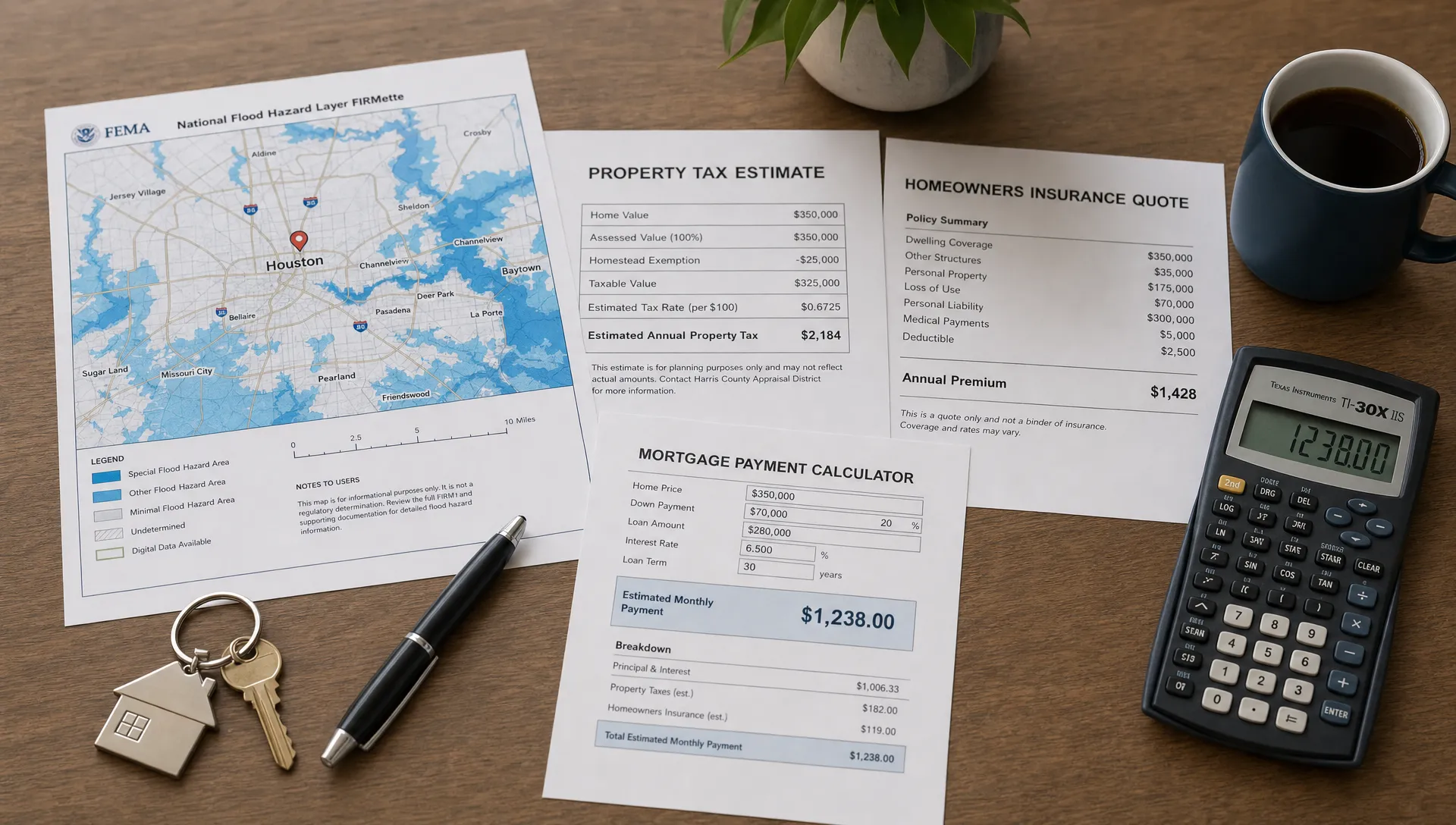
Flood risk is one of the most important local variables in the Houston area. A lender will usually order a flood certification during underwriting, and if the home is in a Special Flood Hazard Area, flood insurance is generally required for federally backed or regulated loans.
A Houston mortgage can still be possible in a mapped flood zone, but the numbers need to work. Flood insurance premiums, elevation data and lender requirements can all affect your monthly payment and cash needed to close. FEMA’s Flood Map Service Center is a helpful public starting point, but your lender’s flood certification controls the loan file.
Understanding common flood zone labels
| Flood zone label | General meaning | Mortgage impact |
|---|---|---|
| Zone X | Lower mapped flood risk | Flood insurance may be optional, but still worth considering |
| Shaded Zone X | Moderate flood risk | Usually not mandatory, but risk is not zero |
| Zone AE or A | Higher flood risk area | Flood insurance is commonly required by lenders |
| Floodway | Area designed to carry floodwater | May create stricter building and lending concerns |
Flood maps can also change over time. A home outside a mandatory flood zone today can still flood during extreme rainfall, and a property inside a zone may have elevation features that affect insurance pricing. In Houston, it is wise to review drainage, nearby bayous, street flooding history and neighborhood elevation before relying on a zone label alone.
Escrow is where taxes and insurance meet your monthly payment
Most borrowers pay taxes and insurance through an escrow account. Each month, the lender collects a portion of the expected annual tax and insurance bills along with principal and interest, then pays those bills when they come due.
A Houston mortgage payment can change after closing if escrow estimates were too low, property taxes rise, insurance premiums increase or a prior shortage must be repaid. This is why the first-year payment is not always the same as the second-year payment. Escrow reviews are routine, but they can frustrate homeowners who expected a fixed monthly bill.
The best defense is to estimate conservatively before closing. If you want to model a realistic payment before you shop, New Era Lending’s guide on how to estimate your monthly mortgage payment explains the pieces to include.
Loan options and local cost considerations
The right loan program depends on credit profile, down payment, occupancy, military service, income type and long-term plans. Houston buyers may consider conventional loans, FHA loans, VA loans, jumbo loans or refinancing options depending on the property and borrower profile.
The right Houston mortgage structure should be chosen alongside local cost estimates. A lower down payment may help preserve cash for moving, repairs or emergency reserves, but mortgage insurance and escrow costs can increase the monthly payment. A larger down payment may reduce the payment, yet it can leave less liquidity for insurance deductibles or maintenance.
If you are comparing programs, New Era Lending has a simple guide to common mortgage loan options that explains when different products may fit.
Income documentation for Houston buyers
Houston’s economy includes salaried workers, medical professionals, energy employees, contractors, business owners, truckers and many households with variable income. Lenders look for stable, verifiable income that supports the payment, so documentation matters as much as the headline income amount.
For a Houston mortgage application, self-employed borrowers and owner-operators should be ready to explain how income is earned, deposited and reported on tax returns. For example, a livestock hauler who uses transparent load marketplaces such as Livestock Way may still need tax returns, bank statements, profit and loss details or other documentation to show qualifying income. The same idea applies to many variable-income borrowers: lenders usually need evidence that the income is consistent and likely to continue.
If your income changes seasonally or includes bonuses, commissions, per diem pay or contract work, talk with a loan officer before you write an offer. A quick document review can prevent disappointment during underwriting.
A practical Houston homebuying cost checklist
Before you commit to a Houston mortgage, build a property-specific estimate instead of using county averages. The goal is not to predict every future bill perfectly. The goal is to avoid being surprised by costs that were visible before closing.
Use this checklist before your option period or inspection window ends:
- Request a tax estimate based on the purchase price and your expected exemptions.
- Ask whether the home is in a MUD, PID or other special district.
- Get homeowners insurance quotes early, especially if the roof is older.
- Confirm wind, hail and named-storm deductibles.
- Review the lender’s flood certification and compare it with public flood map resources.
- Quote flood insurance if the property is in or near a higher-risk area.
- Ask whether HOA dues, transfer fees or resale certificate fees apply.
- Keep cash reserves for maintenance, deductibles and utility setup.
A good estimate should include both monthly payment and cash-to-close. Houston buyers sometimes focus on winning the contract, then discover that insurance, prepaid taxes or escrow deposits make closing more expensive than expected.
Frequently Asked Questions
What makes a Houston mortgage different from a mortgage in other Texas markets? Local property taxes, flood risk, insurance pricing, MUD districts and neighborhood-level drainage patterns can create major cost differences from one Houston-area property to another.
Do I need flood insurance if the home is not in a mandatory flood zone? Not always, but many Houston homeowners still consider it. Standard homeowners insurance usually does not cover flood damage, and flooding can happen outside high-risk FEMA zones.
Why can my payment increase if I have a fixed-rate loan? A fixed-rate loan keeps principal and interest stable, but escrowed taxes and insurance can change. If property taxes or insurance premiums rise, the total monthly payment can rise too.
Are Houston property taxes based on the price I pay for the home? Not directly. Appraisal districts determine taxable value under Texas rules, but a sale can influence future appraisals. Your lender should estimate taxes conservatively during approval.
When should I get insurance quotes during the buying process? Get quotes as early as possible, ideally during the option period. Insurance availability, premium amount and deductibles can affect affordability before closing.
Get a clearer path to home financing
New Era Lending helps buyers and homeowners compare mortgage options with modern tools and human guidance. If you are purchasing, refinancing or exploring equity access, a property-specific estimate can help you understand taxes, insurance, flood risk and monthly payment before you move forward.
Instead of relying on a rough online number, ask for a full payment review that reflects the home, the loan program and your financial goals.