
.jpg)
.jpg)





.jpg)


VA Refinance Loan Requirements to Review First
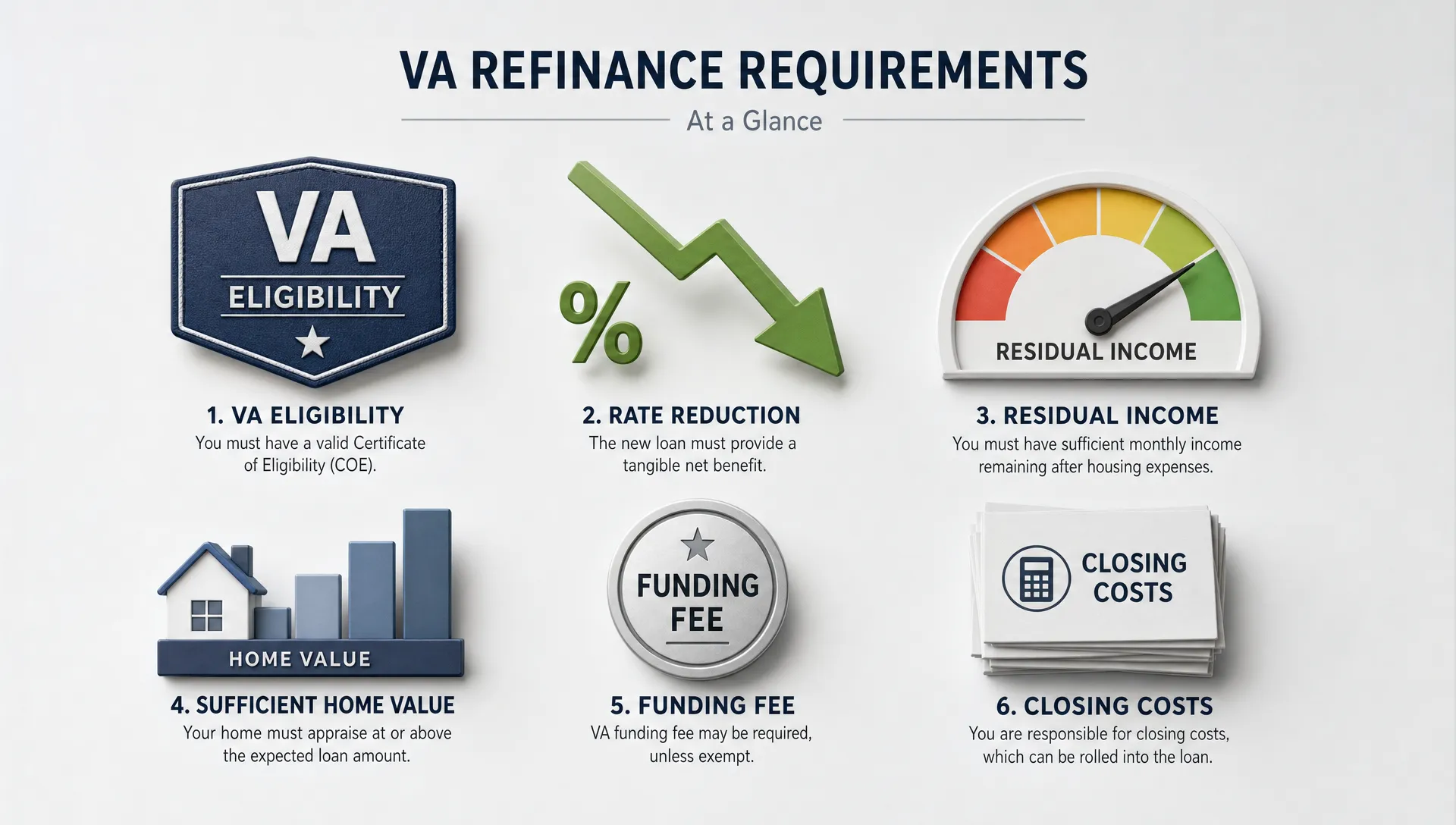
A VA refinance can be one of the most useful benefits available to eligible veterans, active-duty service members and qualifying surviving spouses. It can help lower a payment, move from a less favorable loan into a VA-backed mortgage or access home equity for a defined financial goal.
The key is knowing which rules apply before you start comparing quotes. The requirements for a VA refinance loan are not one single checklist. They change based on whether you choose a VA Interest Rate Reduction Refinance Loan, often called an IRRRL or streamline refinance, or a VA cash-out refinance with full underwriting.
Below are the VA refinance loan requirements to review first, so you can spot potential issues early and have a more productive conversation with your lender.
First, identify the VA refinance type you need
Most VA refinance conversations begin with the same question: what are you trying to accomplish?
If your current mortgage is already a VA loan and you mainly want a lower rate, a lower payment or a move from an adjustable rate to a fixed rate, an IRRRL may fit. If you want to refinance a non-VA loan into a VA loan or take cash from your home equity, you will usually be looking at a VA cash-out refinance.
| Refinance type | Best fit | Key requirements to review first |
|---|---|---|
| VA IRRRL | Refinancing an existing VA loan for a qualifying benefit | Existing VA loan, payment seasoning, prior occupancy certification, net tangible benefit rules and lender overlays |
| VA cash-out refinance | Accessing equity or refinancing a non-VA loan into a VA loan | VA eligibility, full credit and income review, occupancy, VA appraisal, home value and available equity |
| Rate and term VA cash-out structure | Replacing a non-VA mortgage without taking meaningful cash back | Same full underwriting framework as a cash-out refinance, even if the main goal is loan replacement |
The U.S. Department of Veterans Affairs explains the basic structure of both the VA Interest Rate Reduction Refinance Loan and the VA-backed cash-out refinance loan. Your lender may also have additional standards, sometimes called overlays, that affect approval.
Requirement 1: Confirm your VA eligibility and COE status
For any VA refinance, your eligibility foundation matters. The VA loan benefit is generally tied to qualifying service history, and lenders often verify that through a Certificate of Eligibility, known as a COE.
For an IRRRL, the existing VA loan can sometimes help the lender confirm prior entitlement use, but you should still expect your lender to verify VA eligibility in its system. For a VA cash-out refinance, the COE is typically a central part of the file because the loan is being fully underwritten as a new VA-backed mortgage.
Your COE does not approve the loan by itself. It confirms that you have VA loan eligibility based on service or surviving spouse status. The lender still reviews the refinance purpose, property, payment history and financial profile. If you want a broader eligibility refresher, New Era Lending’s guide on qualifying for a VA loan explains the core rules that also matter in refinance conversations.
Requirement 2: Check the occupancy rule for your refinance type
VA loans are built around primary residence financing, but refinance occupancy rules are not identical across loan types.
For a VA cash-out refinance, you generally must certify that you intend to occupy the home as your primary residence. This matters if the property has become a rental, second home or investment property.
For an IRRRL, the VA generally requires that you certify you previously occupied the home. That can make an IRRRL more flexible for some borrowers who used to live in the property but no longer do. Lenders still need to verify that the loan meets VA program rules and their own guidelines.
Active-duty service members should also discuss deployment, relocation and spouse occupancy situations with a lender before assuming the rule is satisfied. Occupancy questions are often simple when handled early, but they can slow a file down if they are discovered late.
Requirement 3: Make sure the refinance provides a clear benefit
A VA refinance should not simply replace one mortgage with another. It should produce a measurable benefit or meet a legitimate borrower need.
For IRRRLs, VA rules include a net tangible benefit requirement. Depending on the scenario, the benefit might be a lower interest rate, lower principal and interest payment, a shorter loan term or a move from an adjustable rate mortgage into a fixed rate. If closing costs are financed into the new loan, your lender may also need to calculate how long it takes to recover those costs through monthly savings.
This is where many borrowers focus too much on the advertised interest rate and not enough on the whole transaction. A lower rate can still be a poor deal if fees are high, the loan term is reset unnecessarily or the monthly savings do not justify the cost. For a deeper look at rate shopping, points and total cost, see New Era Lending’s guide to VA refinance rates.
For a VA cash-out refinance, the benefit can be different. You might be replacing a higher-cost loan, consolidating debt, funding repairs or accessing equity for a planned expense. Even then, the refinance should make sense in the context of your long-term housing budget.
Requirement 4: Review credit, income, DTI and residual income
Credit and income requirements depend heavily on the refinance type.
An IRRRL is often described as streamlined because the VA does not always require the same level of appraisal, credit underwriting or income documentation that a full refinance requires. That does not mean every IRRRL is documentation-free. Lenders may still review credit, employment or income based on their guidelines, the loan characteristics or state rules.
A VA cash-out refinance is different. It normally requires full underwriting, which means the lender reviews your ability to repay the new mortgage. Expect attention to:
- Credit history, including mortgage payment history and major derogatory events
- Verifiable income from employment, retirement, disability, self-employment or other eligible sources
- Debt-to-income ratio, often called DTI
- VA residual income, which looks at money left over after major monthly obligations
- Assets needed for closing costs or reserves, if required by the lender
VA lending is known for flexibility, but flexibility is not the same as automatic approval. A strong residual income position can help a file, while recent late payments, unstable income or unexplained deposits may require more documentation.
Requirement 5: Know whether a VA appraisal is required
The appraisal requirement is one of the biggest practical differences between an IRRRL and a VA cash-out refinance.
With an IRRRL, the VA generally does not require a new appraisal. Some lenders may still require a valuation product or additional review depending on the loan, property, market or risk factors.
With a VA cash-out refinance, a VA appraisal is typically required. The appraiser estimates the property’s reasonable value and checks whether the home meets VA Minimum Property Requirements. Those standards are meant to support safety, soundness and basic livability.
The appraised value affects how much equity is available and whether the requested loan amount works. If the value comes in lower than expected, your available cash-out amount may shrink or the loan structure may need to change.

Requirement 6: Check payment history and loan seasoning
Payment history is one of the first items to review because recent mortgage lates can affect eligibility, pricing or approval.
For an IRRRL, VA seasoning rules generally require enough time and payments to have passed on the existing VA loan before the new loan can close. Borrowers should expect the lender to review when the first payment was due and how many monthly payments have been made. If the loan is too new, the refinance may need to wait.
For a VA cash-out refinance, the lender will review the existing mortgage history as part of full underwriting. Late payments do not always mean a refinance is impossible, but they can create extra conditions or limit options. If you have had a recent hardship, be prepared to explain what happened, when it was resolved and why the new payment is sustainable.
Requirement 7: Gather documents before the lender asks
A cleaner document file can shorten the back-and-forth and help your lender give more accurate guidance. The exact list depends on your refinance type and borrower profile, but the following items are common.
| Document or information | Why it matters |
|---|---|
| Certificate of Eligibility | Confirms VA loan benefit eligibility |
| Current mortgage statement | Shows balance, payment, escrow and loan servicer details |
| Homeowners insurance declaration page | Helps verify coverage and calculate escrow needs |
| Pay stubs, W-2s or retirement award letters | Supports income review for fully underwritten loans |
| Bank statements | Verifies funds for closing, reserves or large deposits |
| Property tax information | Helps estimate the full monthly housing payment |
| Photo ID and Social Security number | Supports identity verification and credit review |
| Divorce decree, child support order or bankruptcy papers, if applicable | Helps underwriters document recurring obligations or prior credit events |
If you want a more complete document planning guide, New Era Lending’s article on veterans mortgage loan documents walks through the records borrowers often need to qualify.
Requirement 8: If you plan to take cash out, review the purpose and budget
A VA cash-out refinance can turn home equity into usable funds, but that decision deserves a careful budget review. You are replacing home equity with mortgage debt secured by your property, so the purpose should be clear and the payment should be sustainable.
If the refinance is meant to cover a specific expense, gather third-party estimates before borrowing. That could mean a contractor bid, tuition invoice, medical estimate or, for a family coordinating care during an international move, a local provider such as dental care in Brisbane. The point is not that every expense needs to be lender-approved. The point is that you should avoid guessing at costs when the refinance will affect your mortgage balance for years.
For debt consolidation, compare the new mortgage payment, total interest, closing costs and repayment timeline against your current debts. A lower monthly payment can create breathing room, but stretching short-term debt over a long mortgage term can increase the total amount paid over time.
Requirement 9: Review closing costs, funding fee and escrow changes
VA refinances can include several cost categories. Some may be paid at closing, some may be financed into the new loan and some may be covered through lender credits depending on the rate and structure.
The VA funding fee is one of the most important items to check. Some borrowers are exempt, including certain veterans receiving VA disability compensation and some surviving spouses. The VA maintains current guidance on funding fees and closing costs, and your lender should explain how the fee applies to your specific refinance.
Also look closely at escrow. Your new payment may include taxes and insurance, and your current escrow account may be refunded after payoff. Timing can create confusion if you compare only the old monthly payment to the new one without looking at escrow setup, prepaid items and refund timing.
Before signing, review the Loan Estimate and Closing Disclosure carefully. Confirm the interest rate, annual percentage rate, loan term, payment, cash to close, financed fees and whether the loan includes points.
A simple pre-application checklist
Before you apply, review these items with your lender or gather the information on your own:
- Your refinance goal, such as lower payment, fixed rate, cash-out or replacing a non-VA loan
- Your current loan type, balance, rate, payment and payoff estimate
- Your COE status and any prior VA loan use
- Whether you currently occupy the property or previously occupied it
- Mortgage payment history for the past year
- Estimated home value and equity position
- Income, debt, credit and residual income strength
- Expected closing costs, funding fee status and escrow changes
This review does not replace underwriting, but it can help you avoid starting with the wrong loan type or an unrealistic expectation.
Frequently Asked Questions
What are the main VA refinance loan requirements? The main requirements depend on the refinance type. An IRRRL usually requires an existing VA loan, seasoning, prior occupancy certification and a net tangible benefit. A VA cash-out refinance usually requires VA eligibility, occupancy as a primary residence, full income and credit underwriting, a VA appraisal and sufficient home value.
Do I need a Certificate of Eligibility for a VA refinance? For a VA cash-out refinance, the COE is typically part of the file. For an IRRRL, the lender may be able to verify prior VA loan use, but eligibility still has to be confirmed. It is wise to ask your lender early if anything is needed from you.
Can I refinance a conventional loan into a VA loan? Yes, eligible borrowers may be able to refinance a conventional loan into a VA-backed loan through a VA cash-out refinance structure, even if they are not taking significant cash back. The loan will generally require full underwriting and a VA appraisal.
Does a VA IRRRL require an appraisal? The VA generally does not require a new appraisal for an IRRRL, which is one reason it is called a streamline refinance. A lender may still require additional valuation or documentation based on its own guidelines.
Can I take cash out with a VA IRRRL? No. An IRRRL is not designed for cash-out. If you want to access equity, you will usually need to look at a VA cash-out refinance and meet the full underwriting requirements.
Will my credit score matter for a VA refinance? It can. A VA cash-out refinance normally includes a full credit review. An IRRRL may be more streamlined, but lenders can still apply credit standards or require documentation depending on the loan scenario.
Review your VA refinance options with guidance
The right VA refinance is not just the one with the lowest advertised rate. It is the loan that fits your eligibility, property, payment history, equity position and long-term financial goal.
New Era Lending helps eligible borrowers review VA refinance options with smart technology, secure document uploads, e-signature support and personalized human guidance. If you are considering an IRRRL, cash-out refinance or a refinance from a non-VA loan into a VA-backed mortgage, you can start by reviewing your numbers with a team that understands veteran lending across 39 states.
Visit New Era Lending to explore your next step with more clarity and confidence.