.jpg)
.jpg)





.jpg)

Smart Rate Home Loans: How to Compare Rates and Fees

Comparing smart rate home loans means finding the best combination of interest rate, upfront fees and flexibility for your situation, not simply choosing the smallest advertised number. A lower rate may require thousands of dollars in points. A higher rate may come with lender credits that preserve your cash at closing.
The practical question is whether those trade-offs work over the time you expect to keep the mortgage. Start with comparable Loan Estimates, build a rate-and-fee comparison and test each offer against both your likely payoff date and your available cash.
Put smart rate home loans on equal footing
Treat “smart rate” as a description to evaluate, not proof of a particular loan structure or savings. Ask what program, pricing assumptions and fees sit behind the offer.
Before comparing lenders, give each one the same loan scenario: purchase price or property value, down payment, requested loan amount, occupancy type and estimated credit profile. Keep the loan program, repayment term and rate-lock period consistent as well.
A 30-year fixed-rate conventional loan with no points is not directly comparable to an adjustable-rate mortgage with an introductory rate or a fixed-rate offer that requires substantial points. Quotes obtained on different days can also reflect market movements rather than differences between lenders.
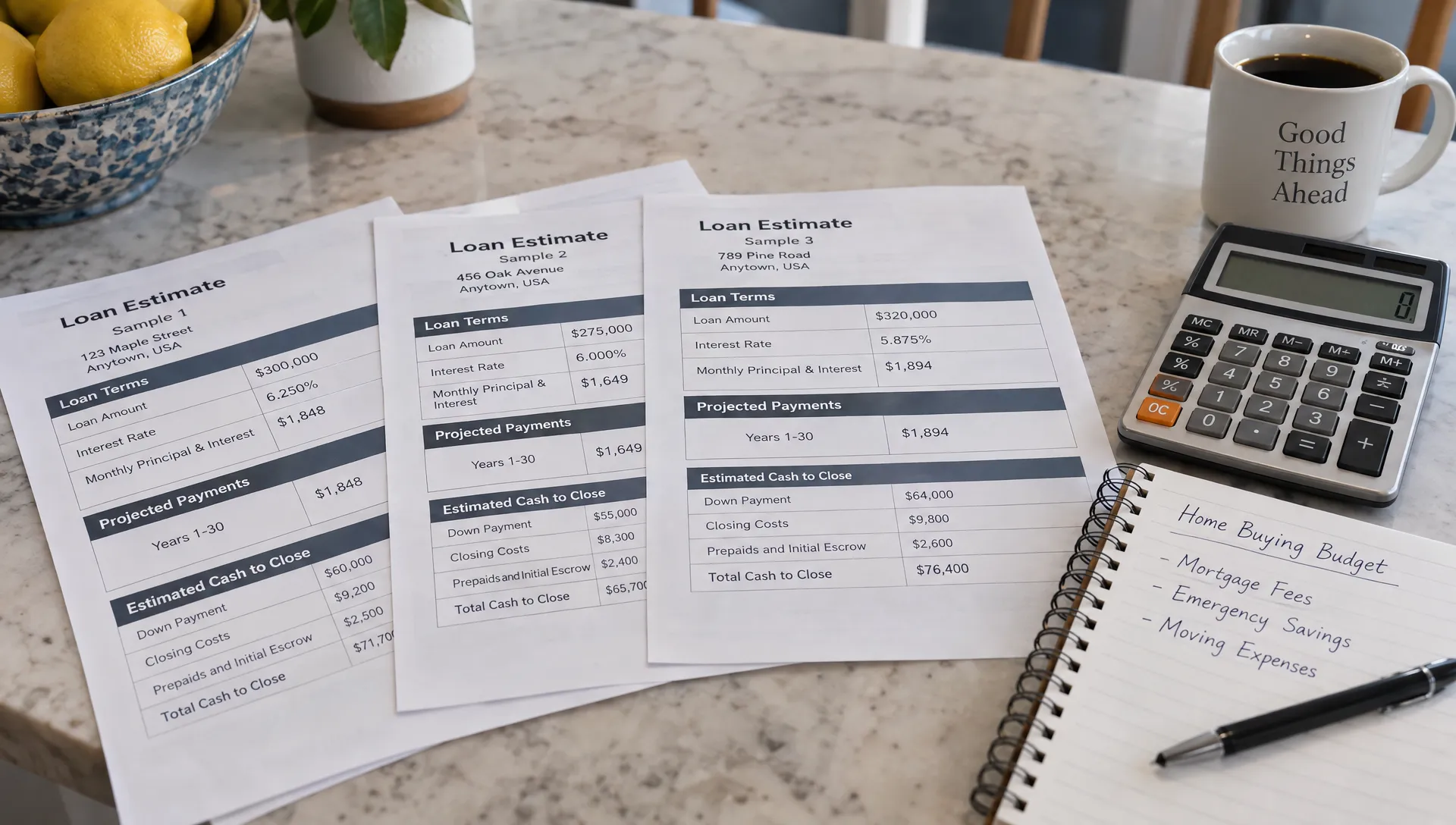
For smart rate home loans, request a written quote that identifies the rate, points, lender credits, origination charges and whether the rate is locked. Once you have applied, use the standardized Loan Estimate explained by the Consumer Financial Protection Bureau to compare actual terms rather than marketing summaries.
If two quotes differ unexpectedly, check the assumptions first. New Era Lending’s explanation of how mortgage loan rates are priced provides useful context for differences tied to borrower profiles and loan details.
Ask for a rate-and-fee menu
Instead of requesting only a lender’s “best rate,” ask for several pricing options for the same mortgage. A useful comparison includes a zero-point option, an option with discount points and an option with lender credits, if available.
Discount points are upfront charges paid to obtain a lower interest rate. One point equals 1% of the loan amount, but it does not buy a universal rate reduction. Lender credits generally work in the opposite direction: accepting a higher rate can reduce eligible closing costs.
Here is a hypothetical comparison, not a current rate quote or an offer from New Era Lending. Each option assumes a $350,000, 30-year fixed-rate loan with otherwise identical terms and charges.
| Pricing option | Interest rate | Monthly principal and interest, rounded | Upfront difference from baseline |
|---|---|---|---|
| Pay one discount point | 6.25% | $2,155 | Costs $3,500 more |
| Zero-point baseline | 6.50% | $2,212 | No difference |
| Accept a lender credit | 6.75% | $2,270 | Costs $2,500 less through an eligible credit |
These payments exclude property taxes, homeowners insurance, mortgage insurance and homeowners association dues. Actual pricing and available credits vary.
A side-by-side menu makes smart rate home loans easier to evaluate because it shows what you pay upfront to change the monthly payment. It also prevents a points-heavy quote from appearing cheaper merely because its headline rate is lower.
Separate pricing fees from timing-related costs
The total cash-to-close figure matters, but not every dollar in it measures the price of the mortgage. Your down payment builds equity. An initial escrow deposit funds future bills. Origination charges compensate the lender for making the loan.
On page 2 of the Loan Estimate, pay particular attention to:
- Section A, Origination Charges: Compare discount points and other lender charges together, rather than focusing on individual fee names.
- Sections B and C, Required Services: Separate services you cannot shop for from those you can, then check which estimates are realistic.
- Sections F and G, Prepaids and Initial Escrow Payment: Review interest, insurance and tax-related amounts without treating all differences as lender savings.
- Lender Credits: Confirm the amount and how it reduces eligible closing costs.
For example, prepaid interest depends partly on the closing date. One quote may assume a different number of prepaid days than another. Property tax and insurance estimates can also differ even when both lenders are financing the same home.
When comparing smart rate home loans, ask lenders to explain material differences line by line. A lower cash-to-close estimate is not necessarily a cheaper loan if it simply understates an expense you will still owe.
Calculate the break-even point before buying points
A simple break-even calculation helps screen a lower-rate offer:
Extra upfront cost ÷ monthly payment savings = approximate break-even period.
Using the hypothetical table, paying $3,500 saves about $57 each month. That produces a payment-based break-even period of roughly 61 months, or just over five years.
If you expect to sell or refinance in three years, those monthly savings would total only about $2,050. At seven years, they would total about $4,800. This comparison ignores differences in principal repayment and the return you might otherwise earn on the upfront cash, so it is a starting point rather than a complete financial analysis.
The lender-credit option deserves the same test. Receiving $2,500 toward eligible closing costs in exchange for a payment about $58 higher produces a simple crossover around 43 months. Before that point, the credit offsets the additional payments; afterward, those extra payments exceed it.
For smart rate home loans, calculate both trade-offs rather than assuming points are always beneficial or credits are always expensive. Your expected mortgage timeline determines which pricing structure deserves closer consideration.
Check the remaining balance, not just payments
For a more complete comparison, ask for amortization schedules showing interest paid and the remaining balance at your expected payoff date. Two loans can have different balances even when their payment differences look modest.
For equal starting loan amounts, a useful financing-cost calculation is:
Net upfront loan costs + principal-and-interest payments made + remaining loan balance - starting loan amount.
Add mortgage insurance and any applicable payoff charges separately. Do not count refundable escrow funds as permanent financing costs, and handle financed fees consistently.
The Loan Estimate’s page 3 “In 5 years” figures offer another starting point. If your likely timeline is shorter or longer, request a comparison for that period instead.
Protect your cash after closing
A rate reduction can be mathematically attractive and still leave your household short of cash. Before paying points, subtract the required down payment, closing costs and planned move-in spending from your available funds. Then decide what reserve you need for emergencies and repairs.
The better choice among smart rate home loans may be the option that preserves adequate reserves, even if its rate is slightly higher. Avoid relying on a future refinance to solve an unaffordable payment: future rates, property values and qualification requirements are uncertain.
Keep a separate move-in budget for moving services, essential repairs and furnishings. For a family setting up a child’s room, checking prices for children’s furniture such as floor beds and step stools can turn a vague furnishing allowance into a more realistic estimate. These purchases belong in your household budget, not in the mortgage-fee comparison.
New Era Lending’s guide to lowering rates without hurting your budget explores that cash-versus-payment trade-off in more detail.
Verify the lock and any temporary rate reduction
A quote is not necessarily a locked rate. Ask whether pricing is locked, when the lock expires and whether its duration comfortably covers your expected closing schedule. Get the answer in writing.
Also ask who pays for an extension if closing is delayed. Extension charges and any float-down provisions are lender-specific, so do not assume an advertised rate includes either protection.
A temporary buydown needs separate attention. It reduces the borrower’s payment for a limited period through a subsidy arrangement; it does not permanently reduce the note rate. Compare the full scheduled payment after the subsidy ends, along with its funding source and program requirements.
If you are considering an adjustable-rate mortgage, review the initial fixed period, adjustment caps, index and margin. A lower introductory rate does not establish the cost after future adjustments.
The APR shown on smart rate home loans helps summarize interest and certain financing charges, but it does not include every closing cost or homeownership expense. It is most useful when comparing similar loan structures and is not a personalized short-horizon cost forecast or a prediction of future adjustable rates.
Turn the comparison into a written decision
Once the figures are aligned, record why you prefer one offer. Your worksheet should show the rate, APR, points, credits, lender charges, total monthly housing payment and cash needed at closing. Add estimated financing costs at your likely payoff date and a second scenario in case you keep the loan longer.
Then ask the lender to confirm any negotiated changes in an updated Loan Estimate. A verbal promise to waive a charge is not enough to establish the revised economics of the offer.
Before closing, reconcile the Closing Disclosure with your latest Loan Estimate. Changes in the rate, points, credits or lender charges deserve an explanation. For most covered mortgages, you must receive the Closing Disclosure at least three business days before consummation, giving you time to review it.
The final comparison of smart rate home loans should answer three questions: Can you afford the full payment, can you close without exhausting needed reserves and does the pricing fit your expected timeline? If an offer fails one of those tests, its lower rate alone does not make it the better choice.
Frequently asked questions
Is the lowest APR always the best mortgage offer? No. APR helps compare financing charges, but your payoff timeline, cash reserves and loan structure also matter. A lower APR may accompany substantial upfront costs that you will not recover before selling or refinancing.
Does a zero-point mortgage have no closing costs? No. Zero points means you are not paying discount points. Origination charges, appraisal fees, title costs, prepaid expenses and escrow deposits may still apply. Ask for the complete Loan Estimate.
How many lenders should I compare? Obtaining three comparable offers is a practical starting point. Consistent assumptions and written terms are more useful than collecting many unrelated advertised rates.
Can I negotiate fees on smart rate home loans? Some lender charges and pricing terms may be negotiable, while taxes and many third-party charges are not controlled by the lender. Share a comparable competing Loan Estimate and request revised written terms without assuming the lender can match it.
Request a comparison built around your timeline
Ask New Era Lending for personalized guidance on available loan options and their rate-and-fee trade-offs. Its technology-driven process and human guidance can help you work through the application and understand the terms presented.
Bring your expected mortgage timeline, comfortable payment range and cash available for closing. Request comparable pricing scenarios, confirm availability for your state and circumstances, then choose based on the written numbers rather than the headline rate.