.jpg)
.jpg)





.jpg)


VA Loan Mortgage Insurance Myths Buyers Should Ignore
If you are an eligible service member, veteran, National Guard or Reserve member, or surviving spouse, you may have heard conflicting advice about “VA loan mortgage insurance.” Some buyers are told VA loans have hidden PMI. Others are told the VA funding fee is basically the same thing. Still others assume that no mortgage insurance means the VA loan is automatically the cheapest option in every situation.
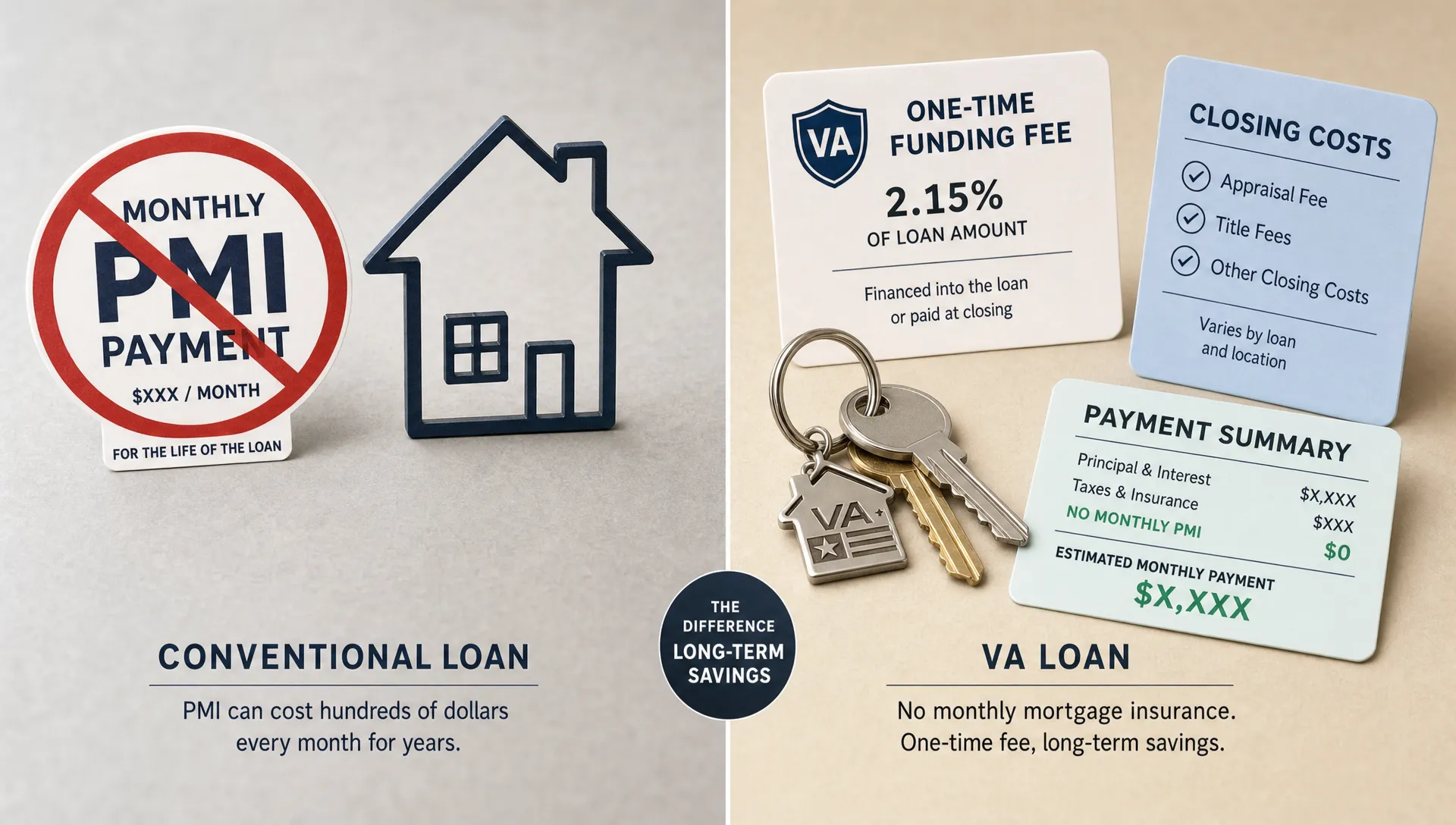
Here is the simple truth: VA loans do not require monthly private mortgage insurance, even when you buy with no down payment. But that does not mean VA loans have no costs, or that every mortgage insurance rumor is harmless. The key is knowing which myths to ignore and which numbers to review before you make an offer.
Below are the most common VA loan mortgage insurance myths buyers should stop believing, along with the practical facts that actually matter when comparing loan options.
Why the confusion around VA loan mortgage insurance exists
Mortgage insurance is easy to misunderstand because different loan programs use different terms.
On many conventional loans, private mortgage insurance, usually called PMI, may be required when a borrower puts less than 20% down. FHA loans have mortgage insurance premiums, often called MIP. USDA loans use guarantee fees. VA loans work differently because the Department of Veterans Affairs provides a guaranty to approved lenders, which helps eligible borrowers access favorable financing without monthly PMI.
The Consumer Financial Protection Bureau explains that private mortgage insurance protects the lender if a borrower stops making payments. It is not the same as homeowners insurance, and it does not protect the borrower’s personal property.
VA loans have their own cost structure, most notably the VA funding fee for many borrowers. That fee is often where the myths begin.
Myth 1: VA loans require PMI because you can buy with 0% down
This is one of the biggest misconceptions. Many buyers assume that any mortgage with less than 20% down must include PMI. That is often true for conventional loans, but it is not true for VA loans.
Eligible VA borrowers can often finance up to 100% of the home’s purchase price, subject to lender approval, VA appraisal requirements, entitlement, and property eligibility. Even with no down payment, the loan does not include monthly PMI.
That difference can matter for affordability. A conventional borrower with a small down payment may have a monthly PMI charge added to principal, interest, taxes, and homeowners insurance. A VA borrower may avoid that monthly PMI line item entirely.
For a deeper breakdown, New Era Lending’s guide on whether VA loans do not require private mortgage insurance explains how PMI differs from VA loan costs.
Myth 2: The VA funding fee is just PMI with a different name
The VA funding fee and PMI are not the same thing.
PMI is generally a monthly insurance cost paid by the borrower on certain conventional loans. It is tied to risk factors such as down payment, credit profile, loan type, and loan-to-value ratio. In many cases, PMI can later be canceled when enough equity is built, depending on the loan and payment history.
The VA funding fee is a one-time charge paid to the Department of Veterans Affairs on many VA loans. According to the VA’s official funding fee guidance, this fee helps lower the cost of the VA home loan program for taxpayers.
The funding fee can often be paid at closing or financed into the loan amount. If it is financed, it increases the loan balance and may increase total interest paid over time. That is very different from a recurring monthly PMI premium.
Myth 3: Every VA borrower pays the funding fee
Not every VA borrower pays it. Some borrowers are exempt from the VA funding fee.
Common exemption situations may include veterans receiving VA disability compensation for a service-connected disability, certain veterans eligible to receive compensation, eligible surviving spouses receiving Dependency and Indemnity Compensation, and some active-duty service members who have received a Purple Heart. Exact exemption rules can depend on documentation and VA confirmation.
This matters because a funding fee exemption can significantly affect the total cost comparison between a VA loan and other mortgage options. If you may qualify for an exemption, ask your lender to verify it early in the process rather than waiting until closing.
Myth 4: No monthly mortgage insurance means no closing costs
Avoiding monthly PMI is a major VA loan benefit, but it does not eliminate all costs.
A VA buyer may still need to plan for typical mortgage and home purchase expenses, such as lender fees, title charges, appraisal fees, escrow deposits, prepaid taxes, homeowners insurance, recording fees, and other allowed closing costs. Some costs may be negotiable, some may be paid by the seller within VA guidelines, and some may vary by state and property.
This is why a Loan Estimate matters. It shows the projected interest rate, APR, monthly payment, closing costs, and cash needed to close. When comparing loans, do not stop at the phrase “no PMI.” Look at the full cost picture.

Myth 5: VA loans are always cheaper than conventional loans
VA loans are often highly competitive, especially for eligible buyers who want to minimize upfront cash or avoid monthly PMI. But “often” is not the same as “always.”
The right answer depends on your credit profile, down payment, funding fee status, interest rate, how long you expect to keep the loan, seller credits, and whether you qualify for a funding fee exemption. A conventional loan with a large down payment and no PMI may be competitive for some borrowers. An FHA loan may make sense in a different scenario. A VA loan may be clearly stronger in another.
The smart move is to compare the full loan structure, not just one feature. Review:
- Monthly payment, including taxes and insurance
- Cash needed to close
- Interest rate and APR
- Funding fee or mortgage insurance costs
- Break-even timeline if refinancing is involved
- How long you expect to own the home
If you want a broader comparison, New Era Lending’s guide to PMI, FHA MIP, and VA options can help clarify how each program handles insurance and fees.
Myth 6: A down payment is pointless on a VA loan
Because VA loans may allow 0% down, some buyers assume a down payment never makes sense. That is not always true.
A down payment can reduce the loan amount, lower the monthly payment, reduce total interest over the life of the loan, and in some cases reduce the VA funding fee. It can also help if the purchase price is above the appraised value, since the VA guaranty is based on the lesser of the purchase price or appraised value.
That said, preserving cash can also be wise. Many buyers prefer to keep savings available for moving expenses, repairs, emergency reserves, furniture, or future maintenance. The best choice depends on your full financial picture.
The important point is that 0% down is a VA benefit, not a requirement. You can learn more about when cash down may or may not be needed in this guide to VA loan down payment rules.
Myth 7: Sellers reject VA offers because there is no mortgage insurance
Some buyers worry that a VA offer looks weaker because it has no PMI or may include no down payment. In reality, sellers usually care about whether the buyer is qualified, whether the offer price is strong, whether the timeline works, and whether the transaction is likely to close.
A well-prepared VA buyer can compete effectively. Strong preapproval, clear communication, reasonable contract terms, and an experienced loan team can help reduce seller concerns. VA appraisals and property requirements are real, but they are not the same as mortgage insurance, and they do not automatically make a VA offer weak.
The myth can become harmful when eligible buyers avoid using a benefit they earned because they assume sellers will not take them seriously. Instead, focus on presentation, documentation, and choosing professionals who understand VA financing.
Myth 8: You need to refinance later to “remove” VA mortgage insurance
With some loan types, borrowers later refinance or request cancellation to remove mortgage insurance. Since VA loans do not have monthly PMI, there is no monthly VA mortgage insurance to remove.
A refinance may still make sense for other reasons. For example, a borrower may refinance to seek a lower interest rate, change loan terms, access home equity, or move from one loan program to another. But the decision should not be based on removing a monthly VA mortgage insurance charge, because that charge does not exist.
If someone tells you that a VA loan is just a short-term stepping stone until you can refinance out of mortgage insurance, ask them to show the actual payment line item. In many cases, the myth disappears once the Loan Estimate is reviewed.
Myth 9: Mortgage insurance protects you if you cannot make payments
This myth applies to all loan types, not just VA loans. Mortgage insurance and loan guaranties protect the lender or program, not the borrower’s income, credit, or home equity.
If you are worried about job loss, disability, deployment-related financial changes, or unexpected expenses, ask about your broader risk-management options. That may include emergency savings, life insurance, disability coverage, budgeting, or speaking with your loan servicer as early as possible if hardship arises.
A VA loan can offer powerful benefits, but it is still a mortgage. Buyers should choose a payment they can sustain, not simply the largest loan amount they can qualify for.
Myth 10: The “no PMI” benefit is the only reason to use a VA loan
No monthly PMI is a major advantage, but it is not the only reason buyers consider VA financing.
VA loans may offer flexible down payment options, competitive rates, limits on certain fees, and refinancing options for eligible homeowners. They can be useful for first-time buyers, repeat buyers, and some homeowners looking to refinance or access equity, depending on eligibility and lender guidelines.
The bigger benefit is that VA financing can align with the way many military households actually buy homes: frequent moves, limited time to save a large down payment, and a need for a process that is clear and efficient.
How to evaluate VA loan costs without getting distracted by myths
The best way to ignore bad advice is to replace it with a simple review process. Before you commit to any mortgage option, ask your lender to walk you through the actual numbers in plain English.
Focus on these questions:
- Is there any monthly mortgage insurance on this loan?
- Is there a VA funding fee, and am I exempt?
- If there is a funding fee, am I paying it upfront or financing it?
- What is the total monthly payment, including taxes and insurance?
- How much cash do I need to close?
- What is the APR, not just the interest rate?
- How does this compare with a conventional or FHA option for my situation?
This approach keeps the conversation grounded in facts. It also helps you compare real loan scenarios instead of reacting to half-true statements from friends, online forums, or outdated advice.
Frequently Asked Questions
Do VA loans have mortgage insurance? VA loans do not require monthly private mortgage insurance, even with 0% down. Many borrowers pay a one-time VA funding fee instead, unless they qualify for an exemption.
Is the VA funding fee the same as PMI? No. PMI is usually a monthly cost on certain conventional loans. The VA funding fee is a one-time charge paid to the VA on many VA loans, and it can often be financed into the loan amount.
Can the VA funding fee be waived? Yes, some borrowers are exempt, including certain veterans with service-connected disability compensation and eligible surviving spouses. Your lender can help verify exemption status using VA documentation.
Does no PMI mean a VA loan has no extra costs? No. You may still have closing costs, prepaid expenses, taxes, homeowners insurance, and possibly a VA funding fee. Always review the full Loan Estimate.
Should I always choose a VA loan if I am eligible? Not automatically. VA loans are often a strong option, but the best mortgage depends on your goals, down payment, exemption status, credit profile, loan pricing, and how long you plan to keep the home.
Get clear on your VA loan costs before you shop
VA loan mortgage insurance myths can make home financing feel more confusing than it needs to be. The right lender should help you separate PMI, funding fees, closing costs, and monthly payment details so you can make a confident decision.
New Era Lending helps eligible buyers and homeowners explore personalized mortgage solutions with modern tools and human guidance. Whether you are purchasing, refinancing, or comparing VA financing with other loan options, getting a clear side-by-side cost review can help you move forward with confidence.