.jpg)
.jpg)





.jpg)


Do VA Loans Have Private Mortgage Insurance?

If you are eligible for a VA home loan, the short answer is simple: VA loans do not have private mortgage insurance, even with 0% down. That is one of the biggest reasons VA financing can be so powerful for qualified veterans, active-duty service members, certain National Guard and Reserve members, and eligible surviving spouses.
But “no PMI” does not mean “no loan costs.” VA loans use a different structure. Instead of monthly private mortgage insurance, most borrowers pay a VA funding fee, which can often be financed into the loan. Some borrowers are exempt from this fee entirely.
Understanding the difference matters because it affects your monthly payment, cash needed at closing, and how you compare a VA loan against conventional or FHA financing.
What Is Private Mortgage Insurance?
Private mortgage insurance, often called PMI, is typically associated with conventional loans when a borrower puts down less than 20%. PMI protects the lender if the borrower defaults. It does not protect the homeowner, pay the mortgage during hardship, or replace homeowners insurance.
For many conventional borrowers, PMI becomes part of the monthly mortgage payment. The cost varies based on factors such as credit score, loan amount, down payment, property type, and loan program. In many cases, PMI can eventually be removed once the borrower reaches enough equity, but it can still add a meaningful cost in the early years of homeownership.
VA loans work differently because they are backed by the U.S. Department of Veterans Affairs. The VA guaranty reduces risk for approved lenders, which is why eligible borrowers can often buy with no down payment and no monthly PMI.
For a broader comparison of how PMI, FHA mortgage insurance, and VA loan costs differ, New Era Lending’s guide to PMI vs FHA MIP vs VA options breaks down the major categories in plain language.
Do VA Loans Have PMI?
No. VA loans do not have PMI.
This is true whether you make a down payment or use the VA loan’s well-known 0% down benefit. Unlike a conventional mortgage, a VA loan does not add private mortgage insurance just because you finance more than 80% of the home’s value.
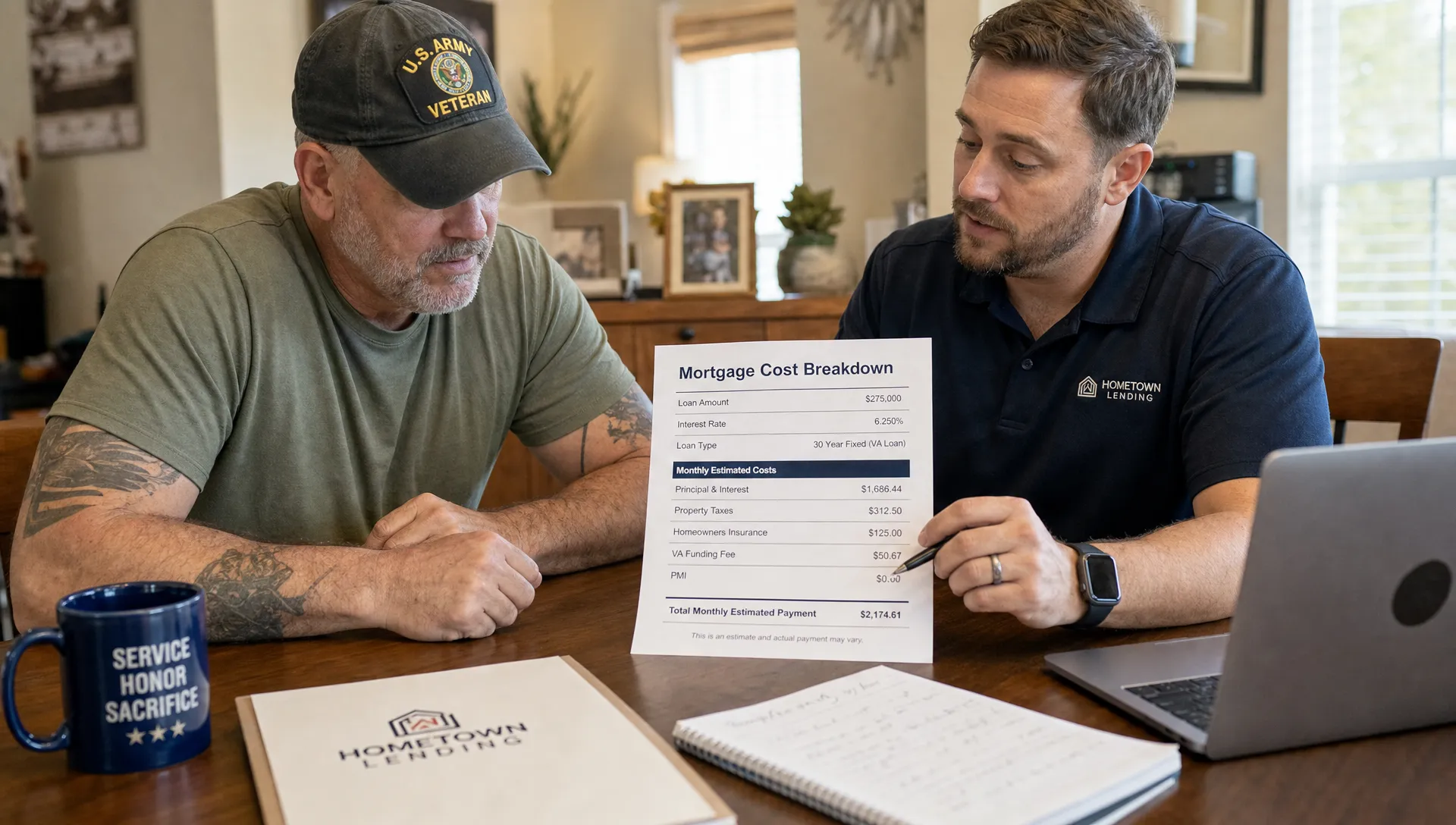
That can create a meaningful monthly-payment advantage. A conventional buyer with a small down payment may have principal, interest, taxes, homeowners insurance, and PMI in the payment. A VA buyer may have principal, interest, taxes, and homeowners insurance, but no monthly PMI.
The key reason is the VA guaranty. The Department of Veterans Affairs does not usually lend the money directly. Instead, private lenders originate VA loans, and the VA guarantees a portion of the loan if the borrower defaults. That guaranty helps lenders offer favorable terms without requiring private mortgage insurance.
What VA Loans Have Instead: The VA Funding Fee
Although there is no private mortgage insurance on VA loans, many borrowers pay a VA funding fee. This is a one-time fee paid to the Department of Veterans Affairs to help support the VA loan program.
According to the VA’s official guidance on funding fees and closing costs, the funding fee amount can depend on the loan type, whether it is your first use of the VA benefit, and your down payment amount.
For many purchase loans, the funding fee is higher when you put 0% down and lower when you make a down payment. Borrowers using the benefit again may also have a different fee than first-time VA users.
The funding fee is not the same as PMI for several reasons:
- PMI is typically a monthly cost on conventional loans, while the VA funding fee is usually a one-time charge.
- PMI is paid to a private mortgage insurance company, while the VA funding fee supports the VA home loan program.
- PMI may be cancelable after enough equity is built, while the VA funding fee is paid upfront or financed into the loan.
- Some VA borrowers are exempt from the funding fee, while conventional PMI exemptions depend on loan structure and equity.
Many VA borrowers choose to finance the funding fee into the mortgage instead of paying it in cash at closing. That can reduce upfront cost, but it also increases the loan balance and total interest paid over time.
Who Is Exempt From the VA Funding Fee?
Some eligible VA borrowers do not have to pay the VA funding fee. Common exemptions may include veterans receiving VA compensation for a service-connected disability, certain veterans who would be entitled to compensation if they were not receiving retirement or active-duty pay, and some surviving spouses.
The VA also recognizes certain other exemption situations, so it is important to verify your status through your Certificate of Eligibility and lender review. If your exemption status is not clear at the start of the process, your lender may need documentation before finalizing the fee.
This is one reason it helps to work with a mortgage team that understands VA guidelines. The difference between paying and not paying the funding fee can affect both your closing numbers and your long-term loan cost.
No PMI Does Not Mean No Insurance at All
One common misunderstanding is that “no mortgage insurance” means a VA borrower does not need any insurance. That is not correct.
VA loans do not require private mortgage insurance, but lenders generally still require homeowners insurance. If the property is in a designated flood zone, flood insurance may also be required. These policies protect the home and, in some cases, the lender’s collateral. They are separate from PMI.
You may also see other escrowed costs in your monthly payment, such as property taxes and homeowners insurance premiums. If you are comparing loan estimates, make sure you are comparing the full estimated monthly payment, not just principal and interest.
Why No PMI Can Make VA Loans More Affordable
PMI can add hundreds of dollars to a monthly payment depending on the borrower and loan size. Removing that cost can improve affordability and may help an eligible buyer qualify for a home with a more manageable payment.
The VA loan’s no-PMI structure can be especially helpful for buyers who have strong income but do not want to drain savings for a large down payment. It can also help preserve cash for moving expenses, emergency reserves, repairs, furniture, or future financial goals.
That said, the best loan is not always the one with the lowest upfront cost. You still need to evaluate interest rate, APR, closing costs, funding fee, monthly payment, and how long you expect to keep the home.
For eligible buyers weighing the full picture, this overview of the benefits of a VA mortgage loan explains why VA financing can be attractive beyond the no-PMI benefit.
Can You Avoid Both PMI and the VA Funding Fee?
Sometimes, yes. If you qualify for a VA funding fee exemption, you may be able to use a VA loan with no monthly PMI and no VA funding fee.
If you are not exempt, you still avoid PMI, but the funding fee may apply. A down payment can sometimes reduce the VA funding fee, but not every buyer wants or needs to put money down. The right choice depends on your savings, monthly-payment target, and long-term plan.
Here is a practical way to think about it: PMI affects the monthly payment on many conventional loans, while the VA funding fee affects upfront cost or the financed loan balance. Both matter, but they affect your budget differently.
VA Loans Are for Primary Residences, Not Vacation Homes
The no-PMI benefit is tied to the VA home loan program’s purpose: helping eligible borrowers purchase or refinance a primary residence. In most cases, you must certify that you intend to occupy the home as your primary residence within the required timeframe.
That means a VA loan generally is not the right financing tool for buying a vacation home, pure investment property, or short-term rental. If your goal is simply to enjoy a private getaway rather than purchase a primary residence, comparing curated luxury vacation rentals can be a better fit than trying to use VA benefits for a property that does not meet occupancy rules.
There are some nuanced situations, such as buying a multi-unit property and living in one unit, but occupancy requirements still matter. If your plans are unusual, discuss them early with your lender so you do not run into issues late in underwriting.
How VA No-PMI Rules Affect Your Down Payment Decision
Because VA loans do not require PMI, making a down payment is not necessary just to avoid mortgage insurance. That is a major difference from conventional loans, where 20% down is often the benchmark for avoiding PMI.
Still, a down payment can influence your VA loan in other ways. It may reduce the VA funding fee for non-exempt borrowers, lower the loan amount, reduce total interest, and potentially make the monthly payment more comfortable.
On the other hand, putting less down can help preserve cash. For many households, liquidity matters. A homeowner with savings available for emergencies may be in a stronger position than one who used nearly all available cash to reduce the loan balance.
If you are trying to decide whether to put money down, New Era Lending’s guide to VA loan down payment rules walks through when 0% down is possible and when extra cash may still be needed.
Questions to Ask When Comparing VA Loan Offers
Since you do not have to compare PMI costs on VA loans, focus on the loan terms that actually apply. A good Loan Estimate should help you review the full picture, but it is still worth asking direct questions.
Helpful questions include:
- Is the VA funding fee included, and am I exempt?
- If the funding fee applies, is it paid upfront or financed into the loan?
- What is the estimated total monthly payment including taxes and homeowners insurance?
- What lender fees and third-party closing costs are included?
- What is the interest rate, APR, and rate-lock period?
- Are discount points being charged to obtain the quoted rate?
These questions help you compare offers more accurately. A loan with no PMI can still have different costs depending on rate, fees, credits, and how the funding fee is handled.
Frequently Asked Questions
Do VA loans have private mortgage insurance? No. VA loans do not have private mortgage insurance. Eligible borrowers can often buy with 0% down and no monthly PMI because the loan is backed by the VA guaranty.
Is the VA funding fee the same as PMI? No. The VA funding fee is a one-time fee paid to support the VA loan program. PMI is private mortgage insurance typically charged monthly on conventional loans with less than 20% down.
Can the VA funding fee be removed later? The VA funding fee is not a monthly charge, so there is nothing to cancel later like PMI. It is paid upfront or financed into the loan. Some borrowers may be exempt from paying it.
Do disabled veterans pay PMI on VA loans? No VA borrower pays PMI on a VA loan. In addition, many veterans receiving VA disability compensation may be exempt from the VA funding fee.
Can I use a VA loan to avoid PMI on an investment property? Generally, no. VA loans are intended for primary residences, not pure investment properties or vacation homes. Occupancy rules are an important part of VA eligibility.
Get Clear on Your VA Loan Costs Before You Apply
A VA loan can be one of the most cost-effective paths to homeownership for eligible borrowers, especially because it does not require private mortgage insurance. But the full cost still depends on your funding fee status, interest rate, loan amount, taxes, insurance, and closing costs.
New Era Lending helps eligible buyers understand their VA loan options with modern tools, transparent guidance, and human support throughout the mortgage process. If you are comparing VA financing, refinancing, or other no-PMI mortgage options, connect with New Era Lending to review your next steps with confidence.