
.jpg)
.jpg)





.jpg)

How Your Monthly Payment Changes With a Mortgage
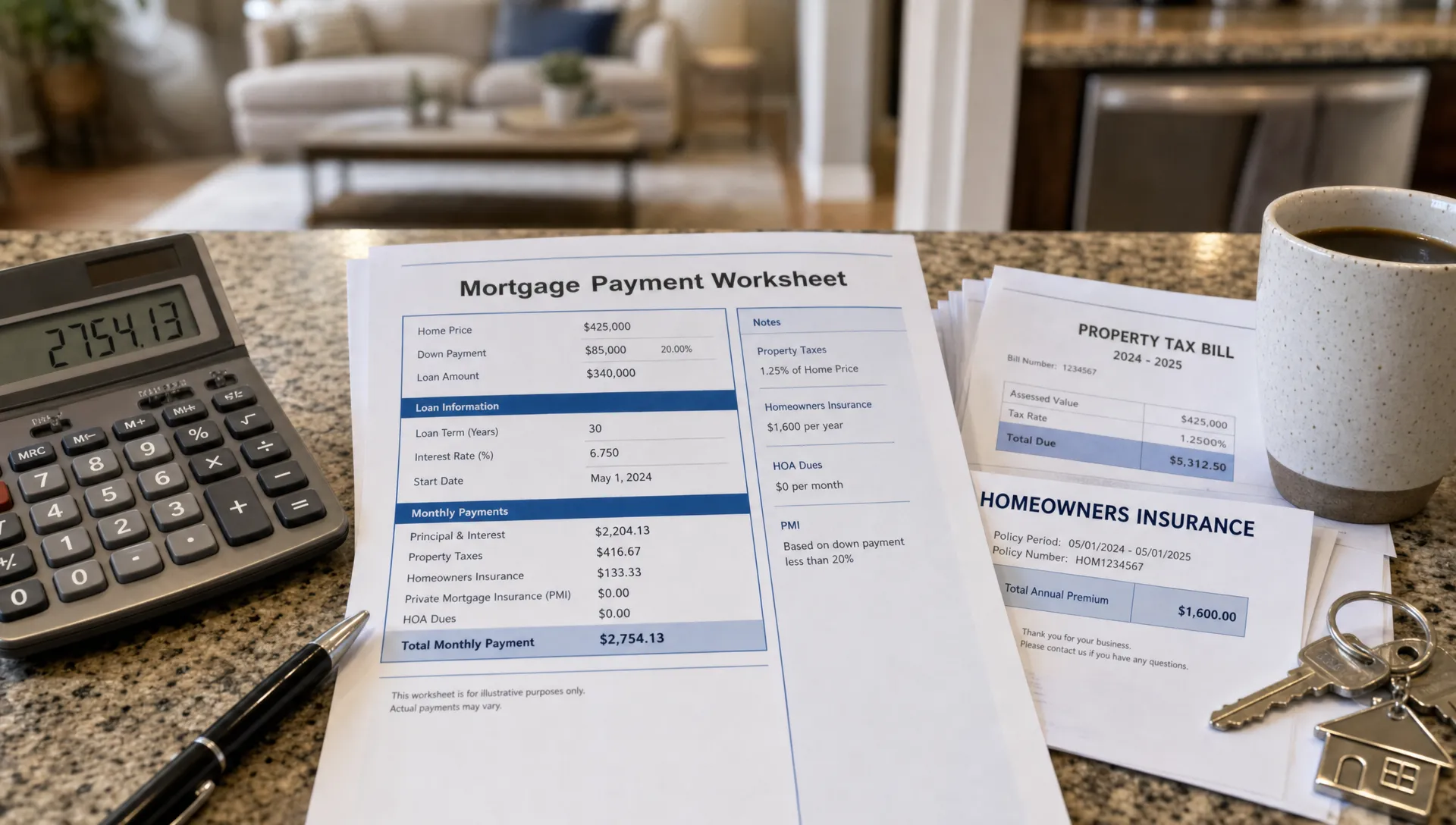
When you take out a mortgage, your monthly payment becomes the number that connects the home you want with the budget you live on every day. It is not just a loan calculation. It reflects the price of the home, how much you borrow, the interest rate, your loan term, taxes, insurance and sometimes mortgage insurance or HOA dues.
The part that surprises many buyers is how much that number can change before closing, and in some cases after closing. A small rate difference, a different down payment or an escrow adjustment can move the payment enough to affect comfort, cash flow and long-term affordability. Understanding those moving parts helps you compare loan options with more confidence instead of focusing only on the sale price.
How your monthly payment is built at the start
Most mortgage payments are made from several layers. Some are tied directly to the loan, while others are homeownership costs collected with the loan payment through an escrow account.
The core loan payment is principal and interest. Principal reduces the amount you owe. Interest is the cost of borrowing. In the early years of a standard amortizing mortgage, more of the payment goes toward interest. Over time, the balance shifts and more money goes toward principal.
Other costs can be included depending on the loan and property. The table below gives a quick view of common components.
| Payment component | What it covers | Can it change? |
|---|---|---|
| Principal | Repayment of the loan balance | Usually fixed within the amortization schedule |
| Interest | Cost of borrowing | Fixed on a fixed-rate loan, variable on an adjustable-rate loan |
| Property taxes | Local tax assessment on the property | Yes, often annually |
| Homeowners insurance | Protection for the home and liability | Yes, as premiums change |
| Mortgage insurance | Protection for the lender on certain loans | Yes, depending on loan type and equity |
| HOA dues | Community or condo association costs | Yes, based on association rules |
If you want a deeper step-by-step approach before applying, New Era Lending’s guide on how to estimate a mortgage payment before you apply can help you gather the right inputs.
The biggest factors that move the payment before closing
The payment you see in an early estimate can change as loan details become more specific. A preapproval, a purchase contract and final underwriting can each refine the numbers.
Loan amount and down payment
Every dollar you borrow can lift your monthly payment because the loan has to be repaid with interest over time. A larger down payment usually lowers the amount financed, which can reduce principal and interest and may also reduce or remove mortgage insurance.
For example, buying a $400,000 home with 5% down means financing about $380,000 before closing costs or other adjustments. With 20% down, the loan amount is about $320,000. That $60,000 difference can have a major impact on the monthly loan payment and the total interest paid over the life of the mortgage.
The down payment can also affect loan-to-value ratio, pricing and mortgage insurance. For a closer look at those tradeoffs, see New Era Lending’s article on how down payment size changes your home loan.
Interest rate
The interest rate is one of the most visible levers because it changes the cost of borrowing on the same loan amount. A higher rate can change your monthly payment even if the home price and down payment stay exactly the same.
Here is a simplified example using principal and interest only, before taxes, insurance, HOA dues or mortgage insurance:
| Scenario | Loan amount | Term | Interest rate | Approximate principal and interest |
|---|---|---|---|---|
| Lower-rate example | $350,000 | 30 years | 6.50% | $2,212 |
| Higher-rate example | $350,000 | 30 years | 7.00% | $2,329 |
| Shorter-term example | $350,000 | 15 years | 6.00% | $2,954 |
In this example, a half-point rate increase on a 30-year loan raises principal and interest by about $117 per month. The shorter 15-year option has a higher monthly cost but pays the loan off faster and usually reduces total interest over the full term.
Loan term and amortization
A 30-year mortgage spreads repayment over more months, which usually makes the monthly loan payment lower than a 15-year mortgage. The tradeoff is that interest has more time to accrue.
A 15-year mortgage often comes with a higher payment because the balance is repaid faster. Some borrowers choose it to build equity quickly, while others prefer a 30-year term for more monthly flexibility. The right fit depends on income stability, emergency savings, debt obligations and how long you expect to keep the home.
Amortization matters too. On a traditional fixed-rate loan, principal and interest are calculated so the loan is paid off at the end of the term if payments are made as scheduled. Extra principal payments can shorten the payoff timeline, but they do not automatically lower the required payment unless the loan is recast or refinanced.

What can change after you close
A fixed-rate mortgage keeps the principal and interest portion stable, but the full housing payment can still move if other components change. This is why two homeowners with similar loan amounts can have different monthly costs over time.
Escrow adjustments
If your lender collects property taxes and homeowners insurance through escrow, the lender estimates those costs and divides them across monthly payments. When taxes or insurance premiums increase, the escrow portion can rise. If the escrow account has a shortage, the lender may spread the shortage across future payments or offer options to pay it separately.
That means your monthly payment can change even when the mortgage rate itself is fixed. This is often confusing because borrowers think “fixed-rate” means the entire housing payment will never move. In reality, fixed-rate usually refers to the interest rate and principal-and-interest schedule, not taxes or insurance.
For more detail on this post-closing side of the process, New Era Lending explains what really changes your home payment over time.
Insurance and taxes
Property taxes can change when local budgets shift, assessed values rise or exemptions change. Homeowners insurance can move because of replacement costs, claim history, location risk, coverage limits and insurer pricing.
The Consumer Financial Protection Bureau notes that borrowers should review mortgage disclosures and compare loan terms carefully. The Loan Estimate is especially useful because it separates loan costs, projected payments and estimated cash to close.
Reviewing these items early can prevent budget shock. A low principal-and-interest payment may still feel tight if property taxes are high, insurance is rising or HOA dues apply.
Mortgage insurance changes
Mortgage insurance can be required on conventional loans with less than 20% down, and government-backed loans may have their own mortgage insurance or funding fee structures. The rules vary by loan type.
In some cases, mortgage insurance may eventually be removed or reduced. In others, it may last for the life of the loan unless you refinance into a different structure. Since the rules are specific, ask your loan professional how mortgage insurance works for the loan option you are considering.
How to compare mortgage options without getting misled
Looking at the lowest possible payment can be tempting, but it is not always the same as choosing the strongest loan. A mortgage with a slightly lower payment could come with higher closing costs, longer repayment, a different rate structure or tradeoffs that matter later.
When comparing loans, focus on the full picture:
- Principal and interest
- Estimated taxes and insurance
- Mortgage insurance, if any
- HOA dues, if any
- Closing costs and lender credits
- Rate type, such as fixed or adjustable
- How long you expect to keep the home
A good comparison uses the same assumptions for each option. If one quote includes taxes and insurance but another shows principal and interest only, the lower number may not be a fair comparison. Ask for clarification when a quote seems unusually low.
It also helps to test a few scenarios. Look at the payment at your target price, then model what happens if the rate changes, the down payment changes or insurance comes in higher than expected. This gives you a more realistic budget range instead of a single fragile estimate.
Ways to keep the payment manageable
You cannot control every factor, but you can control how you prepare. Start with a comfortable budget before shopping at the top of your approval range. Approval tells you what may be possible. Your household budget tells you what is sustainable.
Common ways to manage the payment include increasing the down payment, buying at a lower price point, comparing loan programs, improving credit before applying, paying discount points when appropriate or choosing a longer term for flexibility. Each option has tradeoffs, so the goal is not just to lower the payment. It is to lower risk while supporting your financial goals.
Refinancing may also become useful later if rates, equity or financial goals change. If you already own a home and want to explore safe options, New Era Lending’s guide on how to lower your monthly mortgage payment safely covers several paths to consider.
Frequently Asked Questions
Can your monthly payment change with a fixed-rate mortgage? Yes. The principal and interest portion usually stays the same on a fixed-rate mortgage, but escrow items such as property taxes and homeowners insurance can change.
Why did my mortgage estimate change before closing? Estimates can change because the final loan amount, rate lock, property taxes, insurance premium, HOA dues, mortgage insurance or closing cost structure changed.
Does a bigger down payment always lower the payment? Usually, because it reduces the loan amount. It may also reduce mortgage insurance, but the exact effect depends on loan type, credit profile and pricing.
Is principal and interest the same as the full mortgage payment? No. Principal and interest are only part of the payment. The full monthly cost may also include taxes, insurance, mortgage insurance and HOA dues.
Should I choose the loan with the lowest payment? Not automatically. Compare the full loan terms, total costs, rate type and long-term goals before deciding. A slightly higher payment may sometimes come with better overall terms.
Get a clearer mortgage number before you commit
The best mortgage decision starts with a payment you understand, not just a price you like. New Era Lending combines smart technology with personalized human guidance to help borrowers explore purchase, refinance and equity access options across 39 states.
If you want help comparing scenarios, reviewing loan choices or understanding how a mortgage fits your budget, visit New Era Lending and start with guidance built around your goals.