.jpg)
.jpg)





.jpg)


Mortgage Term Loan: How Length Changes Your Costs
The length of a mortgage term loan affects more than your monthly payment. It determines how quickly you repay the balance, how much interest you pay and how much room remains in your household budget. A shorter term usually means a higher required payment but lower lifetime interest. A longer term usually offers more monthly flexibility at a higher total borrowing cost.
The right comparison has two parts: what the loan costs if you keep it until payoff and what it costs over the years you actually expect to own the home. Those answers can point toward different choices.
How a mortgage term loan changes your costs
A mortgage’s term is its scheduled repayment period. Common options include 15, 20 and 30 years, although availability depends on the lender and loan program.
For a fully amortizing, fixed-rate mortgage, the scheduled principal-and-interest payment stays the same throughout the term. Each payment covers the interest due and reduces the loan balance. Early payments contain more interest because the outstanding balance is larger.
A shorter term requires faster principal repayment. That raises the monthly payment but leaves less time for interest to accumulate. A longer term spreads repayment across more months, reducing the required payment while keeping more debt outstanding longer.
The examples below assume full amortization, not an interest-only period or balloon payment.
Compare identical loan amounts and interest rates
To isolate the effect of mortgage term loan length, consider a $300,000 balance at a fixed 6% interest rate across three repayment periods.
| Loan term | Monthly principal and interest | Total interest through scheduled payoff | Total principal and interest paid |
|---|---|---|---|
| 15 years | $2,532 | $155,683 | $455,683 |
| 20 years | $2,149 | $215,830 | $515,830 |
| 30 years | $1,799 | $347,515 | $647,515 |
These are hypothetical calculations, not current rates or loan offers. Figures are rounded to the nearest dollar, with totals calculated from unrounded payments. They exclude closing costs, property taxes, homeowners insurance, mortgage insurance and other ownership expenses.
In this example, the 15-year option requires approximately $733 more each month than the 30-year option. Keeping both loans through their scheduled payoff dates would make the shorter term about $192,000 cheaper in interest.
The 20-year option sits between them: roughly $351 more per month than the 30-year loan, with substantially less lifetime interest.
Actual rate quotes can change the comparison
Shorter-term mortgages often have lower interest rates than longer-term mortgages, but that is not guaranteed for every borrower or program. The same-rate table isolates term length; it does not predict the offers you will receive.
When comparing a mortgage term loan with another option, use the actual rate, closing costs and discount points quoted for each. A lower advertised rate may require more cash upfront, which matters if you expect to sell or refinance before those costs are recovered.
Compare Loan Estimates prepared on similar dates using the same loan amount and property assumptions. Otherwise, you may attribute savings to the term when part of the difference comes from pricing or fees.
Why your five-year cost may matter more than lifetime interest
Lifetime interest is useful, but it assumes you keep the loan until its scheduled payoff. If you expect to move in five years, compare the payments made, interest paid and remaining balance at that point.
Using the same $300,000 loan and 6% rate, here is the approximate position after 60 scheduled payments:
| Loan term | Principal repaid after five years | Interest paid during five years | Remaining loan balance |
|---|---|---|---|
| 15 years | $72,000 | $79,900 | $228,000 |
| 20 years | $45,300 | $83,700 | $254,700 |
| 30 years | $20,800 | $87,100 | $279,200 |
Figures are independently rounded to the nearest $100. No extra payments, fees or changes in property value are assumed.
Over these five years, the 15-year borrower makes about $44,000 more in payments than the 30-year borrower. But that produces roughly $51,100 more principal reduction and about $7,200 less interest paid.
For a mortgage term loan you expect to keep only a few years, compare interest and fees separately from principal repayment. Principal payments reduce debt rather than disappearing as borrowing costs. However, money paid into the home is less accessible than cash in a savings account.
A lower balance can increase your proceeds when selling, assuming the same sale price and selling costs. It does not protect you from a decline in the home’s value.
Choose a required payment your budget can sustain
The cheapest loan over its full life is not necessarily the most workable loan month to month. A higher required payment can become difficult after a job change, parental leave or an unexpected repair.
Start with your complete housing budget, not just the principal-and-interest figures in the tables. Property taxes, homeowners insurance, mortgage insurance and association dues can materially change affordability. Some of these expenses can rise even when your interest rate is fixed.
New Era Lending’s explanation of how mortgage payments are built and why they change helps separate the loan payment from the broader cost of ownership.
Before choosing a shorter mortgage term loan, test whether the higher payment leaves enough room for:
- Emergency savings and foreseeable home repairs.
- Existing debt payments and essential household expenses.
- Retirement saving and other long-term priorities.
- Income fluctuations, particularly for self-employed or commission-based borrowers.
Lender approval answers whether you meet underwriting requirements. Your budget answers whether the payment is comfortable. A shorter term can also affect qualification because its higher payment increases the monthly debt obligations used in underwriting.
Can a longer term plus extra payments give you flexibility?
A longer loan term generally creates a lower required payment. You can then choose to pay extra principal when your budget allows, subject to the loan’s terms and servicing procedures.
In the same-rate example, paying approximately $2,532 each month toward the 30-year loan instead of its required $1,799 would produce a payoff schedule close to the 15-year loan. That assumes you start immediately, consistently pay the extra amount and have it applied to principal.
A longer mortgage term loan with extra payments can preserve flexibility because you may be able to return to the lower required payment when cash flow tightens. The trade-off is that optional payments require follow-through, and the longer-term loan may carry a higher rate than an actual shorter-term offer.
Confirm how your servicer handles extra payments and whether the loan has a prepayment penalty. Extra principal generally shortens repayment and reduces interest; it does not automatically lower the required monthly payment.
For practical ways to structure additional payments, see New Era Lending’s guide to shortening your loan term without straining your budget.

Refinancing can lower the payment while extending repayment
Term length deserves another look when refinancing. A new 30-year loan does not continue the original loan’s countdown; it starts a new repayment schedule.
For example, refinancing a 30-year mortgage after five years into another 30-year mortgage extends the scheduled repayment period by five years compared with keeping the original loan. The payment may fall because of a lower rate, a longer term or both.
When replacing a mortgage term loan, compare the new offer against the remaining term of your existing loan, not just its original length. Review the interest you would pay from today forward under each option, along with closing costs and any increase in the balance from financed fees.
A lower rate can offset some or all of the cost of extending repayment. A shorter refinance can reduce interest but increase the payment. Neither outcome should be assumed without running the numbers.
Also compare a payoff date aligned with your current schedule, if that term is available, or calculate what happens if you maintain your existing payment after refinancing.
How to compare offers before choosing a term
Use both lifetime figures and your expected ownership period
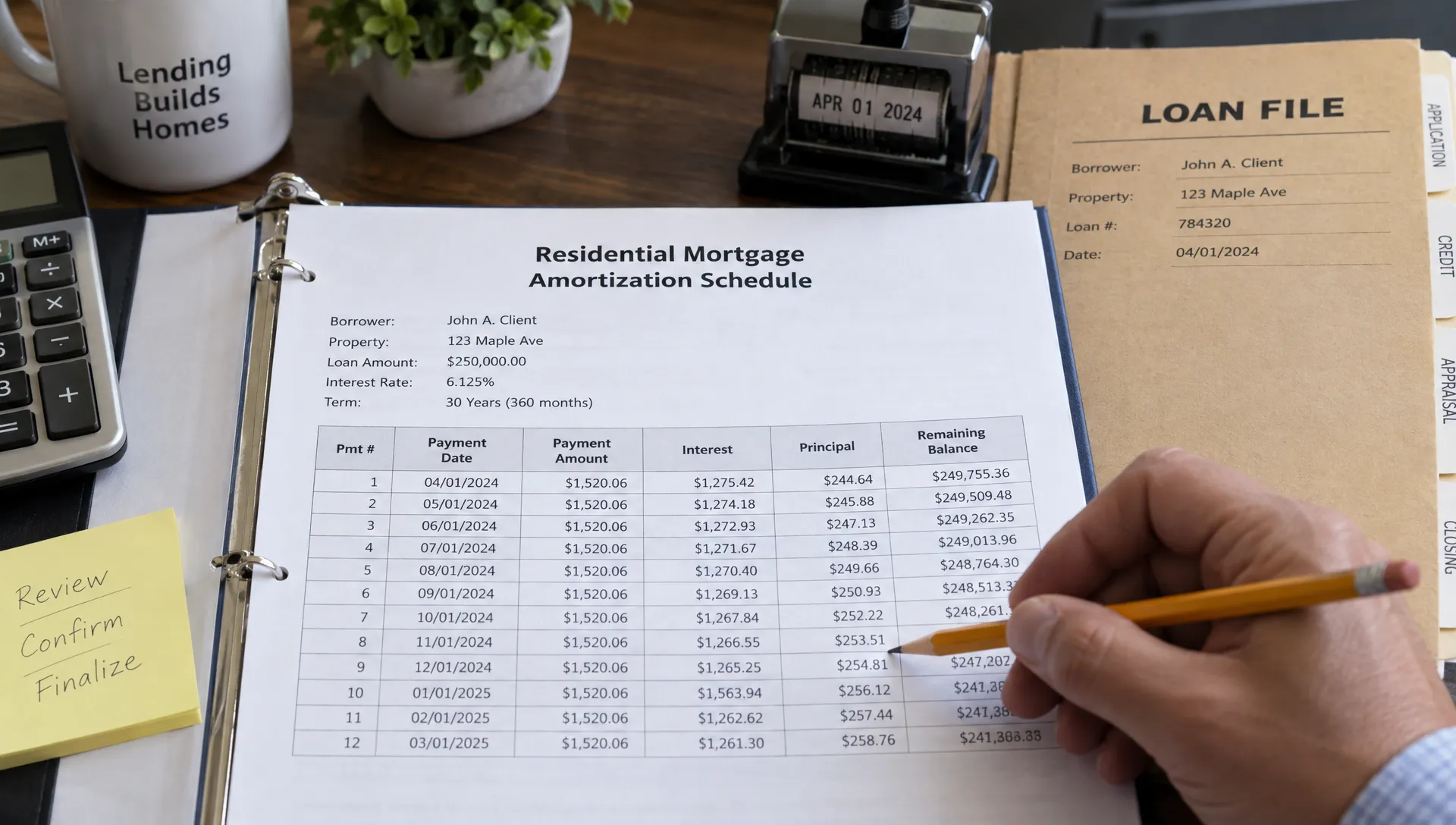
Ask for an amortization schedule for each option. It shows how much of each payment goes toward principal and interest, plus the remaining balance over time.
The Consumer Financial Protection Bureau’s guide to the Loan Estimate explains where to find the monthly payment, closing costs and comparison figures. The document’s “In 5 years” figures help distinguish total payments and loan costs from principal paid down.
For each mortgage term loan offer, compare the required payment, upfront costs, interest over your expected holding period and balance at that period’s end. Also check whether the rate can change and whether a balloon payment or prepayment penalty applies.
APR can help assess borrowing costs because it incorporates the interest rate and certain fees. But it does not tell you whether a payment fits your budget, and it is not a substitute for comparing different repayment periods dollar for dollar.
Keep the application process practical and secure
Collecting consistent documents makes it easier to compare options without repeated delays. Keep the income records, asset statements and other documents your lender requests organized, and use the lender’s approved secure upload process.
If an unreliable computer is interrupting paperwork, resolve the device problem before submitting sensitive files. Levix’s laptop repair and maintenance services, based in the Netherlands, are an example of specialist technical support; borrowers elsewhere can seek comparable local help. Protect financial files before handing a device to any repair provider.
Technical support and mortgage guidance serve different purposes. Your lender should explain the loan options and provide official disclosures, while a repair provider addresses device issues.
Frequently asked questions
Is a 15-year mortgage always better than a 30-year mortgage? No. A 15-year loan usually reduces lifetime interest and builds equity faster, but its higher required payment can limit savings or make your budget less resilient. Compare actual offers and household cash flow before choosing.
Does a longer term always mean a lower payment? With the same loan amount, interest rate and fully amortizing payment structure, a longer term lowers the monthly principal-and-interest payment. Actual offers may have different rates, fees or mortgage insurance costs, so compare the complete payment.
Can I change the term without refinancing? Extra principal payments can shorten the effective repayment period of a mortgage term loan without replacing it. Changing the contractual term generally requires refinancing or an approved modification. A recast, when available, typically adjusts the payment after a substantial principal reduction rather than changing the remaining term.
Do I lose the interest savings if I sell early? You can still save interest before selling, but the difference is smaller than the lifetime figures suggest. Compare interest paid, upfront fees and remaining balances at your expected sale date. Faster principal repayment may also leave you with more equity, depending on the property’s value.
Compare terms around your goals
Choose a term by balancing three figures: the payment you can sustain, the borrowing cost over your expected ownership period and the balance you want remaining at that point.
New Era Lending combines technology-driven mortgage tools with personalized human guidance. Ask which terms are available for your loan program and request a side-by-side comparison using the same loan amount. That gives you a clearer basis for choosing between faster repayment and greater monthly flexibility.