









How to Apply for New Mortgage Loans With a Credit Freeze

A credit freeze does not mean you have to put your homebuying plans on hold. You can apply for new mortgage loans while your credit is frozen, but you will usually need to temporarily lift the freeze before a lender can obtain the reports required to evaluate your application.
The safest approach is to coordinate a limited access window with your loan officer, lift the freeze separately at each required credit bureau and confirm when protection resumes. You do not need to remove your freeze permanently. Here is how to keep the application moving without leaving your credit files unnecessarily exposed.
What a credit freeze changes, and what it does not
A security freeze restricts access to your credit report, making it harder for someone to open a fraudulent account in your name. Placing or lifting a freeze is free, and the freeze itself does not lower your credit score. The Federal Trade Commission’s guidance on credit freezes explains these protections and how they differ from fraud alerts.
A freeze does not erase your credit history, hide existing debts from underwriting or improve your eligibility. You still need to meet the lender’s requirements for income, assets, credit and the property securing the loan.
Also distinguish a security freeze from a credit lock. A lock is a bureau-provided product governed by its terms. A fraud alert, meanwhile, tells creditors to take additional identity-verification steps rather than broadly restricting report access. Ask which protection is active before trying to change it.
Prequalification versus preapproval for new mortgage loans
You can usually discuss financing, estimate a budget and begin gathering documents before lifting a freeze. What you can obtain beyond that depends on how the lender evaluates borrowers.
| Application stage | What it generally means | How a freeze may matter |
|---|---|---|
| Prequalification | An initial estimate based on information you provide, sometimes with a credit check | A discussion may proceed without access, but a credit-based assessment may require a lift |
| Preapproval | A more detailed review of credit and financial information | Required reports generally must be accessible |
| Final loan approval or commitment | An underwriting decision subject to the lender’s stated conditions | Further credit review may be required before closing or funding |
These labels are not used identically by every lender. Ask what has actually been verified and what conditions remain.
A soft inquiry is not a guaranteed workaround for a freeze. Whether a particular credit request can proceed depends on the access rules and the lender’s process. Confirm the requirement rather than assuming that “no hard pull” means “no thaw needed.”
Step 1: Coordinate with your loan officer before a credit check
Tell your loan officer about the freeze before authorizing a report request. If you are applying with another borrower, disclose whether either person has frozen or locked credit files.
Ask which bureaus the lender and its credit-report provider need to access, when the request will occur and whether another review is expected later. Requirements can vary by lender and loan program, so do not assume that one bureau is enough or that every lender follows the same process.
For new mortgage loans, a short coordination conversation can prevent a failed report request from becoming an avoidable application delay. Confirm how the lender wants you to report a successful lift, too.
Your credit-access plan is only one part of the application. New Era Lending’s guide to applying for a mortgage loan explains the broader preparation process, including financial documents and lender comparisons.
Never give a loan officer your credit bureau password or authentication codes. You should manage the freeze directly through each bureau’s official channels.
Step 2: Review your reports and check each borrower’s access
Before scheduling the lender’s credit request, review your reports for unfamiliar accounts, incorrect balances or identity information that does not belong to you. You can request your reports through AnnualCreditReport.com, the federally authorized source. A freeze does not prevent you from accessing your own reports.
Check your ability to sign in to each bureau account while you still have time to resolve problems. An old email address, changed phone number or forgotten login can turn a simple lift into an identity-verification task.
When two people apply for new mortgage loans together, each borrower must manage their own frozen files. Lifting your freeze does not change your spouse’s or co-borrower’s settings.
If you find suspected identity theft, address it before treating the application as routine. Tell the loan officer that information may be fraudulent and keep records of your reports and disputes. A temporary lift gives the lender access; it does not correct inaccurate information or establish that a disputed account is yours.
Step 3: Temporarily lift the freeze at each required bureau
A freeze at one nationwide bureau does not automatically freeze or unfreeze your files at the others. Contact each bureau the lender needs separately.
Use the bureaus’ official freeze pages rather than a link in an unsolicited text or email:
| Credit bureau | Official place to manage a freeze | What to confirm |
|---|---|---|
| Equifax | Equifax security freeze services | The file’s current status and your selected lift dates |
| Experian | Experian Security Freeze Center | Successful identity verification and lift confirmation |
| TransUnion | TransUnion credit freeze services | The access window and when protection resumes |
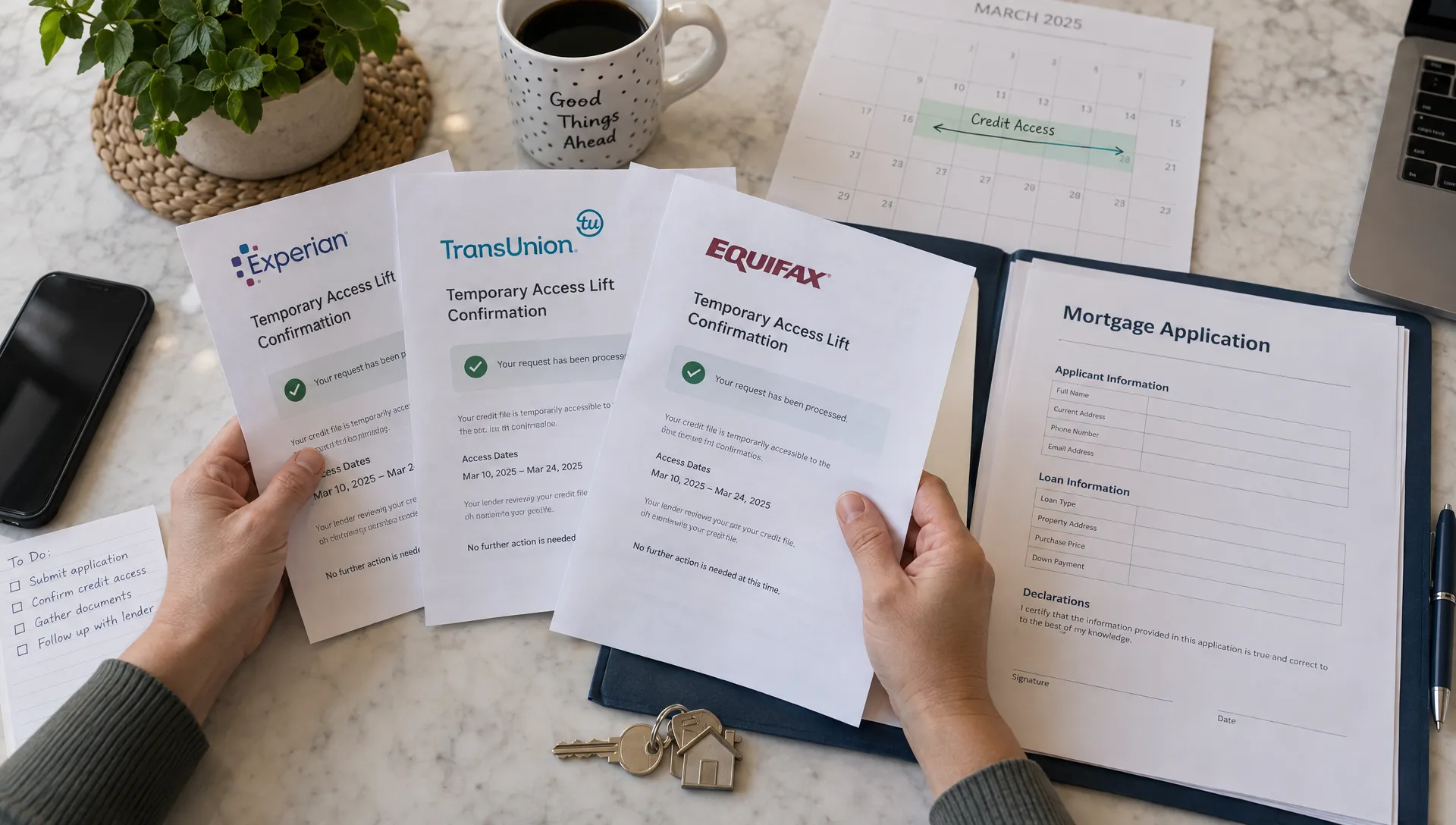
Choose a temporary, date-limited lift when that fits your lender’s schedule. A temporary lift preserves your ability to restore protection without keeping the file open indefinitely. Check the confirmation carefully, including any displayed expiration time.
When applying for new mortgage loans, allow enough access time for the lender’s actual workflow, not just the moment you submit the online application. A request may be processed by a separate credit-report provider or need to be retried after an error.
Save the confirmation from each bureau. Keep these records private and share only the status information your lender needs, using its secure communication process.
Step 4: Allow for processing time and confirm the report was obtained
For a properly authenticated request, federal rules require a credit bureau to lift a freeze within one hour when requested online or by telephone. For a mailed request, the deadline is within three business days after receipt.
Those deadlines do not mean every mortgage credit check will finish within an hour. Account recovery, identity-verification problems and the lender’s processing schedule can still add time. Avoid scheduling your first attempt immediately before a financing deadline.
Once the required bureaus show the lift as active, notify your loan officer and ask for confirmation after the reports have been obtained. A bureau confirmation shows that you changed access settings; it does not prove that the lender successfully retrieved everything it needs.
Applicants for new mortgage loans should also ask whether an unsuccessful request needs to be manually resubmitted. Do not assume a lender’s system will automatically retry when the freeze comes off.
Keep a simple record of the bureau, lift dates, confirmation and lender acknowledgment. This is especially useful when co-borrowers have different access windows or you are comparing more than one lender.
Step 5: Plan for later credit reviews before refreezing
The first successful credit check may not be the last. Depending on the lender’s requirements, report age and application timeline, another report or credit review may be needed before closing or funding.
Some access is permitted despite a freeze, including certain reviews by existing creditors. However, you should not assume that an exception covers every lender, vendor or later mortgage check. Ask your loan officer whether your files need to remain accessible and, if so, for how long.
You have two practical choices: keep a limited window open for the agreed period or restore the freeze and arrange another temporary lift if needed. The right choice depends on the schedule and your security concerns, not a universal rule that credit must remain unfrozen throughout the transaction.
If a delay threatens a purchase deadline or rate-lock expiration, contact your loan officer promptly. New Era Lending’s explanation of when to lock a mortgage rate can help you understand why the timing matters. Any extension availability and cost depend on your lock agreement and lender policies.
After the lender confirms that necessary checks are complete, verify that the freeze has resumed at every bureau where you lifted it.
What to do if the lender still cannot access your credit
A failed credit request does not automatically mean your application has been denied. First, ask the lender for the exact error and which borrower or bureau is affected. Then match the problem to the appropriate fix.
- One file remains frozen: Check every required bureau separately, including each co-borrower’s files.
- The window has not started or has expired: Review the effective dates and times in the bureau’s confirmation.
- A credit lock is still active: Check whether you changed a freeze while a separate lock restriction remains.
- Identity information does not match: Review the name, address, birth date and other identifying details with the bureau and lender through secure channels.
- The original request was not retried: Ask the lender whether its credit-report provider needs a new submission.
For new mortgage loans, repeatedly changing freeze settings without identifying the error can create more confusion. Resolve the specific issue, confirm the new status and have the lender retry when access is ready.
If an unfamiliar company contacts you about “fixing” the freeze, verify the request independently. There is no bureau fee to lift a security freeze. Avoid sending your Social Security number, passwords or authentication codes in response to an unexpected message.
Keep credit access separate from loan eligibility and cost
Lifting a freeze solves an access problem, not an underwriting problem. Conventional, FHA, VA, USDA and jumbo financing have different eligibility rules, and available options depend on your circumstances, property and location. A freeze alone does not tell you which program fits.
Continue protecting your financial profile while the application is underway. Avoid taking on unnecessary debt, missing payments or making major unexplained transfers. Discuss employment changes, large purchases and unusual deposits with your loan officer before acting when possible.
When comparing new mortgage loans, use the same loan amount, term and rate-lock assumptions wherever possible. Review the interest rate alongside lender fees, discount points, mortgage insurance, cash to close and the full estimated monthly payment, including taxes and insurance. For an adjustable-rate mortgage, consider future adjustment terms rather than just the initial payment.
The Consumer Financial Protection Bureau’s Loan Estimate explainer identifies where to find key costs and loan terms. Treat a preliminary quote differently from a Loan Estimate based on your application information.
Finally, separate the effects of the freeze from the effects of a credit inquiry. Lifting the freeze does not lower your score. A lender’s hard inquiry may affect it. Mortgage rate-shopping inquiries may be grouped for scoring, with the applicable window depending on the scoring model, so keep comparisons reasonably close together.
Example: Coordinating a temporary lift with a co-borrower
Suppose you and a co-borrower plan to authorize a mortgage credit check on Thursday. Both of you have freezes, but one person has not signed in to a bureau account for several years.
Early in the week, you confirm the lender’s required bureaus and expected request date. Each borrower checks account access, resolves any login problems and schedules a temporary lift covering the agreed period. On Thursday, you tell the loan officer the lifts are active and request confirmation when the reports are retrieved.
This approach helps applications for new mortgage loans avoid a common mistake: assuming one borrower’s successful lift makes the entire joint application ready.
Before the access windows end, ask whether another review is expected. Extend access only if needed or let the freezes resume and coordinate a later lift. These dates are an illustration, not a required waiting period or guaranteed processing schedule.
Frequently asked questions
Can I submit a mortgage application without lifting my credit freeze? Usually, yes. You can provide application information and documents, but a lender generally needs access to required credit reports to complete its evaluation. Submission is not the same as preapproval or final approval.
Do I have to lift freezes at all three credit bureaus? Ask your lender which reports it requires. Each bureau maintains its own freeze, so lifting one does not change the others. Every co-borrower must also manage access to their own files.
Does temporarily unfreezing my credit hurt my score? No. The freeze or lift itself does not affect your score. A hard inquiry associated with a credit application is a separate event and may have an effect.
Can I refinance with my current mortgage company while frozen? Do not assume existing-customer status eliminates the need for a lift. Although some existing-creditor access is permitted, a refinance application may require reports that cannot be obtained under that exception. Confirm the company’s process.
Does a freeze cause an automatic mortgage denial? No. For new mortgage loans, inaccessible reports may prevent the lender from completing its review, but a freeze is not itself a negative credit-history item. Respond promptly to access requests and any application deadlines.
Coordinate your application before lifting the freeze
Before changing your settings, confirm three things with your loan officer: which bureaus need access, when the reports will be requested and whether another review is likely before funding.
New Era Lending combines a technology-driven mortgage process with personalized human guidance. Discuss your purchase or refinance plans and explain that your credit is frozen so the access window can be coordinated with your application. Keep control of your bureau accounts, document each lift and verify that protection resumes when access is no longer needed.