









How to Calculate the Monthly Payment for an Interest-Only Home Loan

Calculating the monthly payment for home loan options with an interest-only period starts with a simple formula: outstanding loan balance × annual interest rate ÷ 12. For example, a $400,000 balance at 6.5% produces an interest-only payment of $2,166.67 per month, before taxes, insurance and other housing costs.
That starting payment is only part of the decision. You also need to know how long the interest-only period lasts, whether the rate can change and what payment becomes due when principal repayment begins. The steps below show how to calculate each part using hypothetical figures, not current rate quotes.
What an interest-only mortgage payment covers
During an interest-only period, your required loan payment covers interest without paying down the amount borrowed. If you make only the required payments on a $400,000 loan, the principal generally remains $400,000.
This differs from a fully amortizing mortgage, where each scheduled payment includes both principal and interest. Paying all interest due on time does not itself increase the balance, but it also does not reduce it.
The interest-only period is not necessarily the entire loan term. A mortgage might have a 30-year term with interest-only payments for the first 10 years, followed by principal-and-interest payments over the remaining 20 years. Other contracts can require a balloon payment, meaning a large remaining balance becomes due at a specified date.
Your loan documents determine the actual structure. Do not assume you can continue making interest-only payments indefinitely or refinance when that period ends.
Calculate the monthly payment for home loan options with interest-only terms
For a standard monthly estimate, use:
Monthly interest-only payment = outstanding principal × (annual note rate ÷ 12)
Convert the interest rate to a decimal before multiplying. For example, 6.5% becomes 0.065.
Start with the loan amount, not the home's purchase price. A $500,000 purchase with a $100,000 down payment produces a $400,000 loan before any financed costs or other adjustments. On an existing mortgage, use the current outstanding principal.
Use the contractual interest rate, sometimes called the note rate, rather than the annual percentage rate, or APR. APR is a borrowing-cost comparison measure, not the rate used to calculate your scheduled monthly interest charge.
This formula assumes equal monthly interest periods. A loan that accrues interest daily may produce different charges depending on the number of days and the contract's calculation method. An irregular first payment can also differ from the standard estimate.
Worked example: $400,000 at 6.5%
To estimate the monthly payment for home loan interest in this example, the calculation is:
$400,000 × 0.065 ÷ 12 = $2,166.67
The same calculation works for different balances or rates:
| Outstanding balance | Hypothetical annual rate | Monthly interest-only payment |
|---|---|---|
| $300,000 | 6.5% | $1,625.00 |
| $400,000 | 6.5% | $2,166.67 |
| $500,000 | 6.5% | $2,708.33 |
These are interest charges only. They exclude property taxes, insurance, association dues and any other required costs.
If the $400,000 balance and 6.5% rate stayed unchanged for 10 years, you would pay $260,000 in interest during that period. You would still owe $400,000 unless you made additional principal payments.
Add taxes, insurance and other housing costs
An interest-only calculation is not an all-in housing budget. When comparing the monthly payment for home loan offers, separate the loan's interest charge from escrow payments and costs you pay directly.
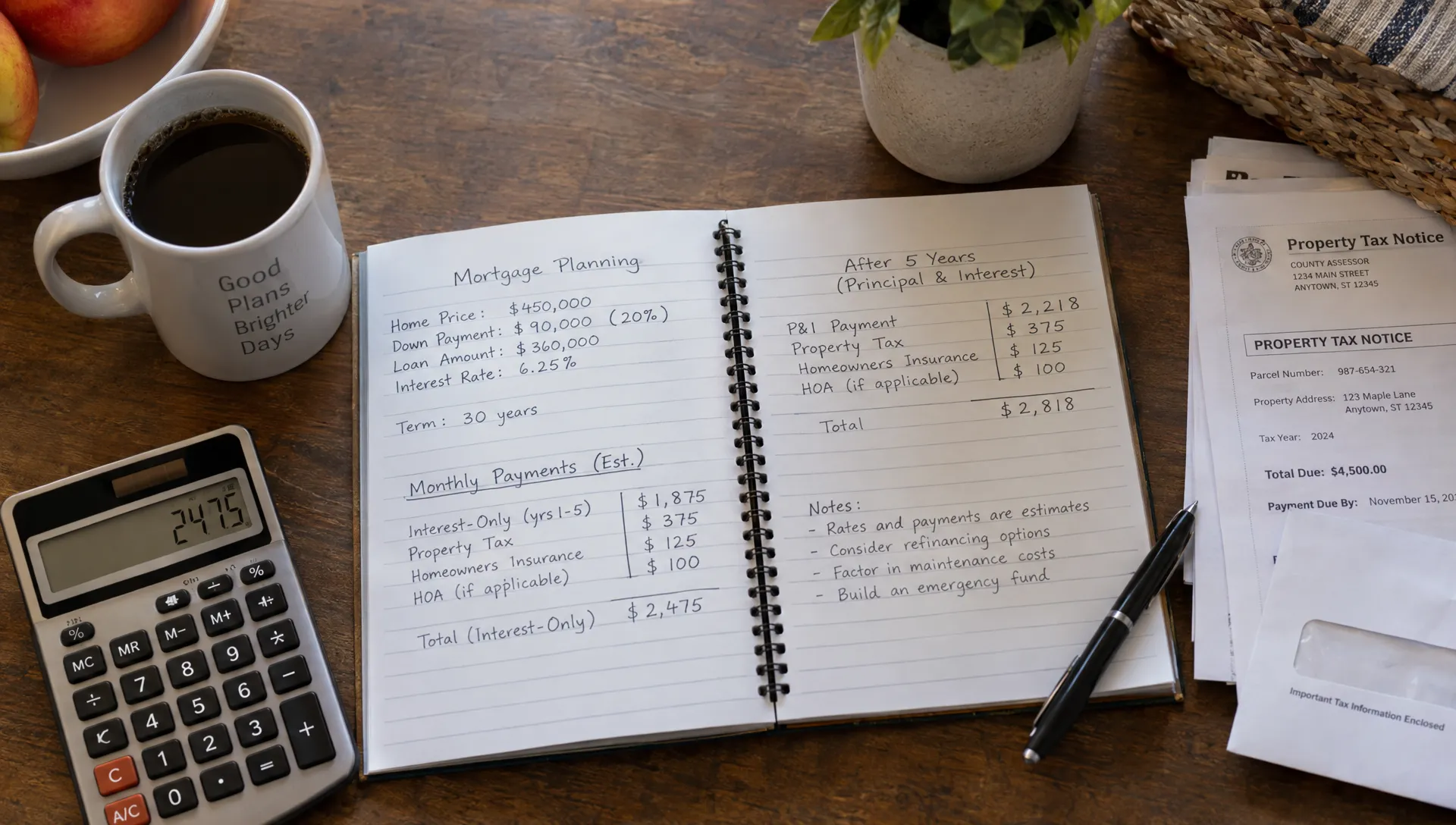
Here is an illustrative budget using the $400,000 example:
| Monthly component | Assumed amount |
|---|---|
| Interest-only loan payment | $2,166.67 |
| Property taxes, based on $6,000 annually | $500.00 |
| Homeowners insurance, based on $1,800 annually | $150.00 |
| HOA dues | $100.00 |
| Mortgage insurance, assumed not applicable | $0.00 |
| Total listed monthly housing costs | $2,916.67 |
If taxes and homeowners insurance are escrowed, the payment to the servicer would be $2,816.67 under these assumptions. The $100 HOA payment would usually be paid separately. Without escrow, you would need to set aside money for the tax and insurance bills yourself.
Mortgage insurance requirements depend on the loan program and terms. Do not assume a zero charge simply because the payment is interest-only. Flood insurance or other required coverage may also add costs.
Replace every assumption with property-specific figures. Local tax assessments, insurance quotes and association documents are more useful than a national average. Utilities and maintenance sit outside this table, but still belong in your budget. New Era Lending's guide to monthly homeownership costs buyers often miss explains those additional expenses.
Recalculate if the interest rate can adjust
Interest-only describes how you repay principal. It does not tell you whether the interest rate is fixed or adjustable.
For an adjustable-rate mortgage, the future rate generally depends on a specified index plus a margin, subject to the contract's adjustment rules and caps. Check the first adjustment date, adjustment frequency and maximum permitted changes.
The monthly payment for home loan options with adjustable rates needs more than one estimate. Holding the balance at $400,000 shows how rate changes affect the interest-only charge:
| Hypothetical annual rate | Monthly interest-only payment | Increase from 6.5% |
|---|---|---|
| 6.5% | $2,166.67 | $0.00 |
| 7.5% | $2,500.00 | $333.33 |
| 8.5% | $2,833.33 | $666.66 |
These are stress-test scenarios, not predictions or statements about any particular loan's permitted adjustments. Small differences can result from rounding.
A fixed interest rate removes this particular source of change during the fixed period. It does not prevent taxes, insurance or other housing expenses from rising, and it does not eliminate the payment increase when principal repayment starts.
Calculate the payment after the interest-only period
When a loan switches to amortizing payments, you must repay the outstanding balance over the remaining repayment term, not automatically over a new 30 years.
For the monthly payment for home loan repayment after the interest-only period, use this standard amortization formula:
M = P × r ÷ [1 − (1 + r)^(−n)]
Here, M is the monthly principal-and-interest payment, P is the remaining principal, r is the monthly interest rate expressed as a decimal and n is the number of remaining monthly payments.
For a 30-year mortgage with a 10-year interest-only period, the remaining repayment term would be 20 years, or 240 payments, assuming that is the structure specified in the contract.
Example: repayment over the remaining 20 years
Assume the balance remains $400,000 and the interest rate stays at 6.5%. Using a monthly rate of 0.065 ÷ 12 and 240 remaining payments produces a principal-and-interest payment of approximately $2,982.29.
That is about $816 more than the initial $2,166.67 interest-only payment, an increase of roughly 38%, even without a rate increase.
Keeping the earlier $750 allowance for taxes, insurance and HOA dues would bring the listed monthly housing costs to $3,732.29. Those expenses could also change over the intervening years.
If the rate resets when amortization begins, use the new contractual rate in the formula. If the agreement instead requires a balloon payment, this monthly amortization example does not describe that obligation. Request the repayment schedule rather than assuming either structure applies.
Compare the starting payment with the full borrowing cost
A lower initial payment does not necessarily mean a less expensive loan. For comparison, a fully amortizing $400,000 mortgage at the same hypothetical 6.5% rate over 30 years would have a principal-and-interest payment of approximately $2,528.27.
That is about $362 more per month than the interest-only payment, but part of each scheduled payment reduces principal. This is a mathematical comparison at an identical rate, not an assumption that both products would be offered at the same rate or fees.
The monthly payment for home loan financing should therefore be compared alongside principal reduction, upfront costs and the later repayment obligation. Ask for both an initial payment illustration and an amortization schedule covering the period after interest-only payments end.
The Consumer Financial Protection Bureau explains how mortgage interest rates differ from APR. Review the disclosed APR and itemized fees, while recognizing that an adjustable-rate loan's future cost depends on how rates actually change.
For broader background, this explanation of effective interest rates and borrowing costs describes how fees and repayment timing affect loan comparisons. For a U.S. mortgage decision, rely on the applicable U.S. disclosures rather than assuming an effective-interest-rate example uses identical calculation rules.
Check whether the later payment fits your budget
Before choosing an interest-only structure, test whether you could afford the payment after principal repayment starts without assuming a refinance, home sale or future raise.
Ask the lender to confirm the interest-only end date, remaining amortization term, rate-adjustment rules and any balloon obligation. Also ask how additional principal payments would affect future required payments. A lower balance may reduce interest charges, but you should not assume it automatically changes every scheduled payment in the way you expect.
For an adjustable-rate loan, review both a reasonable planning scenario and the maximum contractual payment exposure. Keep a separate allowance for changes in taxes and insurance. New Era Lending's explanation of how mortgage payments change over time provides additional context for those changes.
An interest-only period preserves near-term cash flow, but it postpones principal repayment. That trade-off needs to fit a documented repayment plan, not just today's budget.
Frequently asked questions
Does an interest-only payment include property taxes and insurance? The interest calculation does not. Your servicer may collect taxes and insurance through escrow, adding them to the amount due. HOA dues and some insurance expenses may be paid separately.
Why does the payment rise if the interest rate stays the same? Once the interest-only period ends, the payment may need to cover both principal and interest over the remaining term. Repaying the unchanged balance over fewer years raises the required payment even at the same rate.
Can a mortgage calculator estimate an interest-only payment? Yes, if it has a specific interest-only setting. A standard calculator may assume amortization from the first payment. When estimating the monthly payment for home loan options, confirm the calculator's repayment structure and whether its result includes taxes and insurance.
Can I qualify using only the starting interest-only payment? Not necessarily. Underwriting may use a higher qualifying payment and will also evaluate factors such as income, debts, credit and assets. Ask which payment the lender uses to determine eligibility.
Will I build equity during the interest-only period? Required interest-only payments do not reduce principal. Equity can change through additional principal payments or changes in the property's value, but appreciation is not guaranteed.
Get a payment estimate that includes both phases
Before comparing offers, gather the loan balance, note rate, interest-only duration, remaining repayment term and property-specific housing expenses. Request estimates for both the starting payment and the payment after principal repayment begins.
Contact New Era Lending for personalized guidance on available mortgage options. If you are considering an interest-only structure, ask whether it is available for your situation and request a clear explanation of its repayment terms.