.jpg)
.jpg)





.jpg)


Newly Self-Employed? How to Qualify for a Home Loan
Becoming self-employed can make home financing feel less straightforward, especially if your business is new and your income no longer arrives as a predictable W-2 paycheck. The good news is that self-employment does not automatically keep you from buying a home. It simply changes how lenders verify your ability to repay.
For many borrowers, the biggest challenge is timing. You may have strong income today, signed client contracts and healthy bank deposits, but mortgage underwriting usually wants a documented history. If you know what lenders look for, you can prepare a cleaner application and avoid surprises before you fall in love with a property.
This guide explains how loans for newly self employed borrowers are evaluated, what documents matter most and which loan paths may be worth discussing with a mortgage professional.
Why newly self-employed income gets extra attention
Lenders are not trying to penalize entrepreneurs, freelancers, consultants or business owners. They are trying to answer one core question: is this income stable enough to support a mortgage payment?
A W-2 employee can usually prove income with pay stubs, W-2 forms and employer verification. A newly self-employed borrower may have income that changes month to month, business expenses that reduce taxable profit or a limited track record after leaving salaried work. That means the lender has to look deeper.
In most cases, underwriters focus on:
- How long you have been self-employed
- Whether your new business is in the same field as your previous work
- Net income after business expenses, not just gross deposits
- Stability of deposits, contracts and year-to-date earnings
- Credit score, debt-to-income ratio and cash reserves
- Whether your tax filings match the income story you are presenting
The more consistent your file looks, the easier it is for a lender to understand your business income.
The two-year rule, and when there may be flexibility
Many mortgage programs prefer to see a two-year history of self-employment. Two years of filed tax returns give underwriters a clearer picture of average income, business stability and expense patterns.
That said, newly self-employed does not always mean you must wait two full years. Some conventional loan scenarios may allow a shorter history when you have at least one full year of self-employment and can show that your previous employment was in a related field. For example, a salaried software engineer who starts a consulting business may have a stronger case than someone who opens a business in an entirely new industry with no prior experience.
Flexibility depends on the loan program, investor guidelines, documentation quality and the overall strength of your application. A borrower with strong credit, low debts, meaningful savings and steady year-to-date income may have more options than a borrower with a thin credit profile and uneven deposits.
If you want a broader overview of how self-employed borrowers are reviewed, New Era Lending’s guide on how to qualify for a self-employed mortgage loan is a useful companion to this article.
What income does a lender actually count?
One of the most common surprises for new business owners is that lenders usually do not qualify you based on gross revenue. If your business brought in $180,000 last year but your tax return shows $85,000 in net income after expenses, the lender is generally starting from the lower number.
That does not mean every deduction hurts you in the same way. Some non-cash expenses, such as depreciation, may be added back in certain underwriting calculations. Other expenses may stay deducted because they represent real costs of running your business. The details depend on whether you are a sole proprietor, partner, S corporation owner or C corporation owner.
The IRS Self-Employed Individuals Tax Center is a helpful reference for understanding tax responsibilities, but tax rules and mortgage qualifying rules are not the same thing. A CPA may focus on lowering taxable income, while a mortgage lender needs enough documented income to support the loan. If you plan to buy a home soon, it is smart to involve both professionals before filing taxes.
Loan paths to discuss if your business is new
Your best option depends on your income history, credit profile, down payment, property goal and documentation. A mortgage advisor can help you compare options without forcing your situation into the wrong box.
Conventional loans
Conventional loans may work well for self-employed borrowers with strong credit, stable income and clean documentation. They often require detailed tax return review and may average income over one or two years, depending on guidelines and your self-employment history.
If your income is increasing quickly, averaging can feel frustrating because last year’s lower income may pull down your qualifying amount. Still, a conventional loan may offer competitive terms for borrowers who fit the requirements.
FHA loans
FHA loans can be worth exploring if your credit profile or down payment is not as strong as conventional standards require. FHA underwriting still reviews self-employed income carefully, but the program may be more flexible in certain areas.
Newly self-employed borrowers should expect to provide tax returns, profit and loss information, bank statements and an explanation of business stability. FHA does not remove the need to document income, but it may create a path for some buyers who do not fit conventional guidelines.
VA loans for eligible veterans and service members
If you are eligible for a VA loan, this program can be powerful, especially because it may allow no down payment for qualified borrowers. Self-employed veterans still need to document stable income, business history and ability to repay.
New Era Lending offers specialized veteran loan programs, so this is an area where speaking with a lender early can help you avoid missing a benefit you have earned.
Bank statement, portfolio and non-QM loans
Some borrowers with newer businesses may need alternatives to traditional tax-return-based underwriting. Bank statement loans, portfolio loans or non-QM loans may review business or personal deposits instead of relying only on tax return income.
These programs can be useful for qualified borrowers whose tax returns do not reflect their true cash flow. They may also come with different rates, down payment requirements, reserve requirements or fees, so they should be compared carefully rather than treated as a shortcut.
Documents to prepare before you apply
A strong mortgage file tells a clear story. The goal is to help the underwriter connect your business activity, deposits, tax filings and personal finances without guessing.
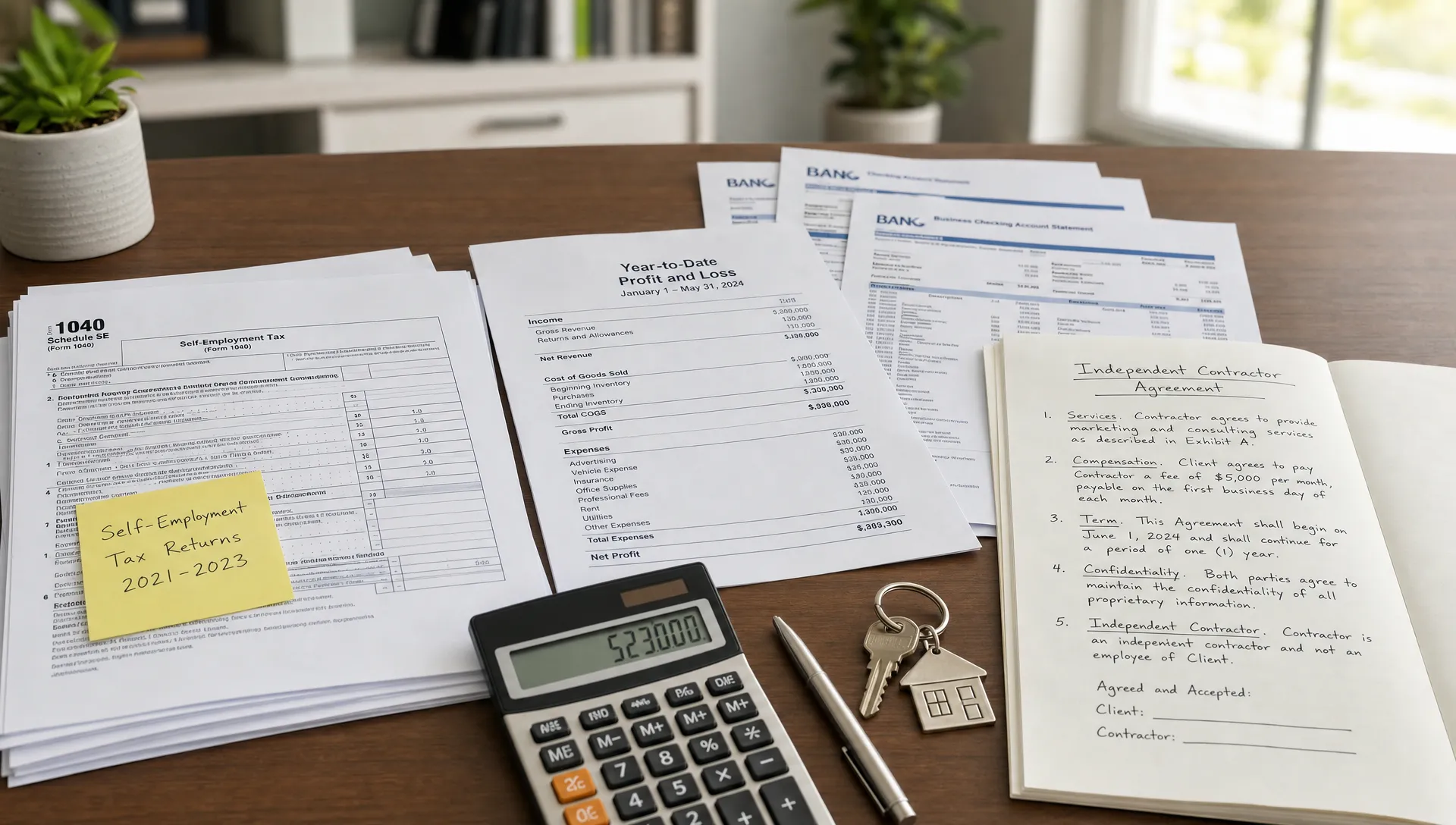
You may be asked for:
- Personal tax returns, often for the most recent one or two years
- Business tax returns, if you file them separately
- Year-to-date profit and loss statement
- Business bank statements and personal bank statements
- 1099s, invoices, contracts or client agreements
- Business license, entity documents or professional certifications
- CPA letter or verification of self-employment, when needed
- Asset statements for down payment, reserves and closing costs
- Explanation letters for large deposits or unusual income changes
Do not wait until you are under contract to start gathering these items. Missing documents can delay underwriting, and delays can create stress once purchase deadlines are in place.

Financial moves that can strengthen your approval odds
Newly self-employed borrowers often have more control over their approval readiness than they realize. Small decisions before applying can make your file easier to approve.
Keep business and personal finances separate. Commingled funds make it harder to identify business income, personal transfers and available assets. A dedicated business account creates a cleaner paper trail.
Avoid new debt before and during the mortgage process. A car loan, large credit card balance or new personal loan can increase your debt-to-income ratio and reduce your qualifying power. Even a purchase that seems unrelated to housing can affect approval if it changes your available cash or monthly obligations. It is usually better to wait on major discretionary purchases, whether that means a vehicle, furniture package or a certified pre-owned luxury timepiece, until after your mortgage closes.
Build reserves if possible. Cash left over after closing can help offset the perceived risk of variable self-employed income. Some loan programs may require reserves, and even when they do not, savings can make your application stronger.
Document large deposits. If money enters your account from a client, asset sale, gift or transfer between accounts, keep the paper trail. Lenders need to verify that funds are eligible and not undisclosed borrowed money.
Reduce revolving credit balances. Paying down credit cards can improve your credit utilization and lower monthly debt obligations. That can help both your credit score and your debt-to-income ratio.
Be careful with tax write-offs before buying
Business deductions are valuable, but they can create a mortgage challenge. Since lenders often use net income from your tax returns, aggressive write-offs may reduce the income available for qualifying.
This does not mean you should avoid legitimate deductions. It means you should plan ahead. If you expect to apply for a mortgage in the next 12 to 24 months, ask your CPA how your tax strategy may affect your qualifying income. Then speak with a lender before filing so you can understand the mortgage impact of your reported income.
For example, a contractor who deducts a large amount of vehicle, equipment and home office expenses may save on taxes, but the lower net income could reduce the loan amount they qualify for. A lender may be able to identify which expenses can be added back and which ones cannot.
What underwriters want your file to show
A newly self-employed borrower does not need a perfect profile. Your file needs to be explainable, consistent and well documented.
Underwriters generally want to see that your business income is likely to continue. A steady client base, signed contracts, recurring invoices or growth in the same industry can help support that story. If income declined, you should be ready to explain why and show whether the issue was temporary.
They also look at your personal financial behavior. Strong credit, on-time payments and manageable debts suggest that you can handle a mortgage even if your business income varies. A larger down payment or additional reserves can help, but they do not replace the need for verified income.
The property matters too. A primary residence, investment property, condo or multi-unit home may be reviewed differently. If you are still deciding what type of loan fits your goal, reviewing home loan options for 2026 can help you prepare better questions before applying.
When should you talk to a lender?
For newly self-employed buyers, the best time to talk to a lender is before you think you are ready. A pre-approval conversation can reveal whether you are close to qualifying now, need another tax return or should consider a different loan program.
Early guidance can also help you avoid common mistakes, such as filing a tax return that lowers your qualifying income too much, moving money without documentation or taking on new debt before closing.
The Consumer Financial Protection Bureau recommends comparing Loan Estimates when shopping for a mortgage so you can understand rates, fees and projected payments. For self-employed borrowers, that comparison should include more than cost. You also want a lender who understands non-W-2 income and can clearly explain document requests.
New Era Lending combines smart mortgage technology with personalized human guidance for purchase, refinance and equity access. Secure document uploads, e-signature support and clear communication can make a real difference when your income file requires extra review.
Common red flags that can slow down approval
Some issues do not automatically block approval, but they can create extra questions.
Recent business formation without related work history can be difficult because the lender has little evidence that the income will continue. Inconsistent deposits may also require explanations, especially if income varies widely from month to month.
Overdrafts, unpaid tax bills, missing tax returns, undisclosed debts and frequent transfers between accounts can create additional review. So can a business structure change, such as moving from sole proprietor to S corporation, if the income is not documented clearly.
If any of these apply to you, be upfront with your lender. A good mortgage advisor would rather know early than discover the issue after your file is already in underwriting.
Frequently Asked Questions
Can I get a home loan if I have been self-employed for less than two years? Yes, it may be possible, especially if you have at least one full year of self-employment, strong documentation and previous experience in the same line of work. Program rules vary, so a lender needs to review your full file.
Do lenders use my gross business revenue to qualify me? Usually no. Lenders generally focus on net income after business expenses, with some possible adjustments depending on the expense type and loan guidelines.
Are bank statement loans good for newly self-employed borrowers? They can be helpful for borrowers with strong cash flow but tax returns that do not show enough qualifying income. They may have different pricing, down payment requirements and documentation standards, so compare them carefully.
Should I wait to file my taxes before applying for a mortgage? Not always. If you are close to applying, speak with a lender and your CPA before filing. Your reported income can affect how much mortgage you qualify for.
Will starting an LLC hurt my mortgage application? Starting an LLC does not automatically hurt you, but changing business structure can create documentation questions. Keep clear records showing ownership, income flow and continuity from your prior work or business activity.
Take the next step with a clearer plan
If you are newly self-employed, qualifying for a home loan starts with clarity. You need to know which income can be counted, what documents are missing and which loan programs fit your timeline.
New Era Lending helps borrowers navigate purchase, refinance and equity access options with modern tools and human support. If you want a mortgage process that feels easier to understand, start by connecting with New Era Lending and reviewing your options before you apply.