.jpg)
.jpg)





.jpg)


Loan Choices That Match Your Budget and Timeline

The right loan choices fit more than your monthly payment. They also leave enough cash for closing, work with the date you need funding and make sense for the years you expect to keep the loan. A mortgage that looks inexpensive today can become costly if you pay for a rate reduction you never use, stretch repayment longer than intended or depend on refinancing later. Start by matching the financing to your schedule, then compare the numbers.
Start with three timelines
Before asking which mortgage is best, separate three different clocks:
- Your funding deadline: When must the purchase close, the refinance fund or the equity become available?
- Your expected holding period: How long do you realistically expect to keep this home and this loan?
- Your repayment horizon: When would you like the debt paid off, considering retirement, income changes and other goals?
These timelines do not always match. You might buy a home now, expect to move in six years and choose a 30-year mortgage to preserve monthly flexibility. That can be reasonable, but it changes how you should evaluate upfront fees and interest savings.
Write down both your expected plan and a fallback. If a move gets delayed or refinancing is unavailable, the payment should still be manageable. Treat future refinancing as an option, not a requirement for making the original loan affordable.
Compare loan choices against a complete budget
Set two limits before reviewing offers: a comfortable monthly housing payment and the maximum cash you can bring to closing without draining reserves.
The monthly limit should include principal, interest, property taxes, homeowners insurance, applicable mortgage insurance and any HOA dues. Keep maintenance and utilities in your household budget even though they generally are not part of the mortgage payment.
Lender approval and personal affordability answer different questions. A lender evaluates whether you qualify under its guidelines; you decide whether the payment leaves room for childcare, retirement contributions, transportation and unexpected expenses. New Era Lending’s guide to the full monthly housing payment explains why the advertised rate is only one part of that calculation.
Also test a less comfortable month. Would the budget still work if an insurance renewal rose, overtime disappeared or an appliance needed replacement? If the payment only works under ideal conditions, reduce the loan amount or revisit the purchase price before comparing finer details.
Separate closing cash from moving and setup costs
When comparing loan choices, distinguish money required to complete the transaction from money needed immediately afterward. Cash to close can include your down payment, lender and third-party charges, prepaid expenses and initial escrow deposits, reduced by applicable deposits and credits.
Moving, repairs and furnishing belong in a separate budget. For example, if you have $35,000 available but want to retain $10,000 for emergencies and $5,000 for moving and setup, your working closing-cash limit is $20,000. That is a planning example, not a required reserve amount or a lending guideline.
Price nonessential purchases before committing to them. Browsing furniture, lighting and home décor at Manor Editions can help you build a realistic furnishing budget rather than treating those expenses as whatever remains after closing. Separate immediate needs from purchases that can wait.
Avoid opening new credit accounts or financing furniture before your mortgage closes without discussing it with your lender. Additional debt can affect qualification, and changes to your credit profile may require another review.
Choose a repayment term that supports your plans
Comparing loan choices by term reveals a tradeoff that the interest rate alone cannot show: how much monthly flexibility you retain versus how quickly you repay principal.
Consider a hypothetical $300,000 mortgage at a fixed 6.5% interest rate:
| Repayment term | Approximate monthly principal and interest | Main budget tradeoff |
|---|---|---|
| 30 years | $1,896 | Lower required payment, slower principal repayment |
| 20 years | $2,237 | Higher payment, shorter repayment schedule |
| 15 years | $2,613 | Highest payment of these examples, fastest payoff |
These figures are rounded amortization calculations, not current rates or an offer. They exclude taxes, insurance, mortgage insurance and HOA dues. Actual rates may differ by term.
A shorter term generally reduces total interest when other assumptions are equal, but the required payment must remain comfortable. A longer term may leave more room for savings or uneven income.
If you prefer a longer term with voluntary extra payments, confirm how additional principal payments are applied and whether the loan has a prepayment penalty. Extra payments generally shorten repayment rather than automatically reducing the scheduled payment. Do not choose a payment you can only afford by stopping essential savings.
Evaluate upfront costs over your expected holding period
Discount points let you pay more upfront in exchange for a lower interest rate. Lender credits generally work in the opposite direction: accepting a higher rate can reduce certain closing costs. Neither arrangement is automatically better.
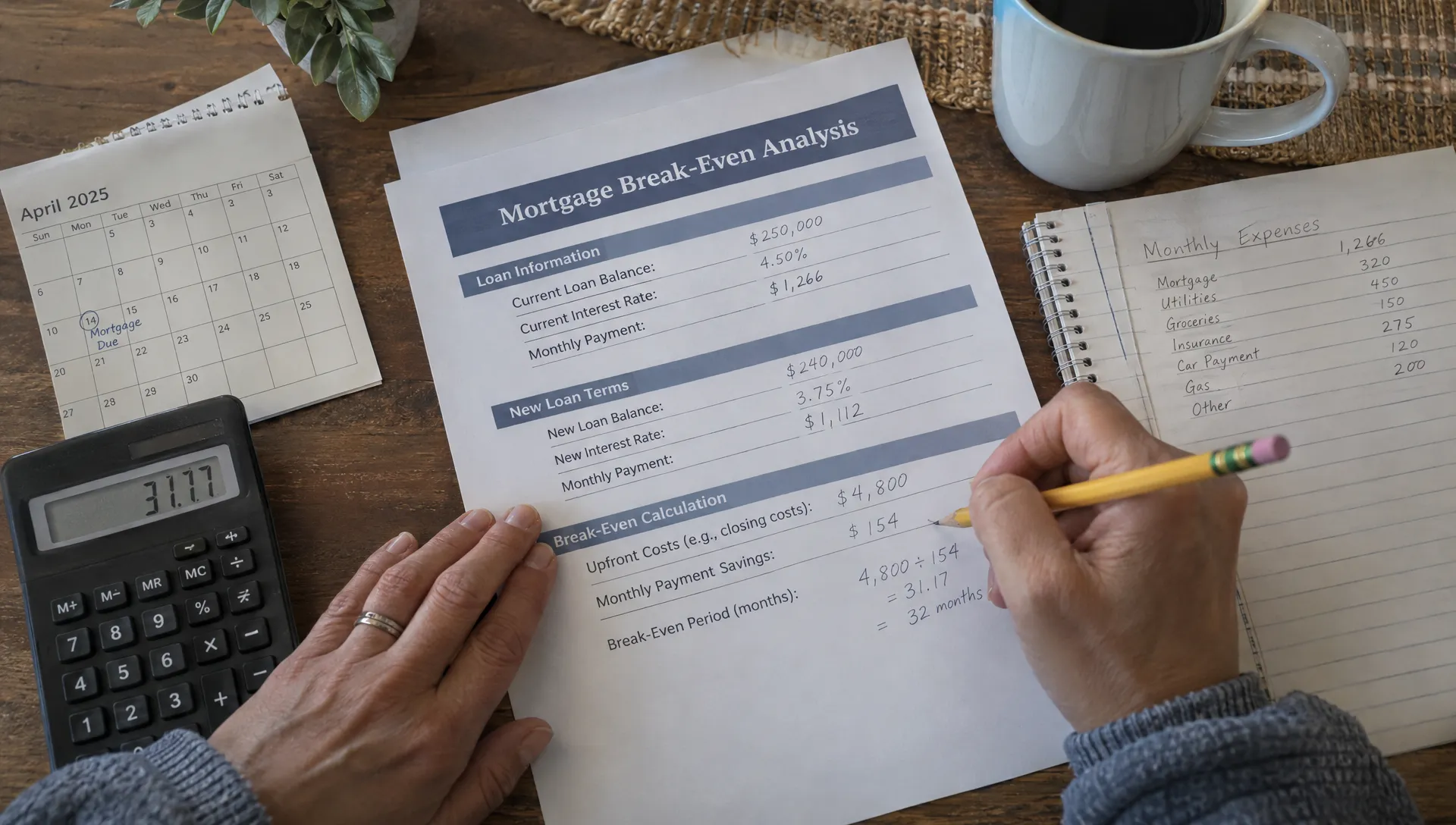
For loan choices with different upfront costs, calculate a simple break-even period before deciding. Suppose one offer costs $2,400 more upfront and lowers the monthly principal-and-interest payment by $40. Dividing $2,400 by $40 gives a payment-based break-even point of 60 months.
If you expect to sell or refinance in three years, that example does not recover the additional cost through payment savings. If you keep the loan much longer, the lower payment may become worthwhile.
This shortcut is only a first screen. A fuller comparison also considers interest paid, remaining loan balance and the opportunity cost of using cash upfront. Keep the loan amount, term and other assumptions consistent.
Use the standardized Loan Estimate explained by the Consumer Financial Protection Bureau to compare offers. Request estimates close together in time, and ask whether the rates are locked. Market changes can make quotes from different days misleading.
Match rate stability to the time you may keep the loan
Fixed-rate and adjustable-rate mortgages solve different payment-planning problems. A fixed-rate mortgage keeps principal and interest stable, although taxes, insurance and other housing expenses can change.
An adjustable-rate mortgage, or ARM, typically has an initial rate period followed by scheduled adjustments. Its starting payment may be attractive, but the adjustment terms matter as much as the introductory rate.
For adjustable-rate loan choices, ask about the first adjustment date, adjustment frequency, index, margin and rate caps. Have the lender show how the payment could change under the contract, rather than relying only on today’s payment.
A planned move before the first adjustment does not eliminate risk. Employment changes, selling conditions or family circumstances might keep you in the property longer. Test whether you could manage a higher payment if that happened.
Also distinguish an ARM from a temporary buydown. A temporary buydown reduces the borrower’s payment for a defined period; it does not permanently lower the note rate. Build your long-term budget around the payment after the subsidy ends, and ask how qualification is handled.

Work backward from the date you need funding
Your funding deadline can narrow your loan choices, but speed should not replace cost and affordability checks. Ask the lender what remains unresolved before setting expectations with a seller, contractor or other party.
Preapproval is useful preparation, not a guarantee of final approval or a closing date. Property valuation, title work, insurance, income verification and outstanding underwriting conditions can affect the schedule. Some programs or property types involve additional requirements.
Before committing to a deadline, confirm who is responsible for each outstanding item and when it is needed. Ask whether the appraisal has been ordered, whether title issues have surfaced and whether any documents may need updating before closing.
Your rate-lock period should also fit the expected schedule. Confirm the expiration date, extension policy and who would pay an extension charge if the closing is delayed. Do not assume an extension will be free.
For most mortgages, you must receive the Closing Disclosure at least three business days before closing. Review it promptly against your Loan Estimate, especially the rate, loan amount, payment and cash to close. Certain significant changes can trigger a new waiting period.
Finally, ask when funds become available. Signing documents and receiving proceeds are not always the same event, particularly for a refinance or equity transaction where a rescission period may apply.
Let the borrowing goal shape the comparison
Purchase financing, refinancing and borrowing against equity require different comparisons. The most useful loan choices are those that address the actual need without unnecessarily changing the rest of your finances.
| Your goal | Comparison to prioritize | Timing issue to check |
|---|---|---|
| Buy a home | Monthly payment, cash to close and qualification | Whether financing can meet the contract deadline |
| Refinance an existing mortgage | Closing costs, savings and remaining repayment period | How long you expect to keep the replacement loan |
| Receive a lump sum from equity | Total payment, fees and effect on existing mortgage debt | When proceeds will be available |
| Pay expenses in stages | Draw rules, variable-rate exposure and repayment terms | When borrowing access ends and repayment changes |
A refinance can lower the monthly payment partly by extending repayment, even if the rate improvement is modest. Compare the new payoff date with the years remaining on your current mortgage.
Similarly, cash-out refinancing replaces the existing first mortgage. A home equity loan or line of credit generally adds separate debt secured by the property. Compare the combined payments and costs, not just the new borrowing amount. These debts put your home at risk if you cannot repay them.
For a purchase, review eligibility requirements across common home-loan programs after establishing your budget and timeline. Program eligibility helps narrow the options; it does not replace the affordability test.
Frequently asked questions
Are the lowest-payment loan choices always the most affordable? No. A lower payment may come from a longer term, a temporary subsidy or a rate that can adjust later. Compare upfront costs, payment changes and the debt remaining when you expect to sell, refinance or retire.
Should I pay points if I plan to move soon? Compare the additional upfront cost with the expected savings before your move. A simple break-even calculation is a useful starting point, but also consider remaining principal and whether using that cash would weaken your reserves.
Can a mortgage provide money instantly? Mortgage funding is not instant. Verification, underwriting, property-related reviews and applicable disclosure or rescission requirements affect timing. Ask for a transaction-specific schedule rather than relying on a general approval-speed claim.
How much emergency savings should remain after closing? There is no single amount that fits every household. Base your target on essential expenses, income stability, insurance deductibles and likely home repairs. Separately, confirm whether your loan program requires documented reserves.
What should I bring to a loan comparison conversation? Bring your comfortable monthly payment, available closing cash, desired funding date and expected holding period. Also provide accurate income, debt and asset information so the lender can evaluate feasible options.
Compare financing around your actual schedule
New Era Lending combines a technology-driven mortgage process with personalized human guidance for home purchases, refinancing and equity access.
Ask the team to compare feasible options using the same loan amount and assumptions, with each offer showing the full payment, cash to close, rate-lock terms and repayment schedule. Start a conversation with New Era Lending using your budget limits and funding deadline, so the discussion begins with what you need the loan to accomplish.