









How to Choose a Home Equity Loans Lender With an Existing HELOC
Choosing a home equity loans lender when you already have a HELOC starts with a practical question: Will the new loan replace your credit line or become another lien on your home? That decision affects lender eligibility, borrowing limits, closing costs and your monthly payment. A lender advertising an attractive rate may not accept a property with two existing mortgages. Before applying, identify the loan structure you need, then compare lenders that can actually provide it.
Document your existing HELOC before requesting quotes
Your current balance is only part of the picture. An unused credit line can still affect underwriting because you may be able to borrow against it later.
Gather your latest first-mortgage statement, HELOC statement and original HELOC agreement. Record these details:
- Balances and limits: Your first-mortgage balance, HELOC balance and full HELOC credit limit.
- Payment schedule: When the draw period ends, how repayment changes and whether a balloon payment applies.
- Closure costs: Any early-termination charge, closing-cost reimbursement or recording fee.
- Account restrictions: Requirements concerning additional liens, line reductions or account closure.
Also ask your current HELOC provider whether it offers a fixed-rate conversion for an existing balance. That might address payment uncertainty without a separate loan, although availability, conversion fees and terms depend on your agreement.
Gathering this information first helps prevent quotes based on an incomplete picture of your debt.
Choose a home equity loans lender that accepts your lien setup
If you have a first mortgage and a HELOC, another home equity loan would generally occupy third lien position unless an existing lien is paid off or priorities change. Many lenders do not offer third-lien loans. Ask about this before paying an application or appraisal fee.
The main possibilities are:
| Structure | What happens to your existing HELOC? | What to confirm |
|---|---|---|
| Add another equity loan | The HELOC stays open | Whether the new lender accepts third position and your existing agreements permit another lien |
| Replace the HELOC with a home equity loan | The line is paid off and closed | Required payoff, lien release, closure charges and remaining cash proceeds |
| Convert part of the HELOC to a fixed rate | The account remains under its existing agreement | Conversion eligibility, fees and treatment of the remaining line |
| Use a cash-out refinance | The first mortgage is replaced; the HELOC may be paid off or retained | Total refinancing costs and any required HELOC subordination |
A lender saying it offers “second mortgages” does not necessarily mean it accepts an existing HELOC ahead of its loan.
If replacing the first mortgage is an option, review the trade-offs between a cash-out mortgage loan and a HELOC, especially if your current first-mortgage rate is favorable.
Get payoff and lien-release instructions in writing
Ask each home equity loans lender whether approval requires a HELOC payoff, account closure, credit-limit reduction or subordination agreement. Those are different conditions.
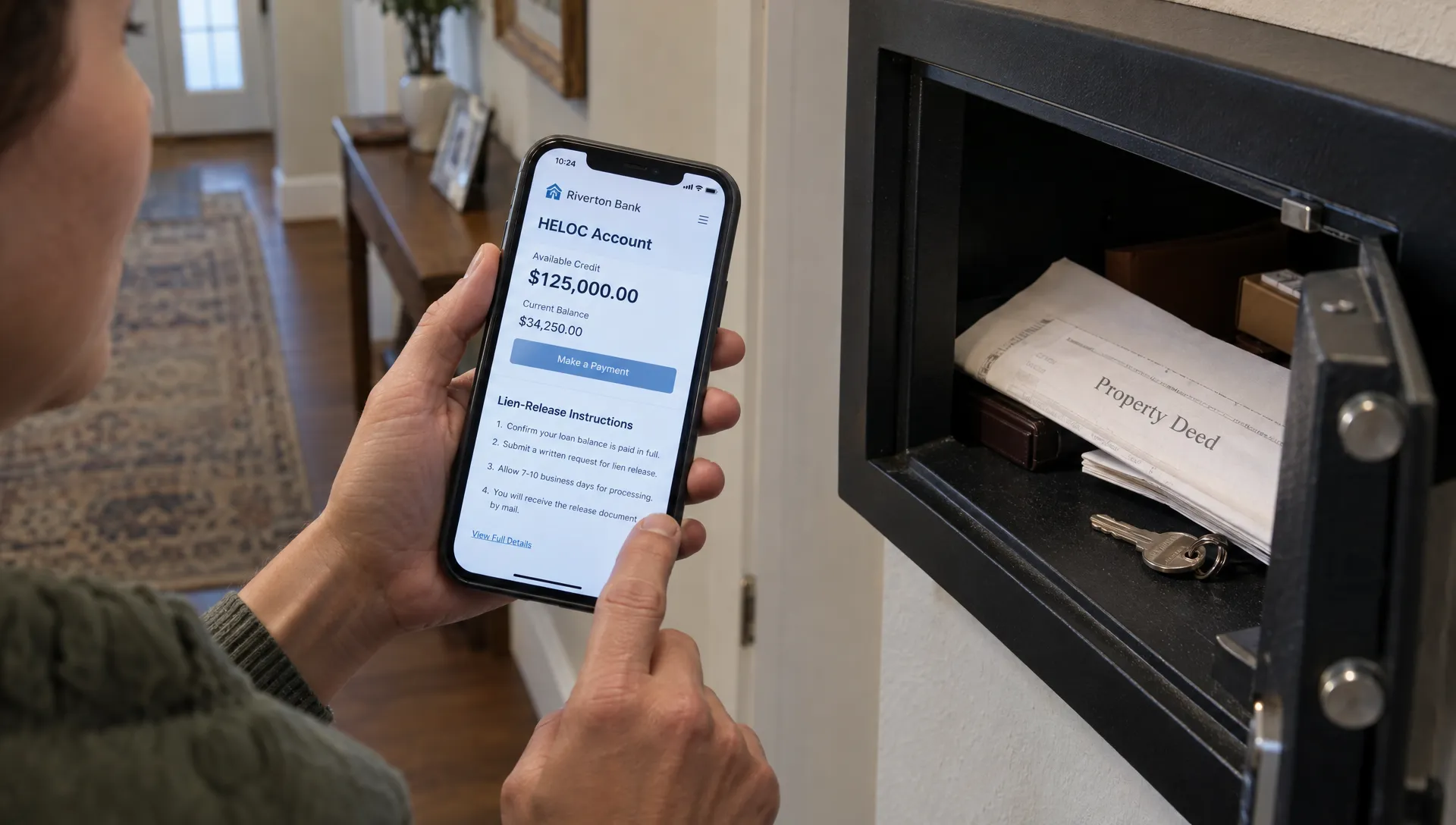
Paying the balance to zero does not necessarily close the account or release its lien. A lender replacing your HELOC may require the line to be terminated so you cannot redraw funds after closing.
Subordination changes lien priority. For example, when refinancing a first mortgage while keeping a HELOC, the HELOC provider may need to agree that its lien will remain behind the replacement mortgage. Approval is not automatic and may involve a fee or separate review.
Request a dated payoff statement rather than relying on the statement balance. Accrued interest and other charges can change the amount needed at closing. Confirm who will request the release and who will verify its recording afterward.
Calculate borrowing room using both HELOC measures
Available equity is not simply your home's value minus the first mortgage. Your HELOC matters, and lenders may consider both its outstanding balance and its full credit limit.
A home equity loans lender may evaluate combined loan-to-value, or CLTV, using outstanding mortgage balances. Some programs also assess home equity combined loan-to-value, or HCLTV, counting the full HELOC limit. Ask which calculation applies and what maximum the program permits.
Consider this hypothetical example:
- Estimated property value: $500,000.
- First-mortgage balance: $280,000.
- HELOC balance: $40,000.
- HELOC credit limit: $80,000.
- Illustrative combined borrowing cap: 80%, or $400,000.
Using the drawn HELOC balance leaves $80,000 of theoretical borrowing room: $400,000 minus $280,000 minus $40,000.
Counting the full credit limit leaves $40,000: $400,000 minus $280,000 minus $80,000.
The 80% cap is an example, not a universal rule. Appraised value, lender policy and other qualifications can change the result. If the new loan replaces the HELOC, its payoff consumes part of the proceeds. Financed fees also reduce the cash you receive or increase the requested loan amount.
Check qualification rules before authorizing paid work
Ask about minimum credit standards, income documentation, debt-to-income limits and property eligibility before ordering an appraisal. There is no single credit-score requirement or equity threshold shared by every lender.
Your debt-to-income ratio compares qualifying monthly debt obligations with gross monthly income. An underwriter may calculate a HELOC payment differently from the minimum shown on your statement, particularly if the current payment is interest-only.
A home equity loans lender should explain how it will count that payment and whether qualification assumes the existing line remains open. Be prepared to document income, employment and other debts, along with housing expenses such as taxes, insurance and applicable association dues.
Confirm eligibility for your state, occupancy and property type. A lender might accept an owner-occupied single-family home but not an investment property, certain condominiums or a manufactured home under the same program. If income is variable or self-employed, ask which tax returns and business records are required.
Compare written offers on the same basis
Once you identify compatible programs, request quotes for the same net cash proceeds, repayment term and HELOC treatment. A loan that pays off your line is not directly comparable with one that leaves it outstanding.
Ask each home equity loans lender to itemize the interest rate, annual percentage rate, monthly principal-and-interest payment, closing charges and any prepayment penalty. Confirm whether the quoted rate is locked and when the lock expires.
For most closed-end home equity loans secured by real estate, the lender must provide a Loan Estimate within three business days after receiving an application. The CFPB's Loan Estimate explainer helps you locate the rate, payment and closing-cost information. HELOCs use different disclosures, so do not expect an identical form for a credit-line offer.
Compare origination charges, appraisal costs, title work, recording fees and charges from closing the existing HELOC. For a “no closing cost” offer, ask whether the lender pays those charges, finances them or imposes repayment conditions if you close early.
APR is useful, but it is not a complete comparison across different product types. A HELOC's advertised APR generally does not capture fees in the same way as a closed-end loan's APR. Compare actual charges and payment terms too.
Stress-test the payment, not just the advertised rate
A longer term can reduce the required payment while increasing lifetime interest. These hypothetical fixed-rate calculations illustrate the difference:
| Loan amount | Interest rate | Term | Approximate monthly principal and interest | Approximate total interest |
|---|---|---|---|---|
| $50,000 | 8% | 10 years | $607 | $22,800 |
| $50,000 | 8% | 15 years | $478 | $36,000 |
These examples exclude fees and are not current offers. If fees are financed, the payment and interest cost increase.
Have the home equity loans lender show your total payment obligations after closing, including any mortgage or HELOC that remains. A low payment on the new loan can be misleading if it is added to two existing obligations.
If you keep a variable-rate HELOC, test a higher rate and the payment required when principal repayment begins. Also compare total dollars paid over the period you expect to keep the debt. If you plan to sell in three years, upfront charges and any early-exit costs may matter more than a small rate difference.

Verify the lender beyond its website
A clear website and responsive representative help, but neither establishes licensing or confirms that the advertised loan is available to you. Check the company's legal identity and the loan officer's licensing or registration through NMLS Consumer Access, then confirm applicable state authorization.
Professional presentation is a separate service from lending. Agencies such as Dorron Marketing, a website design and marketing firm, help businesses present themselves online; borrowers still need to verify credentials and written loan terms independently.
Determine whether you are dealing with a direct lender or a broker. If a broker is involved, ask which lender would fund the loan and whether that lender accepts your existing lien arrangement.
Pay attention to operational clarity as well. The representative should be able to explain who handles underwriting, who coordinates the HELOC payoff and how you will receive status updates. Promises of approval without reviewing income, credit and collateral deserve scrutiny. Before uploading sensitive documents, verify that you are using the company's legitimate secure channel.
Confirm the funding and account-closure timeline
An approval is not the same as money available to spend. Appraisal review, title issues, subordination and payoff coordination can all affect closing.
Ask your home equity loans lender for a timeline covering underwriting, final disclosures, signing, any cancellation period and disbursement. Most nonpurchase loans secured by a principal residence carry a federal three-business-day right of rescission, although exceptions apply. Confirm whether it applies to your transaction and when the period ends.
Keep making required payments until the existing creditor confirms the payoff. Ask how any overpayment will be refunded and when the account will show as closed. Avoid further HELOC draws once the closing team instructs you to stop, since a new advance can change the payoff and delay funding.
If funds are being wired, verify instructions through an independently confirmed phone number. Do not rely solely on an email announcing changed payment details. After closing, retain the payoff confirmation, final disclosures and lien-release documentation.
Keep debt consolidation from increasing your risk
Replacing credit-card debt or a variable-rate HELOC with a fixed payment can simplify budgeting. It does not eliminate the debt, and moving unsecured balances onto your home creates a more serious consequence for missed payments: the home may be subject to foreclosure.
Before accepting an offer, ask the home equity loans lender to separate three amounts: the existing HELOC payoff, additional debt payoffs and cash you will receive. That makes it easier to see whether the transaction reduces costs or mainly extends repayment.
Compare the new payoff date with your current plan. Stretching a balance over 15 years can lower the payment while increasing total interest, even at a lower rate. Keeping a paid-off credit line available also creates the possibility of rebuilding debt after consolidation.
Set your own borrowing ceiling below the lender's maximum if necessary. New Era Lending's guide to accessing home equity without overborrowing offers a useful framework for matching the amount borrowed to the expense and your repayment capacity.
Use a short screening script before applying
A few direct questions can eliminate unsuitable lenders before you spend time gathering a full application package:
- “With my first mortgage and existing HELOC, would your loan require third lien position, payoff or subordination?”
- “Do you count the HELOC's current balance, full limit or both when calculating eligibility?”
- “What qualifying payment will you assign to my HELOC?”
- “Which costs apply if I close or reduce the existing line?”
- “How much cash will I receive after all payoffs and fees?”
- “Can you provide the proposed structure and conditions in writing?”
A home equity loans lender does not need to promise approval during this conversation. It should be able to explain its program's basic rules and identify what still requires underwriting.
Keep each response alongside the written quote. A slightly higher rate may be worth considering if the offer avoids costly restructuring, but compare the actual dollars rather than assigning value to convenience alone.
Frequently asked questions
Can I get a home equity loan while keeping my HELOC? Sometimes. You need sufficient equity, qualifying income and a lender that accepts the resulting lien position. With a first mortgage and HELOC already in place, another loan would generally be a third lien unless the existing arrangement changes.
Does a HELOC with a zero balance still matter? Yes. The account may remain open and secured by a lien. Its credit limit can affect eligibility, and a new lender may require closure or a limit reduction even when nothing is owed.
What is the interest-only payment on a $50,000 HELOC? At a hypothetical 9% annual rate, it is approximately $375 per month, calculated as $50,000 × 9% ÷ 12. Actual billing can vary with daily balances and contract terms. Interest-only payments do not reduce principal.
Will every lender require a new appraisal? No. A home equity loans lender may use a full appraisal, another valuation method or an eligible appraisal waiver under its program. Ask about the method, cost and what happens if the value is lower than expected. Your own estimate does not establish the value used for approval.
Get a review built around your existing HELOC
The right comparison begins with your current loan documents, not an advertised rate. Bring your mortgage balance, HELOC limit, payoff information and desired cash amount to the conversation.
Connect with New Era Lending for personalized guidance on available equity-access and refinancing options. Ask which programs fit your state, property and existing liens, then compare the written structure, total costs and payment obligations before committing.