









Which Loan Payment Terms Allow Prepayment Penalties?
Some loan payment terms allow a prepayment penalty, but only when the loan agreement includes an enforceable provision and applicable law permits it. For most covered consumer mortgages, federal rules sharply restrict which loans may carry the fee, how much lenders can charge and how long it can apply.
A 30-year mortgage does not automatically permit a penalty, and paying extra does not automatically trigger one. The answer depends on the loan type, the penalty clause, the timing and whether you are making a partial payment, refinancing or paying off the balance through a sale.
Which mortgages can legally include a prepayment penalty?
Under the federal Ability-to-Repay and Qualified Mortgage rule, a covered mortgage can include a prepayment penalty only if it meets specific conditions:
- The penalty is otherwise permitted by law, including applicable state law.
- The annual percentage rate cannot increase after closing.
- The mortgage satisfies the rule’s specified Qualified Mortgage criteria.
- The loan is not a higher-priced mortgage under the applicable federal definition.
For loans subject to this rule, the penalty cannot extend beyond the first three years. Federal caps also limit its amount, as explained below. A lender offering a covered mortgage with a penalty generally must also offer a qualifying alternative without one.
Permission is not a requirement. An eligible fixed-rate mortgage may still have no penalty, and state law may prohibit or further restrict a fee that federal law would otherwise allow.
How loan payment terms differ from the penalty period
The repayment term is the time scheduled to repay the debt, such as 15 or 30 years. The prepayment penalty period is a separate, usually much shorter window during which certain early payments may generate a charge.
Payment due-date provisions are different again. Your due date, grace period and late-payment charge govern whether scheduled payments arrive on time. They do not establish whether paying early costs extra.
For example, a 30-year mortgage might have a permissible penalty limited to its first two years. Refinancing during month 18 could trigger that provision, while refinancing during year five would not trigger the expired penalty. Other closing or payoff costs could still apply.
Principal and interest also serve different purposes. Principal reduces your debt; interest pays for borrowing. A prepayment penalty is a separate contractual charge, not simply the interest appearing on your payoff statement.
Which loan types usually allow or prohibit the fee?
When reviewing loan payment terms, start with the product category rather than assuming every mortgage follows the same rules.
| Loan category | General prepayment treatment | What to verify |
|---|---|---|
| Eligible fixed-rate Qualified Mortgage | A limited penalty may be permitted | State restrictions, contract language and federal limits |
| Adjustable-rate mortgage covered by the federal rule | A penalty is not permitted when the APR can increase after closing | The actual rate structure and applicable coverage |
| Standard newly originated FHA, VA and USDA home loans | These programs do not permit prepayment penalties | Confirm the program and distinguish other payoff obligations |
| High-cost mortgage covered by HOEPA | Prepayment penalties are prohibited | Whether the loan falls within this regulatory category |
| Home equity line of credit | Different rules apply; an early account-closure charge may appear | The HELOC agreement and applicable law |
| Business-purpose or commercial real estate loan | Consumer-mortgage protections may not apply | Loan purpose, governing law and the negotiated contract |
The federal high-cost mortgage restrictions separately prohibit prepayment penalties for covered high-cost mortgages. “High-cost” and “higher-priced” are distinct regulatory classifications, not interchangeable descriptions of a rate that seems expensive.
Many conventional mortgages also carry no prepayment penalty. Do not interpret “conventional” or “fixed-rate” as proof that a fee applies.
Which early payments can trigger a penalty?
Full payoff, refinancing and selling
A refinance pays off the existing mortgage with a new loan. If an enforceable penalty applies to that payoff, changing lenders does not eliminate it. Refinancing with the same lender does not automatically waive it either.
Selling also usually involves paying off the mortgage, but some contracts treat a sale differently from a refinance. You may hear these described as “soft” and “hard” penalties: a soft provision may exempt a qualifying sale, while a hard provision may cover both events. Those labels are shorthand, not substitutes for the agreement.
Extra principal payments
Some loan payment terms permit extra principal payments up to a stated allowance without a penalty. Others define different triggers. A modest extra payment may be allowed even when a complete early payoff would incur a charge.
Check whether an allowance uses a calendar year, a rolling 12-month period or another measurement window. Also confirm what balance it references and whether exceeding the allowance creates a fee on the excess amount or a broader prepaid amount.
Ask for a written calculation using your intended payment. “Can I pay extra?” is less useful than “Would a $15,000 principal payment on this date trigger a fee, and how would you calculate it?”
Why HELOCs and business loans need a separate review
The federal three-year and percentage limits discussed here do not automatically govern every credit product secured by real estate.
A HELOC may include an early account-closure fee or require repayment of certain lender-paid closing costs if you close the account within a stated period. Paying the balance to zero and closing the credit line are not necessarily the same event. Check both provisions before replacing a HELOC or selling the property.
Business-purpose financing requires a different analysis too. For example, a medical-device company might borrow to acquire commercial premises while separately budgeting for medical device regulatory support. The primary purpose of the borrowing, not the owner’s occupation or the presence of real estate collateral alone, helps determine which consumer protections apply.
In those situations, loan payment terms might include a step-down penalty, yield-maintenance provision or another negotiated payoff charge. Do not apply consumer-mortgage caps to commercial financing without checking coverage.
For an investment-property or mixed-purpose transaction, ask the lender to explain its classification. If a substantial payoff charge is involved, have a qualified attorney review the provision and applicable state law before signing or paying it.
How much can a permitted mortgage penalty cost?
For a covered mortgage that qualifies for a penalty under the federal rule, the maximum is:
| Timing after closing | Maximum permitted penalty |
|---|---|
| First two years | 2% of the outstanding loan balance prepaid |
| Third year | 1% of the outstanding loan balance prepaid |
| After three years | No prepayment penalty under this rule |
These are ceilings, not standard charges. A contract may impose a smaller fee, end it earlier or include exemptions. State law may be more restrictive.
Suppose you repay $240,000 of principal during month 18 and a valid 2% provision applies to the entire prepaid amount. The penalty would be $4,800. At a 1% rate, the charge on the same prepaid amount would be $2,400. These illustrations do not assume that a particular contract permits either charge.
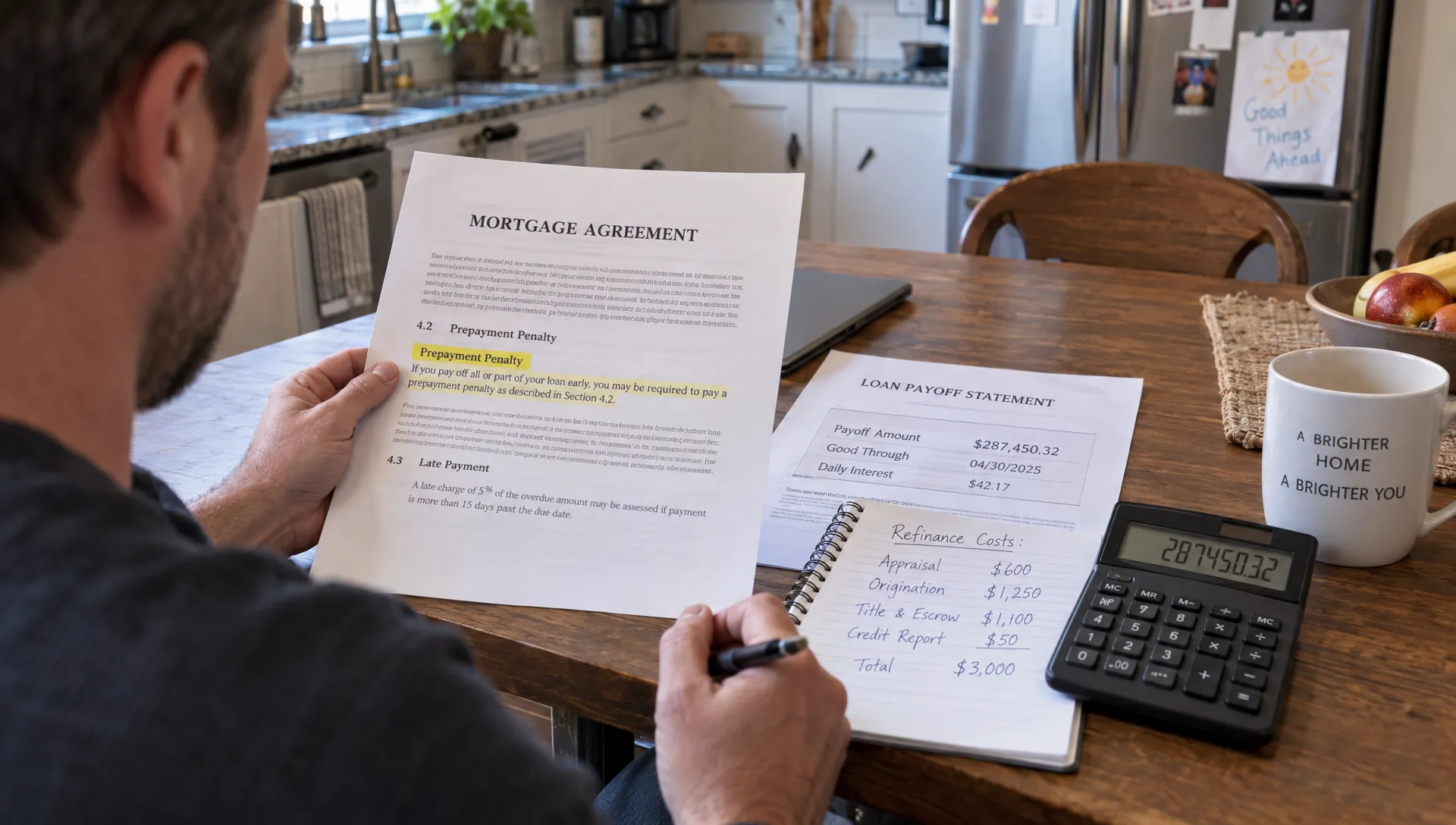
When comparing loan payment terms for a refinance, include any penalty in the upfront-cost calculation. If a hypothetical refinance produces $200 in monthly payment savings but requires $3,200 in other costs plus a $4,800 penalty, the simple cash-flow break-even is 40 months: $8,000 divided by $200.
That shortcut does not measure the full economic benefit. A longer replacement term, a different principal balance or financed closing costs can change the result. Compare those factors when reviewing refinance options to lower your payment or shorten your term.
Where to find the clause before you sign
For most closed-end consumer mortgages using the standard federal disclosure forms, look at the Loan Terms table on page 1 of both the Loan Estimate and Closing Disclosure. The “Prepayment Penalty” entry indicates whether the loan has one and, when applicable, provides the maximum charge and relevant period.
The promissory note and any prepayment addendum provide the contractual detail. Review them together rather than treating a disclosure summary as the complete formula.
Before accepting loan payment terms with an early-payoff charge, get clear answers to these questions:
- Trigger: Does the fee apply to refinancing, selling, partial payments or all three?
- Expiration: What exact date ends the penalty period?
- Calculation: What percentage or formula applies, and to which amount?
- Allowance: How much additional principal can you pay without a fee?
- Exceptions: Are there written exemptions, and what evidence is required?
- Alternative: What rate and closing costs apply to an otherwise comparable loan without the penalty?
An oral assurance that you “probably will not pay it” is not enough. If the lender agrees to remove or change the provision, confirm that the final documents reflect the change before signing.
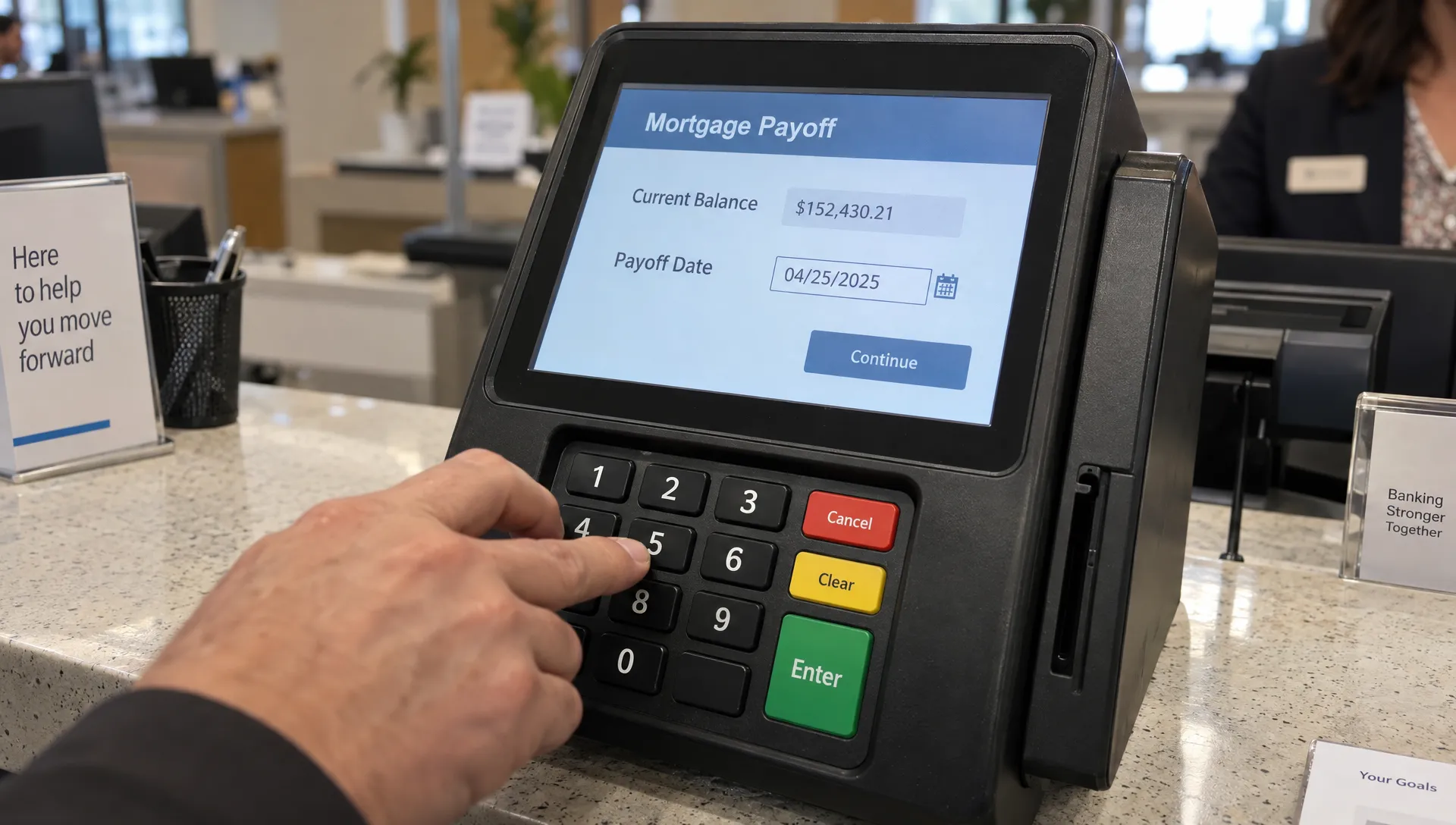
For an existing loan, request an itemized payoff statement for your intended payoff date. Ask the servicer to identify any penalty separately from accrued interest, recording charges or other amounts. If the fee conflicts with your documents or you believe it is prohibited, request a written explanation before proceeding.
How to make extra payments without creating confusion
Permission to prepay and correct payment processing are separate issues. Even when there is no penalty, you still need to confirm how the servicer handles additional money.
Ask how to designate an extra amount as a principal-only payment and whether your account must be current first. Without appropriate instructions, funds may be handled differently than you intended, including being credited toward future installments under the applicable servicing process.
Your loan payment terms should be reviewed alongside the servicer’s instructions. Keep making required monthly payments unless the servicer confirms a different arrangement; an extra principal payment does not necessarily satisfy next month’s installment.
After the transaction posts, inspect your statement or account history. Verify the principal reduction, check for an unexpected charge and retain confirmation of the payment instructions you used.
An extra principal payment generally reduces the balance and future interest, but it does not automatically lower the required monthly payment. A payment reduction may require a permitted recast or a refinance. If your goal is earlier payoff rather than a smaller installment, compare ways to shorten your loan term before choosing an approach.
Frequently asked questions
Can a 30-year fixed-rate mortgage have a prepayment penalty? Yes, some can, but fixed-rate status and a 30-year repayment period are not enough. A covered mortgage must satisfy federal eligibility requirements, applicable state law and the contract’s restrictions. Many fixed-rate mortgages have no penalty.
Can a lender charge a penalty after three years? Not on a covered mortgage subject to the federal Qualified Mortgage prepayment-penalty limits. Different rules may apply to excluded transactions, including certain business-purpose loans. Confirm the loan category before relying on that deadline.
Do all loan payment terms with penalties charge for selling a home? No. Some provisions distinguish a qualifying sale from a refinance, while others cover both. Read the actual trigger and any exemption rather than relying on a “soft penalty” label.
Is an early-closure fee on a HELOC the same thing? Not necessarily. A HELOC can have a separately governed account-closure or closing-cost recovery provision. Ask whether paying down the balance, closing the line or both would trigger it.
Can I negotiate the penalty away? Before closing, ask for an option without it and compare the complete pricing. After closing, you can request a waiver, but do not assume the lender or servicer must grant one. Get any agreement in writing.
Compare the exit cost, not just the monthly payment
A mortgage should fit both your current budget and your likely plans to sell, refinance or pay extra. A lower quoted rate may be less attractive if an early-payoff charge limits those plans.
When discussing financing with New Era Lending, ask about prepayment provisions, no-penalty alternatives and how each option fits your expected ownership timeline. Resolve those questions before signing, when you can still compare your choices.