
.jpg)
.jpg)





.jpg)


Veterans Loan Requirements: Income, Credit, and COE
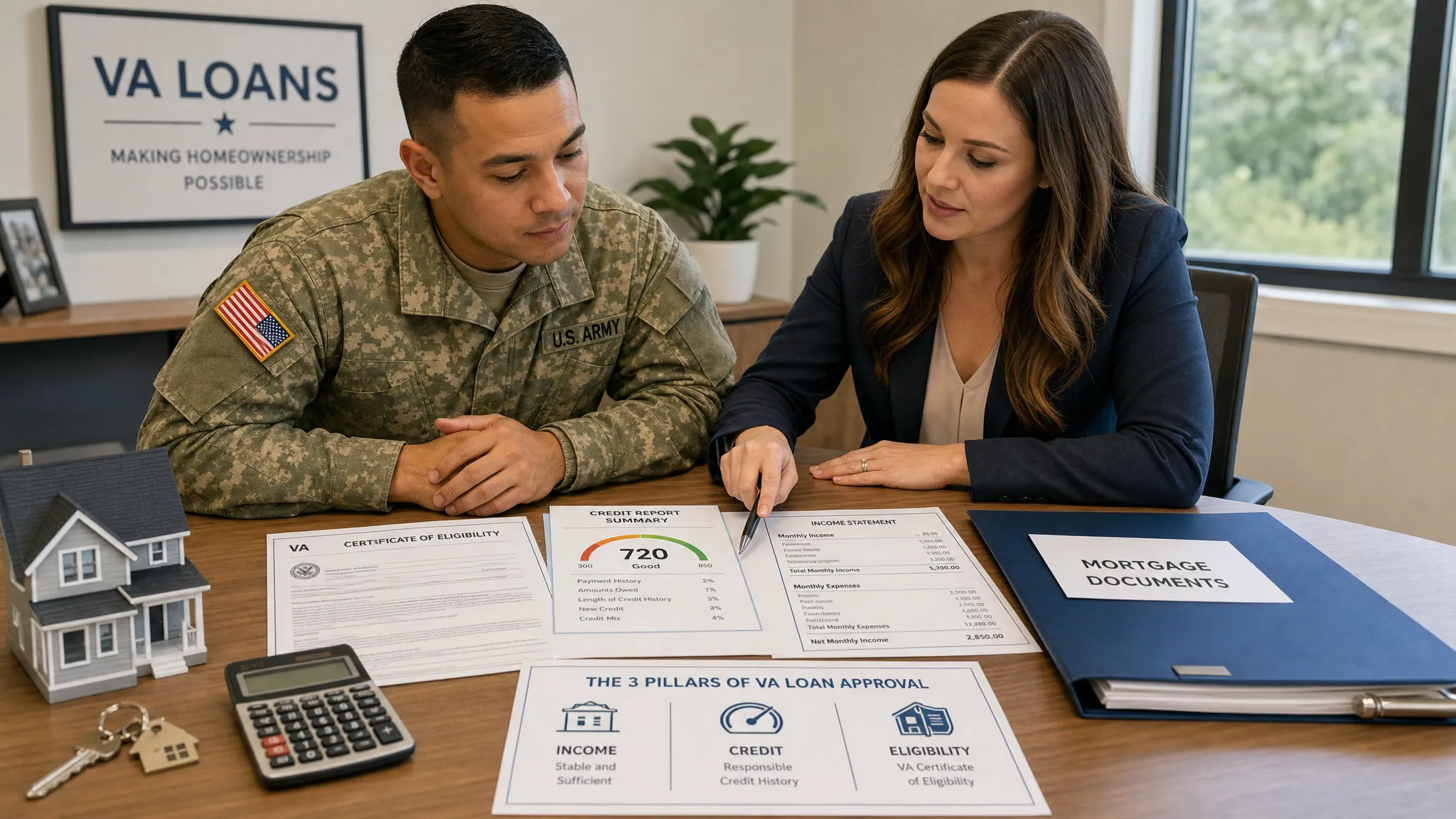
For many veterans, active-duty service members, and eligible surviving spouses, a VA home loan can make buying or refinancing a home more accessible. But eligibility for the VA benefit is only one part of the approval process. Lenders still need to confirm that your income is stable, your credit profile is acceptable, and your Certificate of Eligibility, or COE, supports the loan you want to use.
The good news is that veterans loan requirements are often more flexible than many borrowers expect. VA loans may allow qualified buyers to purchase with no down payment, avoid monthly private mortgage insurance, and qualify under underwriting rules designed with military income and service history in mind. The key is understanding what lenders actually review before you apply.
This guide breaks down the three big pillars of VA loan approval: income, credit, and COE. It also explains the supporting requirements that can affect your timeline, costs, and confidence before closing.
What Are Veterans Loan Requirements?
When people ask about veterans loan requirements, they are usually asking about VA home loan requirements. A VA loan is a mortgage made by a private lender and backed by the U.S. Department of Veterans Affairs. The VA guaranty reduces lender risk, which is why eligible borrowers often receive more flexible terms than they might with some other loan programs.
There are two layers of requirements to understand:
- VA eligibility requirements confirm that your military service or surviving spouse status qualifies you for the benefit.
- Lender underwriting requirements confirm that you can afford the loan and that the property meets VA and lender standards.
In practical terms, you usually need a valid COE, acceptable income, a workable credit profile, sufficient residual income, a primary-residence purchase or refinance purpose, and a property that meets VA appraisal standards.
The VA itself explains service-based eligibility and COE rules on its official VA home loan eligibility page. Your lender then uses that eligibility, along with your financial documents, to determine whether you qualify for a specific loan amount and structure.
Requirement 1: Certificate of Eligibility (COE)
Your Certificate of Eligibility is the document that tells a lender you have VA loan eligibility. It does not approve you for a mortgage by itself, but it is one of the first items a VA lender will need.
A COE typically confirms:
- Whether you meet VA service eligibility standards
- Whether you have available entitlement
- Whether you may owe a VA funding fee
- Whether you may be exempt from the funding fee due to qualifying disability or survivor status
You can request a COE through the VA, or a lender may be able to help obtain it electronically. The exact paperwork depends on your status. Veterans commonly use a DD Form 214. Active-duty service members may need a statement of service. National Guard and Reserve members may need retirement points statements or other service records. Eligible surviving spouses have separate documentation requirements.
If your COE shows full entitlement, you may be able to use a VA loan with no down payment, subject to lender approval, property value, and loan limits that apply to your situation. If you have used a VA loan before and still have one outstanding, or if you experienced a prior VA loan default, you may have partial entitlement. Partial entitlement does not automatically prevent you from using the benefit again, but it can affect whether a down payment is required.
Why the COE is not the same as mortgage approval
A common mistake is assuming that a COE means you are approved to buy a home. It does not. The COE answers the service eligibility question, but the lender still has to verify income, credit, assets, debts, occupancy, and property condition.
Think of the COE as your access pass to the VA loan program. Underwriting determines whether the specific loan works.
Requirement 2: Income That Is Stable, Verifiable, and Likely to Continue
VA loans do not have one universal minimum income requirement. Instead, lenders look at whether your income is stable, reliable, documented, and sufficient for the total housing payment and other debts.
That distinction matters. A borrower with modest income and low debt may qualify more easily than a borrower with higher income but heavy monthly obligations.
Lenders commonly review income from sources such as:
- Military base pay, BAH, BAS, and other eligible allowances
- Civilian W-2 employment
- Self-employment or business income
- VA disability compensation
- Military retirement income
- Social Security or pension income
- Spousal income, if the spouse is on the loan
- Part-time or secondary income, when properly documented and stable
The lender will generally need to confirm that income is expected to continue. For salaried or hourly employment, that may mean pay stubs, W-2s, and verification of employment. For self-employment, it often means tax returns, business documents, profit and loss statements, and sometimes bank statements. For disability, retirement, or pension income, award letters and benefit statements may be needed.
If you are transitioning out of military service, documentation becomes especially important. A lender may want to see a signed civilian job offer, start date, expected pay, and evidence that the work is likely to continue. Tools that help professionals organize verified career information, such as verifiable professional profiles, can support your broader job transition planning, although your lender will still rely on required mortgage documents for underwriting.
How VA Lenders Evaluate Debt-to-Income Ratio
Debt-to-income ratio, often called DTI, compares your monthly debt payments to your gross monthly income. It is one of the main ways lenders evaluate affordability.
For example, your DTI may include:
- Proposed principal and interest payment
- Property taxes and homeowners insurance
- HOA dues, if applicable
- Car loans
- Credit card minimum payments
- Student loans
- Personal loans
- Other recurring debts shown on your credit report or application
VA underwriting is known for looking beyond DTI alone. While many lenders pay close attention when DTI rises above common guideline levels, a higher DTI is not always an automatic denial if the rest of the file is strong. Compensating factors may include strong residual income, excellent payment history, significant cash reserves, stable long-term employment, or a manageable new housing payment.
That said, lower DTI usually gives you more room to qualify, improves approval confidence, and can make your budget easier to manage after closing.
Residual Income: The VA Requirement Many Borrowers Miss
Residual income is one of the most important VA loan requirements, and it is different from DTI. It estimates how much money you have left each month after major obligations are paid.
The VA uses residual income because a family with the same DTI can have very different real-life affordability depending on household size, location, and expenses. A single borrower and a family of five do not have the same monthly needs after the mortgage payment is made.
Residual income requirements vary based on factors such as:
- Family size
- Region of the country
- Loan amount
- Occupancy and household obligations
This is one reason VA loans can be more flexible than they look from the outside. A borrower with a slightly higher DTI may still qualify if residual income is strong. On the other hand, a borrower with a seemingly acceptable DTI may need to reduce debts or adjust the loan amount if residual income is too tight.
Before you shop for homes, ask your lender to estimate both your DTI and residual income. That gives you a more realistic picture of your approval range than a simple online payment estimate.
Requirement 3: Credit That Meets Lender Standards
The VA does not set one single minimum credit score for all VA loans. Instead, private lenders set their own credit requirements. This is why one lender may have different score expectations than another.
Your credit score still matters. It can affect whether you qualify, what rate you are offered, how much documentation is required, and how confidently an underwriter views your file. But VA loans are often more forgiving than some conventional loan programs, especially when the borrower has a strong history of making housing and debt payments on time.
Lenders commonly review:
- Credit score and credit history
- Mortgage or rent payment history
- Late payments, collections, or charge-offs
- Bankruptcy or foreclosure history
- Credit utilization on revolving accounts
- Recent new debt or credit inquiries
- Overall pattern of financial responsibility
A lower score does not always mean you cannot qualify, but it may narrow your lender options or affect pricing. If your credit history includes late payments, collections, or a prior hardship, be ready to explain what happened, show that the issue has been resolved, and document a stable recovery.
How to Strengthen Your Credit Before Applying
Small credit improvements can make a meaningful difference before VA loan pre-approval. You do not need perfect credit, but you do want your report to tell a clear and consistent story.
Start by checking your credit reports for errors. Under federal law, consumers can access free credit reports through AnnualCreditReport.com. Review all three bureaus if possible, because lenders may pull a merged mortgage credit report.
Next, avoid opening new accounts before applying unless your lender advises it. New credit can change your score, add monthly debt, and raise underwriting questions. Also avoid large purchases on credit before closing. A new auto loan, furniture account, or personal loan can change your DTI enough to affect approval.
If you carry credit card balances, reducing utilization may help your score and your monthly obligations. Focus first on revolving accounts with high balances relative to their limits. Even if you pay on time every month, high utilization can weigh on your credit profile.
VA Funding Fee and Exemptions
Most VA borrowers pay a VA funding fee, which helps support the program. The amount can vary based on the loan type, down payment, and whether you have used the VA loan benefit before. Many borrowers finance the funding fee into the loan instead of paying it out of pocket, but that increases the total loan amount.
Some borrowers are exempt from the VA funding fee. Exemptions may apply to veterans receiving qualifying VA disability compensation, certain active-duty Purple Heart recipients, and eligible surviving spouses, among other categories. Your COE may show funding fee exemption status, but if it does not, your lender may need additional documentation.
The funding fee is not the same as monthly mortgage insurance. One major VA loan advantage is that VA loans do not require monthly PMI, even when the borrower uses no down payment.
Property and Occupancy Requirements Still Matter
Income, credit, and COE are central, but they are not the only veterans loan requirements. The home itself also has to qualify.
VA loans are generally intended for primary residences, not vacation homes or investment properties. You usually need to certify that you intend to occupy the property as your primary home within a reasonable time after closing. There are special considerations for active-duty service members, deployed borrowers, and spouses, so talk with your lender if your occupancy timeline is not straightforward.
The property must also pass a VA appraisal. The appraiser estimates market value and reviews whether the home meets VA Minimum Property Requirements. These standards focus on safety, soundness, and basic livability. Common issues can include defective paint in older homes, roof problems, unsafe electrical conditions, inadequate heating, or water and sanitation concerns.
A VA appraisal is not the same as a home inspection. The appraisal protects the lender and VA program, while a home inspection helps you understand the property’s condition in more detail. Many VA buyers choose to get both.
Documents You May Need for a VA Loan
The exact document list depends on your income type, loan purpose, and lender, but it helps to prepare early. A complete file can reduce back-and-forth requests and keep your closing timeline on track.
Common VA loan documents include:
- Government-issued ID
- Certificate of Eligibility
- DD Form 214, statement of service, or applicable military records
- Recent pay stubs or Leave and Earnings Statements
- W-2s or tax returns
- Bank statements
- Retirement, disability, or benefit award letters
- Explanation letters for credit events, if needed
- Purchase contract, if buying a home
- Homeowners insurance information before closing
If you are refinancing, your lender may also request your current mortgage statement, homeowners insurance declaration page, payoff information, and documentation related to your property taxes or HOA dues.
Common Issues That Delay VA Loan Approval
Many VA loan delays come from missing documentation, unclear income, or property-related questions. The earlier you identify possible issues, the easier they are to solve.
Watch for these common roadblocks:
- COE information that shows partial entitlement or needs correction
- Recent job changes without clear income documentation
- Unexplained large bank deposits
- New debts opened after pre-approval
- Credit disputes that must be resolved before underwriting
- Appraisal repairs that require completion or re-inspection
- Seller misunderstanding about VA closing costs or appraisal rules
Most of these problems are manageable. The key is to tell your lender about changes immediately. If you change jobs, move money between accounts, co-sign a loan, receive a gift, or open new credit, your loan team needs to know before it becomes a last-minute underwriting issue.
How to Prepare Before You Apply
A smooth VA loan process starts before you make an offer. Pre-approval gives you a clearer budget, helps identify documentation gaps, and strengthens your position with sellers.
Use this simple preparation sequence:
- Confirm your COE: Make sure your eligibility, entitlement, and funding fee status are clear.
- Review your credit: Check for errors, late payments, high balances, or accounts that need explanation.
- Estimate your full payment: Include principal, interest, taxes, insurance, HOA dues, and any other required costs.
- Gather income documents: Prepare pay, military, retirement, disability, or self-employment records based on your situation.
- Avoid major financial changes: Do not open new debt, change jobs, or move large sums without lender guidance.
- Get a true pre-approval: A stronger review is more useful than a quick estimate based on limited information.
If you are comparing VA, FHA, and conventional options, review more than the interest rate. Compare cash to close, monthly payment, APR, funding fee or mortgage insurance, appraisal requirements, and long-term flexibility. New Era Lending’s related guide on veteran loans for homes can help you think through that comparison.
When a VA Loan May Not Be the Best Fit
VA loans are powerful, but they are not automatically the right choice in every situation. For example, a conventional loan may be worth comparing if you have a large down payment, very strong credit, and want to avoid a funding fee. FHA may be considered if VA eligibility is not available or if a specific property or borrower scenario fits FHA better.
A VA loan may also be more complicated if the property has condition issues that will not meet VA standards, if the home is not intended as your primary residence, or if partial entitlement creates a down payment requirement that changes the math.
The right answer depends on your full scenario. For many eligible borrowers, VA financing is still the strongest option. But the best decision comes from side-by-side numbers, not assumptions.
Frequently Asked Questions
Do VA loans have a minimum income requirement? VA loans do not have one universal minimum income amount. Lenders review whether your income is stable, verifiable, likely to continue, and sufficient for your debts, housing payment, and residual income requirements.
What credit score do I need for a VA loan? The VA does not set a single minimum credit score for every VA loan, but individual lenders usually have their own credit standards. Your score can also affect your rate, approval options, and documentation requirements.
Can VA disability income be used to qualify? Yes, VA disability compensation can often be used as qualifying income when properly documented. It may also affect whether you are exempt from the VA funding fee.
Does a COE guarantee loan approval? No. A COE confirms VA loan eligibility, but the lender must still approve your income, credit, debts, assets, occupancy, and the property.
Can I use a VA loan more than once? Yes, VA loan benefits can often be reused. Your available entitlement, current VA loans, prior usage, and any past defaults can affect whether you have full or partial entitlement.
Can I get a VA loan with no down payment? Many eligible borrowers can buy with no down payment when they have sufficient entitlement and the loan meets lender and VA requirements. You may still need funds for closing costs, prepaid expenses, inspections, or an appraisal gap.
Get Clear on Your VA Loan Requirements Before You Shop
The strongest VA loan application is not just about having a COE. It is about showing stable income, manageable debts, acceptable credit, clear entitlement, and a property that meets VA standards.
New Era Lending helps eligible veterans, service members, and surviving spouses review VA loan options with smart technology and personalized human guidance. With secure document uploads, e-signature support, transparent terms, and loan support across 39 states, you can move from questions to a clearer plan with confidence.
If you are preparing to buy, refinance, or access equity, connect with New Era Lending to review your VA loan requirements and compare personalized mortgage options before you take the next step.